Across the world
The Yoruba diaspora
Where the Yoruba are in the world, and how each community came to be.
Centuries of intermarriage in places like Cuba and Brazil mean many people of Yoruba descent are of mixed or European appearance. The Yoruba homeland and people are West African; what travelled with them — and was shared with others — was the whole heritage of names, language, music, principles, cuisine and faith.
The communities
-
Yorubaland — the homeland
 South-western Nigeria · West Africa Homeland
 - How they came
- from antiquity. Ilé-Ifẹ̀, Ọ̀yọ́ and the Yoruba city-states — the homeland from which every community on this map descends.
- Population
- Over 40 million in Nigeria — one of Africa's largest ethnic groups.
- Common names
- Names carry meaning and praise, often built on Adé- (crown), Ọlá- (honour), Olú-/Olúwa- (God) and Babá-/Ìyá-: e.g. Adéyẹmí, Babátúndé, Ọláwálé, Adébáyọ̀.
- Notable figures
-
- Chief Obáfẹ́mi Awólọ́wọ̀ — statesman and premier of the Western Region
- Wọlé Ṣóyínká — first African Nobel laureate in Literature (1986), from Abẹ́òkúta
- Fẹlá Aníkúlápó-Kútì — creator of Afrobeat
- Faiths
- Christianity and Islam today, alongside the indigenous Ifá/Òrìṣà tradition.
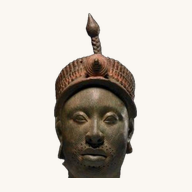
Johnson's History tells this homeland's story. From here — by the Atlantic slave trade, by liberation, and by modern migration — Yoruba people spread across the world.
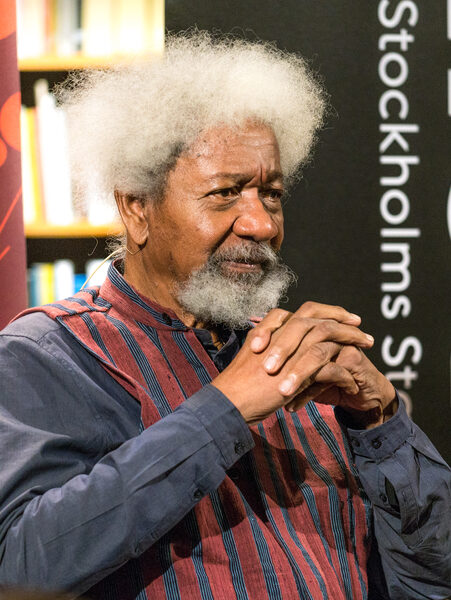
Photo: Frankie Fouganthin · CC BY-SA 4.0 Sources: Samuel Johnson, The History of the Yorubas (ed. O. Johnson, 1921 (public domain))
-
Kétu & the western Yoruba (Nàgó)
 Bénin Republic & Togo · West Africa HomelandMixed ancestry
 - How they came
- pre-colonial. Indigenous Yoruba kingdoms — Kétu, Sàbẹ̀, Idàìsà — whose lands the colonial border split into French Dahomey (now Bénin) and Togo, dividing them from their kin in Nigeria.
- Population
- About 1.6 million — roughly an eighth of Bénin — concentrated in the south-east around Porto-Novo and Kétu.
- Common names
- Yoruba names alongside French forms; the capital Porto-Novo is Àjàṣẹ́ in Yoruba.
- Faiths
- Christianity, Islam and the Òrìṣà tradition.
The 'Nàgó' of Bénin and Togo are Yoruba on the western side of a colonial line. Many of the captives later carried to Bahia came through this country, which is why Kétu's name still marks a great branch of the Brazilian Yoruba.
Sources: Beninois Yoruba (Nàgó) — population and settlement (Joshua Project / ethnographic surveys)
-
Yoruba of Ghana (Anago / Alata)
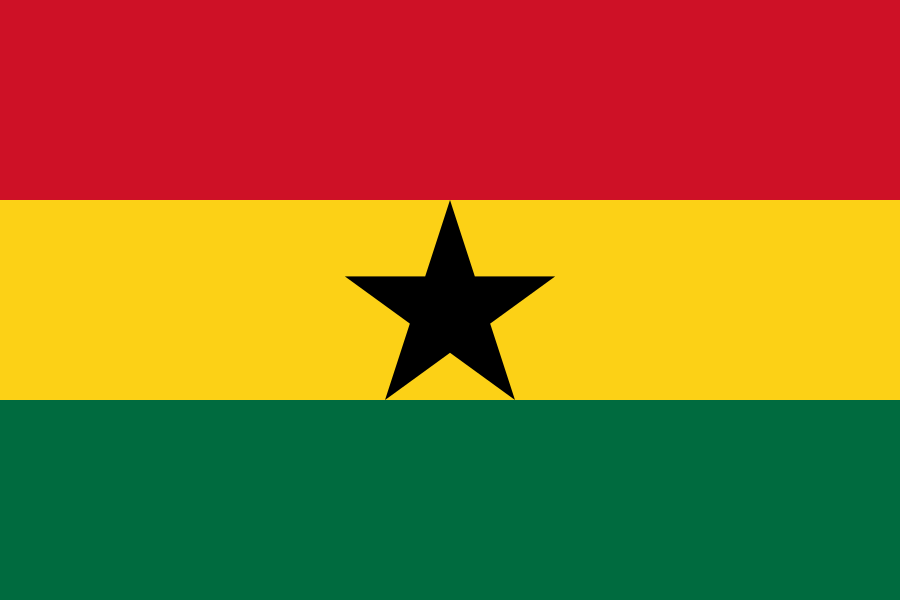 Ghana (Accra, Kumasi) · West Africa Modern migrationMixed ancestry
 - How they came
- 19th–20th c.. Yoruba traders settled across the Gold Coast from the 19th century and became its largest immigrant community — until the 1969 Aliens Compliance Order expelled most of them in the 'Ghana Exodus'.
- Population
- By 1950 Yoruba were about 15% of traders in Accra, 23% in Kumasi and over a third in Tamale; the 1969 expulsions cut the community sharply, though families have since returned.
- Common names
- Known locally as Yoruba, Lagosian, Alata or Anago; many keep Yoruba names alongside Ghanaian and English ones.
- Faiths
- Christianity and Islam, with the Òrìṣà tradition among some families.
Two threads tie the Yoruba to Ghana. One is documented and modern: an enterprising trading community — the 'Anago' — who ran much of the colonial Gold Coast's market trade before the 1969 expulsions. The other is older and traditional: the Ga of Accra hold an oral tradition of origin from Ilé-Ifẹ̀ and the east — reflected in the Yoruba 'Alata' stool of Osu, and renewed in 2022 when the Ga Mantse visited Ifẹ̀ — though the Ga are today a distinct people with their own language, not Yoruba settlers.
Sources: Niara Sudarkasa, Where Women Work: A Study of Yoruba Women in the Marketplace and in the Home (University of Michigan, 1973); Olaniyi, The 1969 Ghana Exodus: Memory and Reminiscences of Yoruba Migrants (International Migration Institute); Gã people of Ghana originated from Ilé-Ifẹ̀ — the Ọọ̀ni of Ifẹ̀ (Premium Times, 2022)
-
Yoruba of Côte d'Ivoire (Anago)
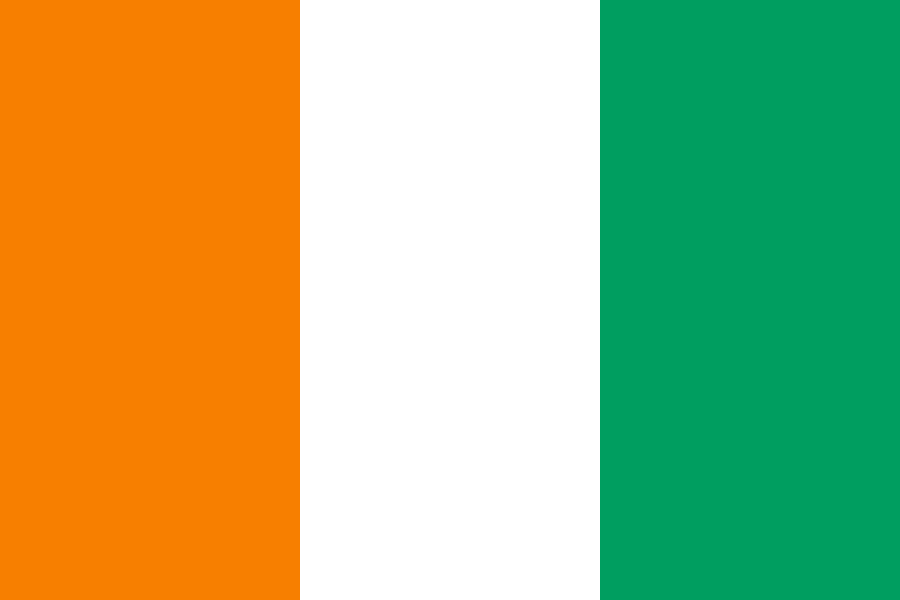 Abidjan, Côte d'Ivoire · West Africa Modern migration
 - How they came
- 20th c.–present. Yoruba traders, artisans and skilled workers — the 'Anago' — migrated to Côte d'Ivoire over the 20th century and built a settled commercial community now into its third generation.
- Population
- At least 135,000, concentrated in Abidjan (Adjamé, Treichville), Bouaké, Korhogo, Grand-Bassam and Gagnoa; one quarter of Adjamé is even named Témidire, a Yoruba name.
- Common names
- French and Yoruba names side by side; third-generation Yoruba-Ivorians speak both French and Yoruba.
- Faiths
- Christianity, Islam and the Òrìṣà tradition.
Like their kin in Ghana, the Yoruba of Côte d'Ivoire — the 'Anago' — are above all a trading people, dominating retail in the great markets of Abidjan. Generations on, many are Ivorian-born and bilingual, carrying Yoruba names, language and faith into Francophone West Africa.
Sources: Yoruba Traders in Côte d'Ivoire: Migrant Settlers and Economic Relations in West Africa (African Research Review (AJOL))
-
Aku / Saro of Freetown
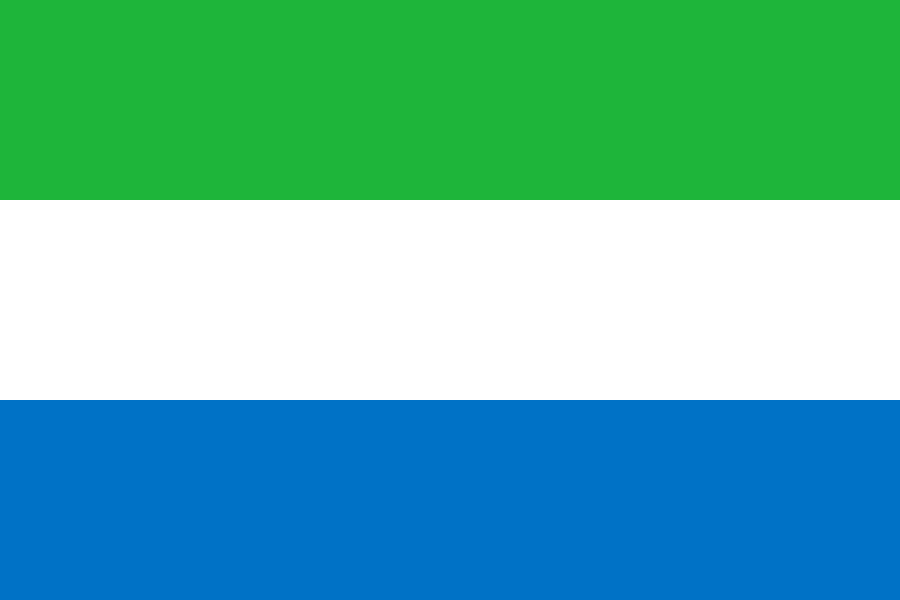 Freetown, Sierra Leone · West Africa Liberated AfricansModern migration
 - How they came
- 1808–1860s. Yoruba ('Aku') recaptives — Africans freed by the British naval squadron from intercepted slave ships after the 1807 abolition — were resettled in Freetown's villages. Yoruba arrivals peaked in the 1830s.
- Population
- A small community (well under 1% of Sierra Leoneans), long concentrated in Freetown's Fourah Bay and Aberdeen.
- Common names
- Anglicised and Yoruba-derived Krio surnames — Crowther, Macaulay, Coker, Pratt; Muslim 'Oku' families keep Aku names.
- Notable figures
-
- Bishop Samuel Àjàyí Crowther — a recaptured Yoruba boy who became the first African Anglican bishop — his translations underpin Johnson's History
- Sir Samuel Lewis — first African knighted in British West Africa
- Faiths
- Largely Christian and Muslim.
These liberated Yoruba — and the educated 'Saro' who later returned to Abẹ́òkúta and Lagos — became teachers, clergy and traders across West Africa. Crowther's work made Johnson's own book possible.
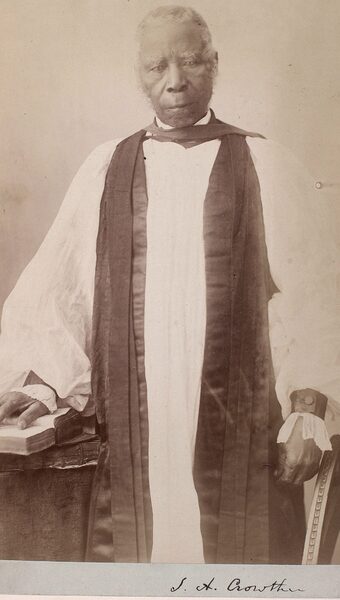
Photo: Unknown photographer (1867) · Public domain Sources: The Diaspora of Africans Liberated from Slave Ships in the Nineteenth Century (Journal of African History, Cambridge University Press); Christopher Fyfe, A History of Sierra Leone (Oxford University Press, 1962)
-
Yoruba of Cuba (Lucumí)
 Cuba · Caribbean Slave tradeMixed ancestry
 - How they came
- late 18th–19th c.. Great numbers of Yoruba captives — many taken in the wars that broke up Ọ̀yọ́ — were carried to Cuba during the sugar-boom slave trade and called 'Lucumí'.
- Population
- Yoruba were among the largest African groups landed in Cuba; a large share of today's Afro-Cubans carry Yoruba ancestry, though centuries of intermarriage make a precise figure impossible.
- Common names
- Spanish surnames; the Yoruba inheritance survived in the 'Lucumí' name and in religion rather than in family names.
- Faiths
- Yoruba identity endured most strongly in the Lucumí (Regla de Ocha) religion.
After generations of admixture, Cubans of Yoruba descent are of every appearance — Afro-Cuban, mixed and white — and Yoruba words, drumming and lineage names are woven through Cuban culture far beyond those of Yoruba descent.
Sources: George Brandon, Santería from Africa to the New World (Indiana University Press, 1993); David H. Brown, Santería Enthroned (University of Chicago Press, 2003)
-
Yoruba of Bahia (Nàgó)
 Salvador, Bahia, Brazil · South America Slave tradeMixed ancestry
 - How they came
- 18th–19th c.. Yoruba captives, called 'Nàgó' in Brazil, were concentrated in Bahia; some freed families later sailed back across the Atlantic to settle in Lagos as the 'Agudá' / Brazilian returnees.
- Population
- Bahia is called 'the Yoruba capital of the Americas'; millions of Afro-Brazilians trace Yoruba ('Nàgó') ancestry, the largest such population outside Africa.
- Common names
- Portuguese surnames; 'Nàgó' marked Yoruba identity, and Yoruba words survive across Bahian Portuguese and cuisine.
- Faiths
- Yoruba heritage is most visible in Candomblé and in Bahian music, food and dress.
Through generations of admixture, Bahians of Yoruba descent are of mixed and European as well as African appearance. A two-way Atlantic traffic of people and goods between Bahia and Lagos shaped both cities.
Sources: J. Lorand Matory, Black Atlantic Religion (Princeton University Press, 2005); The Yoruba in Brazil, Brazilians in Yorubaland (Carolina Academic Press)
-
Yoruba of Trinidad
 Trinidad & Tobago · Caribbean Liberated Africans
 - How they came
- 1840s–1860s. After emancipation, liberated Yoruba were brought to Trinidad as indentured labourers and settled among a mixed plantation population.
- Population
- Several thousand liberated Yoruba arrived from the 1840s; their descendants are part of the wider Afro-Trinidadian population.
- Common names
- English and French-Creole surnames; some families kept the name 'Yarriba' / Yoruba.
- Faiths
- Yoruba inheritance survives in the Orisha (Shango) faith and in drumming.
Trinidad's Yoruba came late and free rather than enslaved, and their culture mingled with the island's African, Indian and Creole peoples to shape a distinctly Trinidadian inheritance.
Sources: Maureen Warner-Lewis, Guinea's Other Suns: The African Dynamic in Trinidad Culture (Majority Press, 1991)
-
Yoruba of Haiti (Nago)
 Haiti · Caribbean Slave trade
 - How they came
- 18th c.. Yoruba captives were carried to French Saint-Domingue alongside Fon and Kongo peoples before the revolution that founded Haiti.
- Population
- One of several West African groups in the colony; their share is folded into the wider Afro-Haitian population.
- Common names
- French surnames; the Yoruba name survives as the 'Nago' nation.
- Faiths
- The Yoruba inheritance lives on as the 'Nago' rite within Haitian Vodou.
In Haiti the Yoruba are remembered as the 'Nago' — one of the African nations whose people helped power the world's first successful slave revolution.
Sources: Leslie G. Desmangles, The Faces of the Gods: Vodou and Roman Catholicism in Haiti (University of North Carolina Press, 1992)
-
Yoruba of Argentina
 Buenos Aires, Argentina · South America Slave tradeMixed ancestry
 - How they came
- 1588–early 19th c.. Enslaved Africans — Yoruba among them, though far fewer than reached Brazil or Cuba — were landed at the port of Buenos Aires on the Río de la Plata.
- Population
- People of African descent were nearly a quarter of Buenos Aires in the early 1800s, but the Afro-Argentine population then declined steeply — and Yoruba were only a small part of it.
- Common names
- Spanish surnames; African origins were largely written out of the national story.
- Faiths
- Catholic; Yoruba religion (Santería) reached Argentina more recently through Cuban influence.
Argentina's African past — Yoruba included — was real but modest, then pushed to the margins of memory by demographic decline and a deliberate 'whitening' of the national story. A growing movement now reclaims that Afro-Argentine heritage.
Sources: Afro-Argentines: a brief story (African American Registry); George Reid Andrews, The Afro-Argentines of Buenos Aires, 1800–1900 (University of Wisconsin Press, 1980)
-
Yoruba Americans
 United States · North America Modern migrationMixed ancestry
 - How they came
- 1960s–present (and a 1970 revival). Most Yoruba Americans came in waves of Nigerian migration from the 1960s for study and work. Separately, African Americans reclaimed a Yoruba heritage — Oba Adéfúnmi founded the Oyotunji African Village in South Carolina in 1970.
- Population
- Nigerian Americans number well over half a million — among the most highly educated groups in the US — with Yoruba a major part; plus African Americans who trace or adopt Yoruba heritage.
- Common names
- Yoruba surnames are kept and worn with pride — Olájúwọ̀n, Ògúnleyè, Adéyẹmí, Babátúndé.
- Notable figures
-
- Hakeem Olájúwọ̀n — NBA Hall of Famer, born in Lagos
- Wale (Olúbọ́wálé Akíntimẹ́hìn) — rapper, of Yoruba parentage
- Adéwálé Ògúnleyè — NFL defensive end
- Faiths
- Christianity and Islam, with a visible African-American Òrìṣà/Ifá revival.
The American Yoruba story is largely one of education and enterprise among recent migrants, plus a chosen heritage among African Americans — making it one of the most varied strands of the diaspora.
Sources: Are Nigerian immigrants top of the class in the US? (Africa Check (US Census/ACS data)); Oyotunji Village (1970– ) (BlackPast.org)
-
Yoruba of Britain
 United Kingdom (London) · Europe Modern migration
 - How they came
- 20th–21st c.. From the post-war student generation onward, Yoruba migration built one of Britain's larger African communities, concentrated in London.
- Population
- Around a quarter of a million Nigerian-born residents (2021 census), with many more British-born of Nigerian descent — Yoruba prominent among them.
- Common names
- Yoruba surnames are kept and celebrated — Adú, Oyèlọ́wọ̀, Akínnúóyè-Àgbàjé, Babátúndé, Olúṣẹ́gun.
- Notable figures
-
- Sade (Fọláṣadé Adú) — singer, born in Ibadan
- John Boyega — actor, raised in a Yoruba household in London
- Anthony Joshua — two-time world heavyweight champion
- Adéwálé Akínnúóyè-Àgbàjé — actor
- Faiths
- Christianity and Islam, with thriving Yoruba churches and mosques.
Britain's Yoruba diaspora is a story of education and achievement — Nigerians are among the most highly educated immigrant groups in the UK — and of a generation of Yoruba-British figures prominent in music, film and sport.
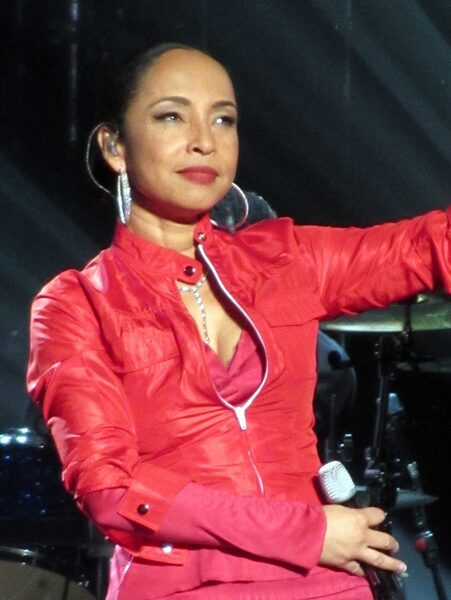
Photo: Thilo Parg · CC BY-SA 3.0 
Photo: Jumeirah · CC BY 3.0 Sources: How Nigerian immigrants outpaced others to be the most educated in Britain (The National, 2023); English people of Yoruba descent (notable figures) (reference list)
Last updated 2026-06-22. This is a living map — communities and sources are added over time.
.jpg)

.jpg)
