Part I — The Country and its People
Chapter 8. Manners And Customs
§ (a) Social Polity
¶2 THE ancient Yorubas were very simple in their manners, their tastes, and habits. Their houses all on the ground floor are built in compounds called Agbo Ile (lit. a flock of houses), that is to say in the form of a hollow square, horse shoe or a circle, enclosing a large central area, with one principal gateway the house being divided into compartments to hold several families, all more or less related or united by ties of kinship, or friendship. One piazza runs right round the whole, and is used for all ordinary purposes by day, and for the reception of visitors. The central area is used in common by all the inmates for general purposes ; usually horses, sheep and goats are found tethered in it.
¶3 / The compartment of the head of the house is usually opposite the main gateway or a little to the right. It is larger, the roof
¶4 | loftier and the piazza morespacious than the rest. Here the master | ls expected to be found at all times (during visiting hours) by a
¶5 ) doorway which leads to his harem at the back of the house. This
¶6 / particular doorway is known as where the master "shows his face" \ (for the reception of visitors) ; it is an essential adjunct to the ‘ houses of chiefs or important personages, being used for no other \._ purpose, for at all other times it is kept closed. A high wall often encloses a garden attached to the back of the building, the space enclosed is always in proportion to the size of the house, the rank, and the means of the owner. The houses of great men contain smaller compounds at the back attached to the main compound, these are called Kara or retiring quarters, each devoted to some purpose from a harem to stables for horses.
¶7 The houses of chiefs are distinguished by a "street verandah "(as it is called) on either side the main gateway on the outside, varying in length according to the taste and capacity of the owner ; the roof of which is an extension or projection of that of the main building. It is used for lounging in the afternoons, at the cool of the day. A small market is almost always to be found at the frontage of such houses. The walls of the houses rising from 7 to 8 feet in height are built of mud, the roof consequently is low, and is covered with a tall grass called Bere or with Sege or Ekan. In forest lands where these are not obtainable, a kind of broad leaf called Gbdddgiis used instead. The houses are without any decorations; the walls are plastered and polished with black and sometimes red earth by the women whose work it generally is. The houses of Kings and Princes are embellished with a sort of wash which is a decoction made from the skin of the locust fruit.
¶8 Now and then attempts are found at artistic decorations, by figures traced on the wall; but more commonly the front posts of the verandah consist of carved figures of various kinds, equestrians swerdsmen, hawkers, etc. The floor is generally rubbed and polished once a week.
¶9 The household furniture consists chiefly of cooking utensils, waterpots, and a mortar with pestles, all of which are deposited in the front and back piazzas of the house.
¶10 The use of bedsteads, tables and chairs being unknown, they squat or lie on mats instead. In modern times those who can afford it keep a few chairs for the accommodation of visitors in European garb, who find it difficult or are unaccustomed to squat on the ground. It is not unusual to find skins of buffaloes, leopard, lion, or a large bullock hung up on the walls of the front piazza which are taken down for distinguished visitors to sit on.
¶11 All their valuables are kept in pots or bags made of bamboo fibres, and placed in one corner of the sleeping room, so that in all cases of alarm, whether of fire, or night attack by robbers or slavehunters, everything of value is soon taken away to a place of safety whenever possible.
¶12 As all the houses are invariably built with mud ceilings which are themselves fire-proof, the losses in cases of fire are small, and of hardly any account, especially if the doors are kept rigidly closed. The property of the women consists chiefly of cloths, beads, with goats, sheep and poultry, these usually form a substantial part of their "dowry."
¶13 The head of the compound’s principal wife is the mistress of the compound, as himself is the master, and all heads of the several families within the compound are bound to pay their respects to them the first thing every morning, the men prostrating on the ground, and the women sitting on the ground and reclining on their left elbow.
¶14 [This is the ordinary mode of saluting a superior in this country; but when greater respect is to be shown, or pardon asked for some offence committed, the men while prostrating lay the right and left cheek alternately on the ground, and the women wrap their cloth lower down, loose their head tie, and recline alternately on the right as well as on the left elbow.
¶15 ( Before Kings and great rulers, for a show of homage, they run? to the porch of the house and back three times, throwing dust on their head or roll on the ground}.
¶16 They are chiefs in their respective domains, where they transact all business affecting the welfare or interest of the people in their respective households. All important cases are judged and decided in the master’s piazza, and he is responsible to the town authorities for the conduct of the inmates of his compound ; hence the saying :—"Bále ni oloran awo" (the master of the house must be privy to all secrets). His word is law, and his authority indisputable within his compound, hence also another saying, "Obé ti Bále ile ki ije Iyale ile ki isé e" (the sauce which the master of the house cannot eat or which is unpalatable to him, the mistress of the house must not cook), which when applied simply means that no one should go contrary to the wishes of the
¶17 _ master of the house.
¶18 To this high authority belongs a leg of whatever is slaughtered in the compound, from a chicken to a bullock ; whether killed for .
¶19 sacrifice, or for a festival, or for any other purpose of whatever kind. At the death of the master of the house, when the period of mourning is over, his successor be it his son, or his brother or cousin as the case may be, removes from his own compartment into that of the master. He is installed into his place by his feudal lord, or in case the deceased be a public man, by the Town Council, with a title that attaches him to one of the senior chiefs. But before the ceremony can take place, the roof over the late master’s compartment (be it old or recent) is taken down and rebuilt afresh ; hence the term for a successor, Arole i.e. one who 7oofs the house. Personal Appearance.—In early times very little regard was paid to personal appearance. Boys and girls up to the age of 8 years walked about in puris naturalibus ; from that period up to the age of puberty they were allowed the use of aprons, the cut and shape for either sex being different, the one from the other, that for boys being called bante, that for girls tobi. The whole period was regarded as one of unencumbered freedom which ceases with the act of marriage. It was not an uncommon thing to find girls | of the age of 15 when engaged in hard work whether at home or in the farm with absolutely nothing on, and even their mothers on such occasions were but scantily clothed. This custom, however, excepting among some tribes as Ìjẹ̀ṣà and Efon has completely died out. The extreme poverty of the people in those early times was probably the chief cause of such disregard of personal attire. In modern times better attention is paid to their outward appearance, and although from the standpoint of an enlightened civiliz ation there may be much to be desired still among the ordinary class of people, yet on the whole, especially amongst the well-to-do, the Yorubas dress very decently and becomingly as compared with former generations of the same people.
¶20 Great regard, however, has always been paid to personal cleanliness, and for this the tribe is specially remarkable. The word Obun (filthy) as applied to a person carries with it such a feeling of disgust which beggars description. The men are always shaved and hence, when one appears unshaven, unwashed, and with filthy garments on, you may safely conclude that he is mourning, for these are the signs of it. Children and youths are either entirely shaved or a strip of hair running from the forehead to the occiput along the top of the head is left which is sometimes made into circular patches. As it is considered decent and cleanly for men to carry their heads bald so on the contrary "the hair is the glory of the woman," and much attention is paid to it. Women have their hair done up in all sorts of ways dictated by their usual vanity; the unmarried ones are distinguished by their hair being plaited into small strips (from 8 to 14) from the right to the left ear, the smaller and more numerous the plaited strips the more admired. Married women on the other hand adopt other forms of plaiting ; usually they commence on both sides and finish up in the middle in a sort of net-work running from the forehead to the occiput ; ornamental forms are adopted by some, such as stuffing the hair in the middle of the head after being gathered from all sides ; and others again as the Ìjẹ̀bús finish up theirs in the shape of a pair of horns.
¶21 Character.—As regards the social virtues, the ancient Ọ̀yọ́s or Yorubas proper were very virtuous, loving and kind. Theft was rare as also fornication in spite of the scantiness or often times complete absence of clothing to which they were accustomed. Friendship was more sincere. Children were more dutiful to their parents, and inferiors respectful to their superiors in age or position. Liars were formerly punished by exclusion from society and from the clubs; but as the whole people took delight in ambiguous forms of speech which were not understood by those unaccustomed to their habits they were regarded and spoken of as prevaricators. Now, as formerly they are remarkably patient of injuries, and would never resist or retaliate except in extreme cases when provocation became insupportable. They are characteristically unassuming in their manners and submissive to their superiors. They are very shrewd in driving bargains, and hence foreigners speak of them as "African Jews "in reference to their commercial instincts.
¶22 No nation is more remarkable for cautiousness and for putting themselves generally on the safe side. When powerless they would submit to oppression and wrong to any extent so long as they find resistance useless ; but when an opportunity offers for asserting their rights and overthrowing their oppressors, they are never slow to embrace it. The common proverb embodies this trait in their character :—"Bi owo eni ko te eku ida a ki ibére iku ti o pa baba eni," i.e., if one has not grasped the handle of his sword he should not attempt to avenge the death of his father.
¶23 Intercourse with other nations has caused various forms of vice to creep in among modern Yorubas or Ọ̀yọ́s; their natural timidity and submissive spirit have produced a degeneracy of manners so as to be considered essentially lacking in straightforwardness; they can effect by diplomacy what they cannot accomplish by force, in which proceeding the Ọ̀yọ́s differ widely from the other tribes, some of whom are characterised by a proud and intractable spirit, but they are no less determined in carrying out their object although the means used to effect their purpose is essentially different.
¶24 Yorubas as a whole are social, polite, and proverbially hospitable. Licentiousness is abhorred. There are well attested cases where a member of a family would be condemned to slavery by a unanimous vote of all the relatives when he has brought disgrace on the family. Sometimes forcible emasculation is resorted to as a punishment (as in cases of incest) or total banishment from the town and neighbourhood to where the offender is not likely to be known.
¶25 A peculiar custom was prevalent amongst the ancient Ọ̀yọ́s. Young men were permitted to have intimate friends among the fair sex, and they were often the guests of each other. At the annual festivals the young man and his female friend would meet and take an active part in the ceremonies, and render pecuniary services or manual assistance to each other. At the time of harvest the female friend with the full consent of her parents would go for about a week or a fortnight to assist her male friend in bringing home his harvest while he himself may be engaged on his father’s farm. Yet notwithstanding so much mutual intercourse strict chastity was the rule not the exception. The practice, however, has long been discontinued, owing to the degeneracy of the present age.
¶26 Filial Duties.—It was the duty of every male child to serve his father although he might be married and have a family of his own unless he was exonerated from the obligation by the father himself. As a general thing a small portion of farm work was allotted to him as his day’s work after attending to which he may go and see after his own business. So while serving his father, every son had his own private farm also to manage; and it was on his own portion of land that the female friend used to render assistance in time of harvest.
¶27 All married women were also engaged in their husband’s farm and the harmony that usually prevailed between them and the young people was very remarkable.
¶28 Young men were not allowed to marry until they could give their father 10 heads of cowries, equal in those days to £10 sterling. They were seldom married before the age of 30 and the young women, not before 20. Promiscuous marriages were not allowed, freeborn must be married to freeborn, slaves to slaves, and foreigners to foreigners. Except amongst the Igbonas consanguineous affinity however remote was not allowed.
¶29 Privileges of the Great.—Kings and nobles who kept harems were exempted from this rule of affinity ; they were at liberty to multiply wives from any tribe, and these wives might be of any condition of life. It was the pride of Kings to fill their harems with women of every description, such as foreign women, slaves, hostages, daughters of criminals given as the price of redemption, or seized in confiscations ; dwarfs, albinoes, hunch-backs, and any other in whose persons there should appear any signs of lusus naturæ. Such beings, being considered unnatural, were the King’s peculiar property. Hence the saying "Ọba ni ije Oro" (it is Kings who are to feed on the uncommon).
Ẹ̀GBÁ MARKS
ÌJẸ̀BÚ MARKS
IFẸ̀ MARKS
IGBOMINA MARKS — YAGBA MARKS
§ Facial Marks
¶35 The facial marks are for the purpose of distinguishing the various Yoruba families. Of these, only those of the principal ones can be indicated. They are designated :—(a) Abaja, (0) Kéké or Gombg, (c) Ture, (d) Pele, (e) Mande and (f) Jamgbadi.
¶36 I. The Ọ̀yọ́ marks are:—The Abaja, Keke or Gombo,
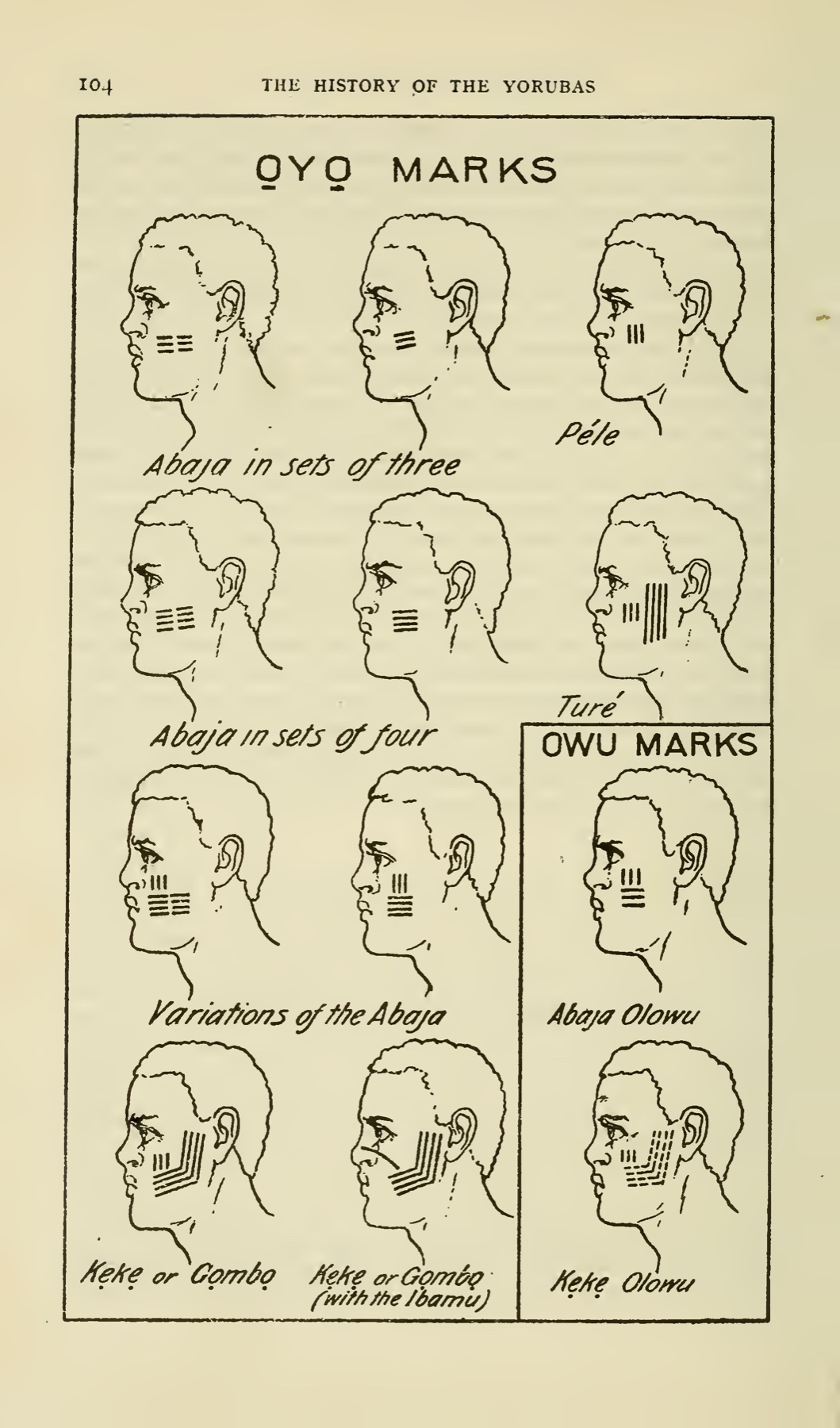
¶37 Ture.
¶38 (a) The Abaya are sets of three or four parallel and horizontal lines on each cheek; they may be single or double, each line being from half-an-inch to one inch long.
¶39 Lines in sets of three :—
¶40 The double sets are those of the Royal Family! of Ọ̀yọ́ the single that of the older line of Baṣọ̀runs. Lines in sets of four :—
¶41 These marks distinguish some noble families of Ọ̀yọ́. Variations of these marks are made by adding three perpendicular lines to them as a family distinction thus :—
¶42 HN me
¶43 The latter of these is common amongst the Ibolos and Epos. (5) The Kéké or Gombo consists of four or five perpendicular and horizontal lines placed angularly on each cheek; they occupy the whole space between the auricle and the cheek bone; three small perpendiculars are also placed on the horizontal lines on both cheeks thus :—
¶44 A variation of this is sometimes made by adding on the left cheek the /bamu i.e. a line running aslant from the bridge of the nose to the horizontal lines. This also is for the purpose of distinguishing a family.
¶45 When the lines are rather bold, the mark is termed Kéké, when fine and faint it is termed Gombo. The Kéké or Gombg is a common mark of all Ọ̀yọ́s and of the Egbado tribe.
¶46 (c) The Ture consists of four perpendicular lines somewhat like the Gombo, but longer, with the three small perpendiculars but without the horizontals.
¶47 (a) The Pele are three short perpendicular lines over the cheek bones, each about an inch long. They are not distinctive of any particular family, but are used generally by some men who disapprove of tribal distinctions, usually Moslems, but are loth to remain plain-faced, e.g.
¶48 (e) (f) The Mande and Jamgbadi are no longer in use; the latter is said to be distinctive of aliens naturalized amongst Yorubas.
¶49 These are the principal facial marks. The other principal Yoruba families are distinguished by a slight variation of these marks :—
¶50 II. Ẹ̀gbá marks:—The Abaja Oré i.e. the upright Abaja is distinctive of the Ẹ̀gbás. They consist of three perpendicular lines each about 3 inches long on each cheek. The younger generations, however, have their lines rather faint or of shorter lengths undistinguishable from the Pele.
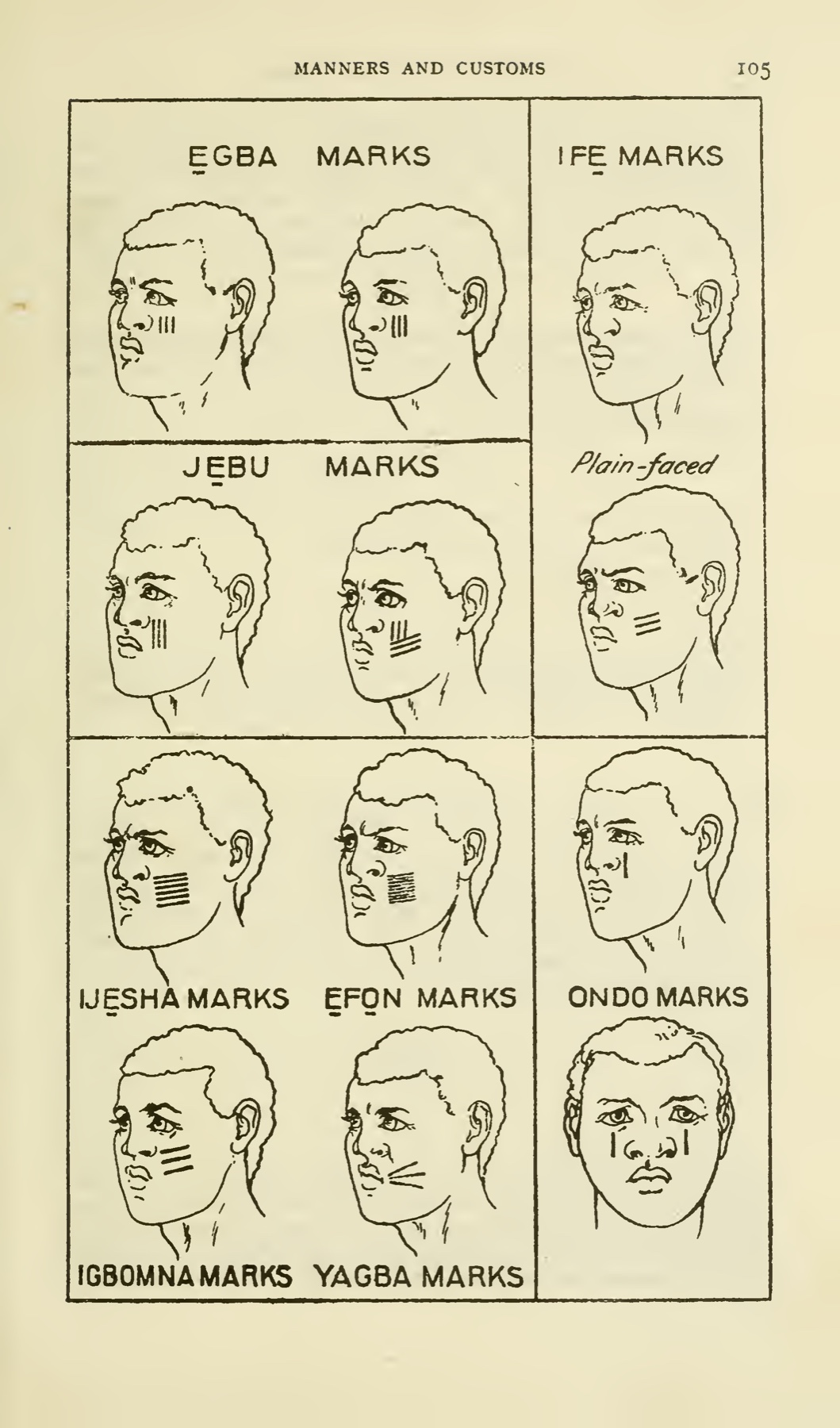
¶51 III. The Egbado marks are the same as the Ọ̀yọ́ marks generally as this family remained in close connection with Ọ̀yọ́ and in their allegiance to the Aláàfin long after the break-up of the kingdom, and the establishment of tribal independence.
¶52 IV. Òwu marks. These are of two kinds, both being variations of Ọ̀yọ́ marks. They are:—(a) Abaja Olowu and
¶53 (6) Keke Olowu.
¶54 (a) The Abaja Olowu are three horizontal lines surmounted by three perpendiculars each about one and a-half inches long.
¶55 (0) The Keke Olowu is like the Keke or Gombo with the lines discrete or interrupted.
¶56 V. Ìjẹ̀bú marks are also of two kinds (4) the first is much like the Abaja Olowu (the tribe from which they are partly descended) but with the horizontals curved.
¶57 iw, (6) The other is the Abaja Ord of the Ẹ̀gbás. The former is more distinctive of Ìjẹ̀bús.
¶58 VI. Ifẹ̀ marks are three horizontal lines like those of the original Baṣọ̀run’s marks, each being shorter, about half-inch long. Otherwise Ifẹ̀s are usually plain faced.
¶59 VII. The Ondos and Idokos have only one bold line or rather a gash about one and a half inches to two inches long over each malar bone.
¶60 VIII. The Ìjẹ̀ṣàs as a rule have no distinctive marks ; they are mostly plain-faced; some families, however, are distinguished by having on each cheek 5 or 6 horizontal lines. They are closely drawn, and much longer than any Ọ̀yọ́ mark, e.g.
¶61 Amongst the Efons an Èkìtì family, the lines are so many and so closely drawn that the whole together form a dark patch on each cheek, e.g.
¶62 IX. The Yagbas are the most north-easterly tribes of Yoruba; they are distinguished by three long lines on each cheek, far apart behind, but converging to a point at the angle of the mouth, e.g.
¶63 X. The Igbominas are by some classed with OOyos, and by others with Èkìtìs. It will, perhaps, be more correct to say they are Ọ̀yọ́s with Èkìtì sympathies. They occupy a midway position between the two ; and so their facial marks are parallel like those of Ọ̀yọ́s, but long and far apart like those of Yagbas, yet not convergent in front e.g.
¶64 On the whole, speaking generally, the finer and more closely drawn lines, are more elegant than the same drawn bold, and too far apart.
¶65 We may note how each of the principal marks is indicated by a different verb signifying "to mark’ :—~ To be marked with the Pele is Oko Pele Abaja_,, O bu Abaja Keke ,, O sa Keke Gombo ,, O wa Gombo
§ (c) Diet
¶67 The diet of the common people is plain but substantial. The morning meal is a kind of gruel made from corn flour (maize or guinea corn) and taken between 7 and 8 a.m. with Akara an oily cake made of beans, ground and fried. There are no fixed hours for meals. After midday, dinner is served, each family consulting its own convenience as to the precise time of eating. Supper is taken in the evening generally between 7 and 9 p.m.
¶68 In ancient times pounded yam is served out in a large bowl or earthenware vessel, and both the father and his children and grandchildren sit around it to partake of the food. Each one dips
¶69 his hand into the dish and takes a morsel in strict order of seniority, F
¶70 a» vp a"?
¶71 3 as a?
¶72 the youngest present acts the part of a servant and waits on his seniors ; and whether the food be sufficient or not care was usually taken to leave some portion for him.
¶73 The staple articles of diet are yam and yam flour, corn and corn flour, beans of various kinds, cassava, sweet potatoes, etc. Only the well-to-do can afford to indulge in flesh diet daily, the poorer people are mostly vegetarians, except when animals are slaughtered for sacrifice they seldom partake of meat; game, however, is plentiful. Dwellers on the coast have a plentiful supply of fish.
¶74 Of fruits the principal are :—The shea fruit in the plain, the Oro (Irvinga Barteri Hook) in forest lands. The Ori or black plum (verbenacea cuneata), locust, bananas, plantains, pawpaws, oranges, lime (citron), pine-apples, the well-known kola nut, and the bitter kola (garcinia kola-Heckel), ground nuts (Arachis hypogea), etc. Their drink consists of palm wine, bamboo wine, and beer made from the guinea corn or from maize.
§ Dress
¶76 The Yorubas clothe themselves in loose flowing robes like the people of the East, whence indeed they trace their origin. The men wear gowns, vests, and a very free and ample kind of trousers called Sokoto. In lieu of the gown sometimes a sheet of cloth three yards by two is thrown around the body for a covering, passing under the right arm-pit, and overlapping over the left shoulder.
¶77 In ancient times the gowns were made very plain and were ,of purely native manufacture. They were without embroidery on the breast and around the neck as at present ; only kings and chiefs wore gowns made of superior stuffs richly embroidered. The covering for the common people is called Elegodo. The weavers have a standard of breadths for all home-made cloths. Men’s coverings are made of 14 breadths, and women’s of 10, of about 5 inches each. Cloths of wide breadths—say about a yard—were first imported from Oro or Ìlá in the Igbomina province, and were known as Akoko cloths being chiefly the production of Akoko women ; hence the practice spread all over the country for women to manufacture broad width cloths, and men narrow ones. Formerly only men were weavers and tailors, but from intercourse with other nations the women now engage in the same craft.
¶78 The vest spoken of above is known as kukumo over which the gown or loose cloth is thrown. It is sleeveless and without a collar, and open in front ; it may be made of any kind of native stuff, 5O@
¶79 but that which is made of Alari (crimson dye) or of Samayan (rough silk) is the most respectable, as it is at the same time most costly.
¶80 Another kind of vest is termed Ewu; this is much like the former, but with sleeves ; it is more commonly used in modern times ; in full dress it is often worn under the gown, and is always made of white stuff.
¶81 There is another form which seems to be of foreign importation used only by big men; it is full of pleats below reaching to the calves, but the sleeves are very ample and long, about 12 inches longer than the arms, very wide at the end. It is called Dandogo, and is worn in lieu of the gown.
¶82 Togo is a sleeveless dress like kukumo but smaller and simpler ; it is the soldier’s dress and is often worn with a turban wrapped round for a belt.
¶83 There are three sorts of gowns, the Suliya, Agbada and Girike. The Suliya is the smallest, plainest and lightest ; always made of white material, it reaches much below the knee, open at the sides, with the arm stretched the sleeve would reach as far as the wrist, but long and pointed below. The Agbada is a larger form, always made of dyed or coloured stuff. It reaches as far as the ankles, much embroidered at the neck and breast, open at the sides, and quite covers the arms. The Girike is the largest and heaviest, it is like the Agbada but more ample; it is much embroidered, reaching also as far as the ankles, and extends beyond the arms.
¶84 Trousers (called Sokoto) are made of different shapes and lengths, but all are kept round the waist by a strong cord. They are worn below the vests. They consist of the following :—
¶85 (a) Ladugbo is the commonest, worn by young and working men, it is quite free, but somewhat tight at the knee where it terminates. It is now out of fashion.
¶86 (b) Aibopo, also common, worn by all classes. It is free but tightened towards the knee where it terminates.
¶87 (c) The Alongo. This is tight throughout, and is not unlike a bishop’s gaiters. It reaches below the knee, and is used chiefly by sportsmen. .
¶88 (d) The Kafo is a tight-legged dress like the Alongo, but reaches as far down as the ankles. It is worn by warriors and ruffians generally.
¶89 (e) The Kembe. This is made like the Aibopo but richly embroidered about the legs with threads of crimson dye. This is the kind usually worn by nobles and gentlemen.
¶90 (f) The Efa or Abenugbangba. The name (wide-mouthed) well describes the nature of the trousers. It is a kind that is very free, longer than the Aibopo, is somewhat shaped like European trousers, but stops short a little below the knee.
¶91 (g) The Wondo is made entirely like the European trousers. Though once fashionable, yet is now entirely out of use.
¶92 (h) The last is the Agadansi. This is adopted from the Nupes, by whom it is commonly used. It extends from the waist to the ankles ; it is very free throughout save at the ankles where it terminates and is heavily embroidered there. It is often made of two or three yards wide (sometimes more) so that when the feet are thrust in at either end, and the cord drawn above, it gathers into a large volume between the legs.
¶93 The men’s head-gear is usually a cap (Fila) of which there are two kinds ; the ordinary fila which is about 10 inches long, rather close fitting, and is bent upon itself on the top. The turban is generally wound round it by Moslems and full-dressed gentlemen. The other kind is used generally by young folks, and is called Fila Ab’eti i.e. the ear-covering cap. It is shaped like the sector of a circle, the pointed ends being used—as its name denotes—for covering the ears in cold weather. But when used otherwise the pointed ends are turned fore and aft, the point on the forehead being tilted up in a sporting manner to show the under-surface prettily done up with cloths of bright colouring : it is then termed Labankada.
¶94 Hats made of straw, and ornamented with coloured leather are worn solely for protection from the sun: the crowns are large enough to accommodate the turbaned head.
¶95 The women’s dress is much simpler, two or three wrappers and a head dress or circlet complete their toilet. Unmarried women generally use two wrappers, the under wrapper being fixed above the breasts. This is made of fine cloth and is heavier. The upper is fixed about the middle of the body ; and is made of lighter cloth. To these married women add a third, used as a . shawl, or covering for the head and back. Underneath all these, and immediately next the body is worn from the age of puberty a short apron or petticoat reaching the knees, and tied round the waist with a strong cord or band. This is called Tobi.
¶96 Female headgear consists of a band, of about 6 to 10 inches wide and 5 feet long (more or less). This is wound twice round the head and tucked on one side. It may be of plain cloth or costly, as she can afford. Well-to-do ladies use velvet cloths.
¶97 Hats are used only as sunshades ; the crown is small for the head but the rim is as wide as an open umbrella.
¶98 Camwood to the feet and stibium to the eyelids complete the female toilet.
§ (e) MARRIAGE
¶100 In ancient times the Yorubas were mostly monogamic; not from any enlightened views on the subject however, but rather from necessity ; for, although polygamy was not actually forbidden, yet only rich folk could avail themselves of indulgence in that condition of life.
¶101 Besides, in a community mainly pastoral and agricultural, where all were peaceful, and no one engaged in any occupation perilous to the lives of its male population e.g. warfare, seafaring, deep mining, etc., where wants were few, and those easily satisfied, the young men married as soon as they were of an age to support a family, and therefore a superfluous female population was hardly ever known.
¶102 The marriage laws and customs have undergone changes brought about by intercourse with other peoples, but the chief features in them are still preserved.
¶103 Where all things are equal and normal, there are three stages to be observed, viz. 1, An early intimation. 2, A Formal Betrothal. 3, The Marriage.
¶104 1. An early intimation.—It is generally the duty of the female members of the family to look out for a wife for their male relative ; girls are generally marked out from childhood as intended for a particular young man, with or without her knowledge ; this is the first stage in the process. Mutual relations at this time are of an informal nature; much depends upon subsequent events, especially on the girl’s liking for the man when she is of age, and the consent of the parents. There are other important factors in the matter, but for the former, ways and means are found for the girl to make the acquaintance of the future husband. This period is also employed in making a close acquaintance with each other’s family, for before a formal betrothal is made the relatives on both sides will first satisfy themselves that the family of the other side is free from the taint of any hereditary disease such as insanity, epilepsy, leprosy, etc. and also whether they be insolvent debtors. As mutual understanding becomes established, presents are usually given at the New Year, and at other annual festivals. This period will last until the girl is of marriageable age.
¶105 2. The Betrothal.—This is called the "Isihun "or formal consent. No girl will marry without the consent of her parents ; and it is rare for a girl to refuse the choice of her parents. The family oracles are invariably consulted before the final decision is arrived at.
¶106 The ceremony of betrothal is a very important one; it is generally performed in the night, when all the most important members of the family on both sides will be at leisure to be present, as well as their intimate friends. The young man is to present 40 large kola nuts, some money, and several pots of beer for the entertainment of those present. The kola-nuts have to be split, and all present as well as important absentees must have a share of them, indicating thereby that they are witnesses of the betrothal. From this day, the girl is not to meet her fiancé or any member of his family without veiling or hiding her face.
¶107 Then follows what is known as the Ana or "dowry." The bridegroom-elect has to present to the parents of the intended bride, choice kola-nuts, some alligator pepper, and bitter kolas.? Also a fine wrapper of good quality, a large covering cloth, a head tie, and some money according to his ability. . Well-to-do families rarely require more than 10 heads of cowries in these days, in earlier times one head was considered ample—only as a token.
¶108 Whatever variations may be in these presents, the kola-nuts of both kinds and the alligator pepper are invariable and essential. If the girl happens to be doing debtors’ service at the time, the young man will pay the debt and release her, before the marriage can take place.
¶109 This event (the betrothal) is also an occasion of rejoicing, feasting, and offering of sacrifices. The parties themselves are to carry special propitiatory sacrifices offered to the evil one. This is termed "Ebo Iyawo" i.e. A bride’s sacrifice.
¶110 3. Marriage. (Igbeyawo).—Marriages may be solemnized at any time of the year, except during the fasts, but the most usual time is after the season of harvest, and following the Egugun festival.
¶111 The bride is conducted to her new home always in the night, attired in her best with a thin white cloth for a veil, and attended by her companions all well clothed, with drums, and singing and dancing. The bridal party is met at the entrance gate of the bridegroom’s compound by a female band of the house specially selected for the purpose, and by them the ceremony of washing the bride’s feet is performed, and then the bride is literally lifted and borne into the house. Hence the term for marriage "Gbe Iyawo "i.e. lifting or carrying the bride. She is then conducted into the bathroom where she is washed, rubbed down, perfumed,
¶112 Tt5
¶113 and dressed up afresh, and then conducted into the apartment of the head lady of the house. She now becomes the inmate of that house for life.
¶114 The bride is usually brought with her idols, and furnished from her home with every thing that appertains to the female department of house-keeping, including cooking utensils, brooms, and other articles for house use.
¶115 If she gives satisfaction to her husband, and friends, presents are sent on the next day to her parents, she herself is covered with trinkets (consisting chiefly of corals and other costly beads, gold necklaces where they are obtainable, etc.) and the festivities continue for at least three days.
¶116 A bride who is found unchaste is rather hardly used and some times severely punished to the extent of having her tied! and severely flogged, thus compelling her to name her violator so as to have him severely fined. No ornaments are allowed her and she may be ordered to perform errands out of doors unveiled, the next day, or may be sent out with a pitcher for water! Otherwise, a bride is never seen out of doors for 12 months at least after her marriage, except closely veiled, and with attendants.
¶117 In the case of Moslems, liturgical forms of ceremonies are performed by the priest in the house or in the mosque. This is termed Isoyigi. Such women alone in former times had the privilege of covering their head with a light shawl when out of doors ; but the practice has now been extended to all married women.
¶118 Widowhood and Remarriage.—Three months is the period of mourning in Yoruba, during which time widows remain closely indoors ; they may spin, dye, or do any home work, but must do nothing that will take them out of doors. Among other signs of widowhood is an entire absence of personal attention, they neither bathe nor do up their hair, nor change the cloth they had on at the time of the husband’s death.
¶119 This period over, they are open to offer of marriage from members of the deceased husband’s family. Where there are several women, the heir (usually the eldest son or younger brother) who succeeds to the headship of the house, usually inherits the majority of the women, except of course his own mother. The custom is for each man to send his chewing stick (tooth brush) round to the woman of his choice, she is expected modestly to decline
¶120 it once or twice; but if she refused it the third time, the refusal is taken as final.
¶121 The following peculiarities mark Yoruba wedded life :—
¶122 1. Women are never really married twice ; they may be inherited as widows, or taken for a wife outside the late husband’s family, but the marriage ceremony is never gone over again under any circumstances.
¶123 2. Once married they are attached for ever to the house and family of their deceased husbands ; hence it is more usual for widows to choose another husband from the same family.
¶124 3. No woman is without a husband, except in extreme old age, but every woman must in any case have a male protector who is responsible for her.
¶125 4. Divorce is very rare; so rare as to be practically considered as non-existing. It is by no means easily obtained especially when there are children of the union.
¶126 The causes that may lead to a divorce are :—Adultery with the husband’s blood relation, kleptomania, repeated insolvency, especially such as may bring trouble to the house. A woman may apply for a divorce for extreme cruelty, which can be testified to, and ill-usage.
¶127 But these causes notwithstanding a divorce is never granted by the rulers of the town until all possible means of reclamation have been exhausted.
¶128 5. A woman divorced from her husband can never be married, or taken up legally by another man; hence the saying A ki isu opo alaye (no one can inherit the relict of a living man).
¶129 Under purely Native Government the above rules still hold good.
OTHER RECOGNIZED FORMS OF MARRIAGE
¶131 There are cases in which all the above forms and ceremonies are not gone through, and yet the woman is regarded as the lawful wife of the man of her choice. Mutual consent is the only thing indispensable. Of such cases, some may be girls who when of age, will not accept the man chosen for them from childhood, except one of their own choice. Some may be widows who failed to be mated at the house of her late husband. Some may be slaves who have redeemed themselves, or a captive of war, or one bought to be made a wife of. In all such cases, the woman’s free consent, and the recognition of her by the members of the man’s family, are all that is required for her to be regarded as the man’s lawful wife.
¶132 There is a third form of marriage which is more common among
¶133 Moslems of modern times. In such cases, it is not usual to mark out a husband for the girls from childhood; but when they are of age, the father, seeing a young man he delights in, or an elderly man with whom he desires to form a connection, if he expresses himself willing to accept the gift, the father after a very short notice will order his daughter to be washed and dressed up and taken over to the man in the evening, as a "Saraha" i.e. a free gift of God! The girl may not even know the man until she is taken to him!
¶134 In such cases a girl that is wild and unruly who is likely to bring disgrace on the family receives but a few hours’ notice ; but a dutiful and obedient daughter will always have her feelings consulted, and her wishes granted as to her choice of the man and the time of the marriage. Festivities are performed in these cases also.
¶135 These are the three forms of wedlock recognized by the Yorubas the first being far more binding than the latter two.
¶136 Moslems hold that the Koranic law limits them to four wives, and, therefore, the ceremony of Jsoy1gi is never performed for the same man above that number.
¶137 Other wives taken without the ceremony of Jsoyigi are known as Wahari (a Hausa word) ; they are legal in every way and their children quite as legitimate, but both mother and children are regarded as somewhat inferior to those others. Amongst pagans the "customs "detailed above take the place of Zsoyig? with the status it confers upon both the mother and the children.
¶138 Only the products of an illicit intercourse are regarded as illegitimate.
§ (f) TRADES AND PROFESSIONS
¶140 The principal occupations of men are:—Agriculture, commerce, weaving, iron-smelting, smithing, tanning and leather working, carving on wood and on calabashes, music, medicine, barbing, and other minor employments.
¶141 Agriculture.—This is the most general occupation of the bulk of the people. It is carried on with simple and primitive instruments, viz. a hoe and a cutlass, and nothing more, both of home manufacture. Ploughing is unknown, and it is very doubtful indeed whether a plough would be of much service to them under present conditions; experiments with that instrument by those who understand the use of it have not proved successful.
¶142 The principal articles of food and of commerce grown are :— Corn (guinea corn in the north and maize in the south), beans of several varieties, ground nuts (avachis hypogea), yams of various species, sweet potatoes, koko (colocasia antiquorum), pepper, piper, calabashes and other kinds of gourds, coffee, cocoa, kola nuts, vegetables of all sorts for home consumption, cotton for weaving, etc.
¶143 When a plot has been worked with rotation of crops for a few years, it is left to lie fallow for some years whilst contiguous plots are put under cultivation, and so on alternately ; manuring is unknown. The soil is remarkably fertile under present system.
¶144 Women and children assist in reaping and in bringing harvest home. No beasts of burden are employed in agricultural operations.
¶145 All farmers and men of any importance have generally smaller farms nearer home "Oko Etile" and a more distant one generally in the forest "Oko Egdn." When engaged in the nearer one, they work from 6 or 7 a.m. to 5 p.m., with intervals for meals, and then return home; but at the distant farm, they invariably remain there for weeks and months before returning home. Regular farmers do so only at-the annual festivals. In these farms, not only are fruits of the earth cultivated but also poultry and smaller cattle are reared for the market. Fairs are held periodically in some central farm markets where these products are disposed of to market women from surrounding towns and villages.
¶146 Although the soil is well adapted for raising fruits, yet fruit trees are rarely cultivated for the supply of markets.
¶147 Commerce.—Commerce comes next in the order of importance. Yorubas are keen traders, they are to be found in every part of neighbouring countries for that purpose. A large trade is carried on by barter. Cowry shells, the medium of exchange, being too clumsy for large transactions, are used only for small exchanges locally ; the very small species are used by travellers. Costly beads are used by many on distant journeys for trade, they are valued as precious stones. Thus the products of the north are given in exchange for those of the south, and those of Yoruba land for those of neighbouring states always by barter. Both sexes are engaged in trade but each in his own line.
¶148 Currency.—Metallic currency was unknown previously to the arrival of European traders, and even as lately as 1897 in places far off from the coast coins were regarded more or less asa curiosity. Silver was better appreciated than gold or copper, because it can be converted to ornaments. Silversmiths abound in the country whilst there were no goldsmiths. Shells then stood for money and are thus calculated :—
¶149 40 cowries = I string 50 strings = 1 head 10 heads =1 bag I1g
¶150 The value of a cowry was never fixed. Countries nearer the coast can obtain them with greater facility than those inland, and therefore they are of higher value in the interior ; but since the British occupation of Lagos the principal port of the Yoruba country, and English coins began to circulate in the country, the rate of exchange became practically fixed at 6d. for a "head" (the usual standard of calculation) i.e. 2,000 cowries ; hence 3d. ==1,000cowries. But coppers being considered inferior in value, one penny is taken at 300 cowries each ; 3d. in coppers then would be goo cowries. Cowries are an absolute necessity at the present stage of the country, and should be used pani passu with coins for purchases below one penny. Fruits, herbs, and small articles of food may be purchased for a few cowries, beggars collect them by two’s and three’s from passers by, and thereby earn enough to keep life going ; to what extent they are rare, to that extent the hardships of life are felt in the land. .
¶151 The custom of stringing cowries was for the facility of counting large sums; they were usually strung by 200 in § strings of 4o each, three of 66 or two of 100 each and with a discount of one per cent.
¶152 Esusy is a universal custom for the clubbing together of a number of persons for monetary aid. A fixed sum agreed upon is given by each at a fixed time (usually every week) and place, under a president ; the total amount is paid over to each member in rotation. This enables a poor man to do something worth while where a lump sum is required. _ There are laws regulating this system.
¶153 Weaving.—This also is carried on by both sexes but in different styles of manufacture. Men weave cloths of narrow breadths about 54 inches wide called Alawe. The loom is operated upon with both hands and feet ; the threads of the warps are so arranged that they open and close by a mechanical contrivance worked by both feet moving alternately as the pedals of an harmonium, whilst the shuttle about 8 by 2 inches carrying the woof is tossed and caught by the right and left hand alternately through the opening, the disengaged hand being rapidly used in ramming in the thread. The cloth is woven in one long strip and then cut to the required lengths and tacked together.
¶154 Tailoring is done mostly by men only as it is only men’s dress which requires a tailor. It includes embroidery made in the neck and breast of men’s gowns. Women being wrapped in plain cloths hardly require tailoring. The stitches are made the contrary way to that of European tailors, the needle being pushed away from the seamster, and not toward himself.
¶155 Iron Smelting was carried on more largely in earlier than in modern times. Certain districts are rich in iron ores, its iron production gave its name to the city of Ìlọrin, from J/g ivin, iron grinding, also to Eleta a district of Ìbàdàn "Eta" being the term forironore. Certain districts in the Èkìtì province are also famous for their iron ores from which good steel was made, such as Oke Mesi. Charcoal from hard wood, and the shells of palm nuts are the materials generally used for generating the great heat required for the furnace (called Jleru) which is kept going all the year round. Iron rods and bars of European commerce being cheaper are fast displacing home-made products, and here and there all over the country the furnaces are being closed, and soon will doubts begin to be expressed as to whether Yorubas ever knew the art of smelting iron from the ores!
¶156 Other products of the mines e.g. gold, silver, tin, etc., are not known among the Yorubas.
¶157 Smithery is carried on largely. Before the period of intercourse with Europeans, all articles made of iron and steel, from weapons of war to pins and needles were of home manufacture ; but the cheaper and more finished articles of European make, especially cutlery though less durable are fast displacing home-made wares.
¶158 There are also brass and copper smiths who make ornaments from these materials; for this purpose brass and copper bars are imported from foreign parts.
¶159 Workers in leather were formerly their own tanners, each one learns to prepare for himself, whatever leather he wants to use; black, white, green, yellow, and brown are the prevailing colours given to leather. They are now largely imported from Hausaland, principally from Kano.
¶160 Every worker is expected to know, and to be able to execute the various crafts performed with leather, e.g. saddlery, sheaths to swords and knives, leather ornaments on hats, waistbands for children, leather cushions, bolsters, boots and shoes, sandals, etc.
¶161 It may be remarked that shoes and boots are used only by riders on horseback, and therefore they are always made with spurs immovably fixed upon them.
¶162 Music is a favourite pastime and gives occupation to many, both men and boys.
¶163 Musicians also have first to learn how to manufacture the instruments they have to perform upon, hence each one can easily repair a damaged instrument.
¶164 Yoruba music has yet to be studied and reduced to a system by a competent musician ; how essential this is can easily be recognized when we consider how much time and trouble is spent in acquiring the art, and how much the practice of it enters into the varied life and conversation of the people. Having learnt how to make their instruments, they then begin to learn how to speak with them, an operation to which the Yoruba language readily lends itself, as it consists chiefly in modulation of the voice; this the instruments try to imitate. The praises and attributes of great men and distinguished names are got up, and the various measures in dances are learnt. There is no sound more common in Yoruba towns than what Europeans term "tomtoms." Musicians are in requisition at weddings, funerals, in processions of all kinds religious and otherwise ; they are constant attendants on all great men, and many of them parade the streets asking alms on their drums.
¶165 Musical Instruments used by the Yorubas are of two classes only, viz. wind and percussion.
¶166 (a) The Ivory trumpet and the Kakaki introduced from the Hausa and Nupe are used for the ALÁÀFIN alone. The Fami fami, Okinkin, Igba, Tiyako fife and the Oge. These are the principal wind instruments.
¶167 (0) The Koso is the ALÁÀFIN’s drum, and the Ogidigbo is used only on the occasion of the ALÁÀFIN and the Baṣọ̀run dancing on the annual festivals.
¶168 The Calabash drum—ornamented with strings of cowries— is called Sékéré. The Yangede, Dundun, Bata, Ayé, Sami, Siki and the Apinti are all ancient drums. The Aro (cymbal) the Bembe, introduced from Hausa, and the Gangan the noisiest but most popular are of recent invention. These are the percussion instruments.
¶169 Stringed instruments are rarely used, except by Hausa mendicants.
¶170 Medicine.—There are certain persons, doctors by profession (general practitioners) to whom people resort on an emergency. They are called Adahunse. There are no institutions like hospitals, but some of these doctors do keep on their premises a number of invalids suffering from chronic or constitutional diseases, e.g., leprosy, insanity, chronic ulcers, etc. Many of these patients being unable to pay the doctor’s fees, style themselves "Gba miora mi" i.e., help me and appropriate me. Such persons on being cured become the property (or perpetual house servant) of the doctor.
¶171 Formerly there were certain clans known as medicine people, and were licensed as such by the King. For instance, the inhabitants of the towns of Oguré, Ogidi, Abe, Agberi, Apaté, Arohungbé. They were remarkable for their skill in using secret poisons, and crimes committed by them generally went unpunished, they being under the special protection of the King. They are expected to be at the King’s service when required, but it meant death to any of them-if the poison given to the King for his use upon his enemies did not take fatal effect.
¶172 There was also a particular family of Efon descent living at one time at Ọ̀yọ́ said to have belonged to the Ondasa tribe. Their great ancestor was said to have been invited to the capital by one of the early Kings of Ọ̀yọ́ for medical advice when all his wives were barren. His prescriptions were successful, and so he was detained at Ọ̀yọ́ and rewarded with a high rank and position in the palace amongst the household officers. His descendants are now distinguished from the citizens of Ọ̀yọ́ by the totem Ogo (a club) being affixed to their names.
¶173 The art of medicine is kept a profound secret by those who profess it ; an increase of knowledge can only be gained by an interchange of thoughts between brother professionals ; many die without imparting their secrets to others, and thus much valuable knowledge is entirely lost. But some do impart their secret to those of their children male or female who show special aptitude for such knowledge and whom they particularly love.
¶174 On the whole we can unhesitatingly assert that those men who are specialists in one or two particular branches but who do not make the practice of medicine a profession can be more confidently relied upon.
¶175 Carpentry is in a very backward condition. Of joinery they have no idea whatever. Carpenters are called Gbenagbena. They are the crudest and most primitive of handicraftsmen ; their services are not much in requisition.
¶176 Carving in wood is executed in a rather primitive way but such natural genius is displayed by some men, that it is a matter of surprise that such artistic achievements can be displayed by an illiterate person, and with tools so simple and primitive.
¶177 The Yorubas of the Egbado district are said to be the best artists in the country. They certainly have in their forests wood most suitable for carving purposes.
¶178 Calabash dressers are always found in a row in market places plying their trade; all sorts of geometrical figures are traced or cut in calabashes ; some designs are exquisitely correct and beautiful. Names, mottoes, and phrases are burnt into calabashes by educated artists, figures only by the uneducated. These designs are recently being imitated by Europeans under the term of Poker Work.
¶179 Seamanship.—There are very few large rivers in Yoruba land and nearly all of them fordable during the dry season, consequently only in coast towns and on the Niger are canoemen found who make any pretence to seamanship.
¶180 When the inland rivers are swollen by rains, large bowls and very large calabashes are used in ferrying passengers across. The passengers sit on them with their luggage, with the ferryman in the water, pushing the freight across.
¶181 All canoes are dug out from large trees. Our canoemen cannot really be called experts, as they rarely sail out of sight of land, and canoes can ill endure any storm or tempest ; nevertheless, when war canoes are rigged up and manned, they are handled with no little skill in their fights, sham or real. In the title of Aromire (i.e. one in friendly terms with water) we have preserved a chieftain who ranked as an admiral in the olden days of sea fights.
¶182 Fisheries,—Deep sea fishing is but little practised, the rivers and lagoons furnish all that they can harvest. Shrimps and oysters are plentiful in their season. The fishing industry is of course confined to coastal towns, and as there are no means of supplying inland towns the consumption of the fresh article is confined to the coast.
¶183 Building as a profession is almost unknown ; houses as a rule are built by men clubbing together, but there are always a few experts among them in particular lines, either in building the mud walls or in roofing and they distribute themselves accordingly. These are always in requisition whenever they can be spared from their farms. Large works are undertaken and arranged for, when all hands can conveniently be spared from their farms.
¶184 Pastoral Work as a profession is carried on only in the northern provinces more suited for that purpose from the extensive plain and pasture land of those regions. But very few Yorubas are found engaged in it. Gambaris (i.e. Hausas) are generally engaged by the chiefs to tend their cattle.
¶185 The barbers and ropemakers are also mostly Hausas and Fulanis, these are crafts rarely practised by Yorubas.
¶186 These Hausas also perform some minor surgical operations such as cupping, bone-setting, tapping hydroceles, etc. Some are even oculists, and profess to be able to operate for cataract. It goes without saying that much mischief is often done by their crude performances. They are unskilled and the instruments used are rather clumsy. It is a wonder that more mischief is not done, or that they occasionally get good results at all.
OCCUPATIONS OF WOMEN
¶188 It is specially the province of women advanced in age to seed cotton and spin thread. The former is done by rolling out the seeds from the wool between a smooth log of hard wood and a polished iron rod, the latter by weighting a thin rod of about 12 inches long with a small ball of clay about 1 inch distant from one end, attaching the cotton to the other end and setting the ball spinning like a top, the wool being rapidly drawn out to the required fineness. Seeded cotton is rendered fluffy for spinning by being attached to the string of a bent bow, and the string constantly pulled as if shooting an arrow. These operations being an occupation of a sedentary nature, and more suitable for old women are performed by them leisurely all day. Reels of spun thread are sold to dyers.
¶189 Aged women who reside in the farms also employ their time in shelling the kernels from the palm nuts, and also tending poultry, goats and sheep for the market.
¶190 Dyeing is done by women. They buy a quantity of the yarn, bleach and dye them in various colours, and sell them to the weavers, male or female. The commonest colour is blue or blue black from the indigo dye. The preparation of indigo balls for the market is also an important industry. Women are equally with men engaged in trading and weaving; but whereas men weave in small breadths and carry on their occupation in courtyards or secluded squares in the streets where they can stretch their warp 20 yards or more, the women on the contrary fix their looms in the piazza of the house, close to the door of their apartments where they may be seen sitting on the ground, with their legs in a hole under the loom; they weave the cloths in broad pieces called Kijipa two or three breadths forming a covering.
¶191 The warp is wound round two stout bamboo poles fixed athwart two strong upright posts, top and bottom. There is a mechanism by which the threads can be made to cross each other. The woof in rods of about a yard long is passed slowly right and left as the warp is opened and separated one way and the other, being rammed down each time by a flat smooth staff.
¶192 Besides indigo dyes of light blue and dark shades, the scarlet called alahari and rough silk, Samayan in grey are the prevailing colours of Yoruba yarn.
¶193 Palm oil making and nut oil making from the kernels of the palm nuts, as well as shea butter from the shea fruit are exclusively female industries.
¶194 Beer-brewing from guinea corn or maize is done also by women ; for this they have a sheltered place within or near the compound to insure protection against fire.
¶195 A large class is engaged in preparing articles of food. They are purveyors of cooked food, keepers of refreshment stalls and other branches of dietary for the market, especially to accommodate working men and caravans.
¶196 The manufacture of beads from the hard shells of palm nuts, or from the cocoa nut shells, is an important female industry. The former quality is more highly valued.
¶197 Pottery is also a female industry. Men may sometimes be seen assisting to dig up the clay and to perform some rough initial work, but as a rule the whole industry is in the hands of women. The drying, pulverising, sifting, mixing and moulding, are all done by women and girls.
¶198 Large pots for brewing beer, and for setting indigo dyes, and cooking Eko (the morning gruel) for sale are turned out with marvellous skill. Cooking utensils, dishes, water pots, etc., are also made for the markets. Some parts of the country furnish clay of superior quality, notably Ìlọrin.
¶199 Although ignorant of the use of the wheel, or any such mechanical contrivance used in pottery, yet the figures, forms and shapes of the articles turned out are wonderfully correct.
¶200 Every woman whatever her trade may be, is expected to keep a few chickens and a goat or two from which she derives small income for house keeping and general "pin money." The rearing of poultry then must be reckoned among female occupations.
¶201 Hair dressing may also be mentioned among female occupations, for although the race has not much to boast of in that form of natural adornment, yet they often contrive to bring out styles and fashions which satisfy them ; but a marked distinction must always be made between that of married women and the unmarried; this is a social law which on no account should ever be infringed.
¶202 On the whole the women seem to be far more industrious than the men, for whereas the men always contrive to have leisure hours and off days from work, the women seem to have none. Boys and young men certainly have more idle hours than the girls. The care of the children also devolves almost entirely upon their mother, an inevitable result of polygamy.
§ (g) LEARNING
¶204 As the Yorubas have no knowledge of letters, their learning consists chiefly in oral traditions. The historians are the King’s cymballists and ballad singers, the chief of whom is called the OLOGBO or AROKIN. They may be compared to the rhapsodists of the Homeric age, as they perform almost precisely similar functions. They chant to the King the story of the nation, and history of former reigns, for his information and instruction. They are kept in the royal service and are well supported. The office is hereditary.
¶205 Like many other heathen nations the Yorubas have their tradition about the creation and the deluge. It is their belief that at the creation men fed on wood and water, that they had a long projecting mouth; that the bat was originally a creature in human form, and was a black-smith by trade, and that with his instrument he reduced men’s mouths to their present shape, for which cause he was condemned to lose the human form and to assume that of a beast, and to use one and the same mouth for receiving food as well as for evacuation. The allegation that water was the original food of man is supported by the fact that it is the first thing taken by a new-born babe, as well as the last thing taken at a man’s dying moments.
§ (hk) WEALTHY PERSONAGES
¶207 There were certain historical personages in Yoruba who were noted for their great wealth, viz., Amoloki of Ord, Gedegbe of Ọ̀fà, Lapemo of Ijomu near Ord, Onibiyo of Guguru, Minimi of Erubu. There is also a sixth spoken of who resided at Gbudu. There was also a lady known as the Olowo of Ìjẹ̀bú.
§ THE IWOFA SYSTEM AND THE LAWS REGULATING IT
¶209 The term Jwofa has no equivalent in English. It denotes one who serves another periodically in lieu of the interest on money lent. In short, it is one in service for interest.
¶210 It has been mistranslated a "pawn’ by those who fancied they saw a resemblance to it in that system, and are trying to identify everything native with those that are foreign, and consequently, as in other similar cases, much mischief has been done thereby.
¶211 The Yoruba man is simply shocked to hear of "pawning" a man as is done with goods and chattels ; to pawn in Yoruba is ft dogo which term is never applied to a human being.
¶212 It has also been compared to slavery by those ignorant of the legal conditions ruling the system; but an Iwofa is a free man, his social status remains the same, his civil and political rights are intact, and he is only subject to his master in the same universal sense that "a borrower is servant to the lender."
¶213 Iwofas are held quite distinct from slaves; the verbs applied to each system mark the distinction e.g. 7@ to buy is applied to a slave, ydé to lend or engage (a hand) to an Iwofa; consequently you can buy a slave, but engage an Iwofa or service man.
¶214 The derivation of the term-is probably from Ìwó the entering into, and Efa a period of six days; hence an Iwofa is one who enters into a recurrent sixth day service.
¶215 The Iwofa system is a contract entered into in the presence of witnesses called Onigbowo i.e. sponsors, the money-lender is termed Oluwa i.e. master, and the worker Iwofa, 1.e. a service man.
¶216 It is a legal transaction recognized and protected by the laws of the country. Whatsoever the amount of money lent, it.is the law that the service rendered goes for the interest, and only the principal is paid back whenever payment is made whether after a few days or after many years.
¶217 An Iwofa may be a man or a woman, a boy or a girl, and the laws for each differ accordingly.
¶218 A man Iwofa lives in his own house and plies his own trade, but he is required to clean a piece of land equal to 100 yam heaps or an equivalent in his master’s farm once a week, the Yoruba week consisting of five days.
¶219 The people being mainly agricultural, farm-cleaning is the work of their daily life, and is the recognized ordinary system of labour. .
¶220 Cleaning three hundred heaps is the ordinary amount of an average man’s day’s work, consequently a strong man often found it possible to work in three different farms on the same day, for different masters, or to do three week’s work at a time in one farm, and have 14 off days at a stretch, in which he is free to follow his own trade without interruption. Special arrangements can also be made if a longer period is desired, but the Iwofa is bound to make up for the number of days lost.
¶221 This is the original law, but it is subject to slight modification or variation in various places, according to the local value, or the amount of money lent; e.g. amongst the Ẹ̀gbás, a whole day’s work is required instead of a morning’s work. But whatever modification of the original law is made in any particular locality, the law for that tribe is always fixed by authority, and never subject to the whims and caprice of an individual money-lender.
¶222 The master is to treat the service man as his social rank demands, he mingles freely with his equals in the house or in the field as a member of the household. A kind master often allows him his breakfast before he quits the field although he is not bound to do so, and if a master be too exacting or disagreeable, he may be changed any day without any previous notice, once the money lent is paid back in full.
¶223 Where the master is a great chief or a rich man, the service man may live under his protection and own him his feudal lord ; hence some men never troubled themselves to pay back the money, but may rather incur further obligations, being safe and free under the protection of a great name. Some men there are ,who are better able to do another man’s work than their own.
¶224 An Iwofa is never subject to punishment physical or otherwise, if he fail in his weekly service, the sponsors are called upon to make good the deficiencies.
¶225 In fine an Iwofa differs from a slave in that a slave must live with his master, an Iwofa in his own house. A slave can be compelled to work for his master every day, an Iwofa for a limited amount of work for half a day in the week, and that not by compulsion but from obligations of honour. A slave can be punished, an Iwofa cannot be. A slave has lost his independence and political rights, an Iwofa retains both. A slave has no one responsible for him, an Iwofa has two at least. In fine an Iwofa can go and come as he likes, a slave cannot.
¶226 For women the same law holds good generally but with some modifications on account of their sex; they work generally as char-women once a week, and have a meal in the house before returning home. In some cases they may live among the women folk in their master’s house, carrying on their own work, and lending a helping hand in the housework and in harvest time do their own share of the day’s work in the field along with the other women.
¶227 Some are engaged in trade, in which they sell for their master at the same time, and bring him the proceeds of his own articles as the allotted service rendered. When the trade is done in the home market, payments are made every nine days which are market days ; when out of town, at the return of the caravan.
¶228 If a service woman is tampered with by the master, the money is thereby considered absolutely paid, and the debt discharged. If forced against her will, not only is the debt cancelled, but he is also liable to prosecution and heavy fines besides to be paid both to the woman’s husband as damages and to the town authorities as court fees.
¶229 If a young unmarried woman is tampered with, not only is the debt ipso facto discharged, but the master has to repay the fiancé all the money he has spent on her and also a betrothal "dowry "to the parents besides.
¶230 If the matter is not arranged amicably and the case has to go before the town authorities, the master has to pay, and heavy fines are inflicted on him besides. Often has a rich man been reduced to poverty by this means and consequently they are always very careful.
¶231 If a betrothed girl becomes marriageable whilst in service and her fiancé wishes to get married at once, he has only to pay back the loan and lead his intended bride away. A woman cannot be married whilst doing service work.
¶232 A boy or a girl in service has to live entirely with the master or mistress as a domestic servant, inasmuch as their services are not worth much and they have to be trained besides, and the parent or whoever placed him there is supposed to have his whole time to ply his trade and withdraw his child as soon as possible ; therefore, the boy must give the master his whole time whatever that may be worth. The master is bound to feed him but not necessarily to clothe him, although many kind masters do that as well. They have a fixed time to visit their parents, usually once a week.
¶233 The boys generally tend horses and run errands, and the girls engage with the house-wives in domestic affairs. They are always with the boys and girls of their own age in the family.
¶234 The law protects such children very strongly. If the child refuse to stay any longer with the master or mistress for any cause whatever, they are never forced against their wish, but the parent or guardian must provide a substitute, or perform himself the weekly task.
¶235 If a child die during his or her service, the master must prove to the satisfaction of the parents and (if need be) of the town authorities that it was not due to any act of carelessness or neglect on his part, and that he provided ample medical aid for him.
¶236 The troubles accruing from young Iwofas are often a deterrent to the acceptance of them for service ; some folks would expect and demand more comforts for their children in service than they can provide for them at home. Marriages and funerals are the two great causes of money borrowing.
¶237 But this system is not limited alone to the business of professional money-lenders, it enters much into other transactions of their everyday life.
¶238 The system of engaging domestic servants for service with a monthly wage is unknown in this country, the Iwofa system is what is resorted to for that purpose. A parent will even put his child into service that way when there is no debt to pay in order to train him into habits of discipline and industry, and return the money when they feel that the child has been sufficiently trained.
¶239 Some would do so and put the money into trade and when satisfied with the profits made, return the principal and bring the child home.
¶240 The system is used also for apprenticeship. A man who wants his son to learn a particular trade would put him under the craftsman for the purpose, and obtain from him a certain amount of money ; the master, wishing to get his interest out of the boy will see that he learns speedily and well, so as to be of some use to him. In this way both are benefited.
¶241 A chief or a well-to-do gentleman with a wild and unruly son whom he wishes to tame, or who is indulged at home, would also resort to this method for training and discipline ; in such a case the boy will remain with such a handicraftsman until he is able to earn his own livelihood by his craft, then the money is paid back and the boy returns home.
¶242 This method of lending money is the only one known for investment and is therefore resorted to as their banking system.
¶243 So the Iwofa system may be regarded at one and the same time as one for banking, apprenticeship, and domestic service.
¶244 Since the establishment of the British Protectorate there has been more than one attempt made to abolish the system as a "species of slavery!" The Yorubas themselves never at any time regarded it as such; to so regard it must be due either to an ignorance of the laws regulating it, or because an exact equivalent cannot be found in any European system. It can, however, be imagined what chaos will result in any European country if the banking system, apprenticeship, and domestic service were abolished at a stroke—if that be possible. Like any other system it may be reformed if given to abuse, that is more reasonable and statesmanlike. But to abolish it outright because it has no foreign analogue would be to disorganize the social life of a people with no compensating advantage to borrower or lender. If such were done in this case the greatest sufferers will be those it was intended to benefit, viz., the service men themselves. But with the country now settled, and everyone free to prosecute his business, there must be less of money borrowing and service for interest, and thus a gradual change or modification is naturally effected in this system, with no tendency to abuse.
§ (j) DISTRAINING FOR DEBT
¶246 The Yorubas have a peculiar method of forcing payment out of an incorrigible debtor. When a creditor who has obtained judgment for debt finds it impossible to recover any thing out of the debtor, he applies to the town authorities for a licensed distrainor. This individual is called Ogo, he is said to d’ogo ti i.e. to sit on the debtor (as it were). For that purpose, he enters the premises, seeks out the debtor, or esconces himself in his apartment until he makes his appearance, and then he makes himself an intolerable nuisance to him and to the members of the house generally until the money is paid.
¶247 The distrainor is a man of imperturbable temper, but of a foul tongue, a veritable Thersites. He adopts any measures he likes, sometimes by inflicting his presence and attention on the debtor everywhere and anywhere he may go, denying him privacy of any kind, and in the meantime using his tongue most foully upon him, his own person being inviolable, for touching him implies doing violence to the person of the authorities who appoint him the task. He demands and obtains whatever diet he may require, however sumptuous and may help himself if not quickly served. If he thinks fit, he may lay hold on any poultry or cattle he finds in the premises, and prepare himself food, and all at the expense of the debtor. He must not take anything away but he may enjoy the use of anything he finds in the house.
¶248 Loud in his abuses, intolerable in his manners to all in the house whilst going in and out with the debtor, he goes on in this way all day, and from day to day if needs be, until even the inmates of the compound get tired of this, and then means will quickly be found of getting rid of the distrainor by paying off the debt.
§ (k) WAR
¶250 In early times war expeditions were sent out every other year by the ALÁÀFIN of Ọ̀yọ́ to distant countries chiefly amongst the Popos. War then was for spoils and to keep their hands in, and not for captives ; the victors rarely pursued the vanquished ; those who concealed themselves behind heaps of rubbish, or in any hiding place in the town or in the fields were quite safe. When a town was taken the shade trees about the principal market—which is always in front of the official residence of the chief ruler of the town—are cut down as a sign of conquest. Slave-raiding and the traffic in human beings did not then exist. Long sieges were unknown, for whether victorious or defeated, the presence of the Kakanfò or his corpse was expected home within 60 days.
¶251 There never was or has been a standing army, nor any trained soldiers (except at Ìbàdàn latterly where the idea began to germinate, and some of the chiefs had a number of their slaves trained solely for war ; some chiefs had also a corps of boys, not to bear arms, but to be attendant on them in battle, in order to familiarize them with the horrors of war!) But according to the custom of the country, every man capable of bearing arms is expected to serve in war ; but the law did not make it compulsory except for men of rank and title, and for home defence.
¶252 At the close of every war, each one goes away to his farm, and, except on an occasion of importance, as when the King’s messengers are to be received, even the Bále and the Balógun could not be found at home during the day at the busy seasons.
¶253 Before the introduction of fire-arms (a comparatively recent affair) their weapons of war consisted of bow and poisoned arrows, a short sword called Jomo and Ogbo a kind of heavy cutlass used chiefly by the common people.
¶254 As sieges then were of short duration and always carried on in the dry season, there was no necessity to provide against severe weather; the chieftains generally used awnings made of Ayin mats spread on four poles. Since sieges began to be carried on for more than 60 days, booths of palm branches have come into use, and in later times even these have given way to huts and houses built of swish.
¶255 The preserved food used in earlier expeditions consisted of parched beans, and a sort of hard bread made of beans and corn (maize) flour called Akara-kuru.
¶256 By the rules of warfare piye or foraging was permitted. The Ìbàdàns, who, more than any of the others carried on war operations for longer periods, and over wider regions, were accustomed to cultivate the lands all around their camps and in the neighbourhood whenever a long siege was anticipated.
¶257 WAR TITLES AND METHODS
¶258 War titles are of two grades, senior and junior, but both are modelled on one and the same plan.
¶259 Senior Grade:—The Balógun or Commander-in-Chief comes first with his principal lieutenants the Ọ̀tún and Òsì, that is Generals commanding the right and the left wings, then the (Asipa), Ekerin, Ekarun and Ekefa i.e. the fourth, fifth and sixth. These command the veterans.
¶260 Junior Grade:—The SẸ́RÌKÍ with his principal lieutenants also, viz., the Ọ̀tún, Òsì, with the Ekerin, Ekarun, and Ekefa. These command the young warriors, and those not attached to any of the greater war-chiefs.
¶261 The ASAJU is the leader of the van, he too has his lieutenants.
¶262 The SARUMI or chief of the cavalry and his men form a class by themselves; he also has his Balógun of the cavalry, with the Ọ̀tún, Òsì, etc.
¶263 These titles constitute what is termed "Oye Ilu" or "Town titles," because they are conferred by Bále or chief of the town and the town council, and they are all members of the town council with a right to speak and vote.
¶264 Among the senior war titles may be mentioned the Bále’s war chiefs. The Bále himself does not go to war ordinarily, but he has his war-chiefs, the Ọ̀tún Bále, Òsì Bále, Ekerin, Ekarun, Ekefa as well, who represent him in war ; they are always chosen from among the older men who have past their best days.
SIGNIFICATION OF THE TITLES
¶266 The term Balógun is contracted from Iba-li-Ogun i.e. lord in war. In time of war, and generally in the camp, the Ibalogun is not only supreme, but he is also above all laws, he commands implicit obedience from all, and he can do whatever he likes.
¶267 The Balógun’s Ọ̀tún and Òsì (right and left) are also the Ọ̀tún and Òsì of the town and of the army ; they command respectively the right and left wings, and they rank next after the Ibalogun.
¶268 The Asipa is a title borrowed from Ọ̀yọ́ to satisfy any war-chief who, being equal by merit to the Ọ̀tún and Òsì, yet just missed becoming either.
¶269 The Ekerin, Ekarun, Ekefa are the fourth, fifth and sixth respectively of the senior generals.
¶270 Sẹ́rìkí is a Hausa word signifying a "king." He is practically like the Balógun, and is as important among the. young warriors as the Balógun is among the veterans. A brave Sẹ́rìkí ranks himself next to the Balógun, the Ọ̀tún and Òsì Balógun notwithstanding ; for it often happens when he is exceptionally brave, that he skips over these and succeeds the Balógun, when a vacancy occurs. Otherwise the Ọ̀tún succeeds.
¶271 All booty and perquisites that fall to the army are divided into two unequal parts, the larger portion belongs to the Balógun and his lieutenants and the lesser to the Sẹ́rìkí and his lieutenants also. The Balógun and the Sẹ́rìkí are each entitled to one half of the portion that falls to them, the other half being equally divided among the subordinate war chiefs of each respectively.
¶272 In every successful expedition each of the subordinate war chiefs is expected to give one half of his plunder or captives to his chief, the seniors to the Balógun, the juniors to the Sẹ́rìkí, and they themselves also receive the like from their subordinates.
¶273 Subordinate Titles :—Every one of the above chiefs, Senior and Junior had his own subordinate chiefs modelled on the same plan of Balógun, Ọ̀tún, Òsì, etc., in the same way, these also form their companies on the same plan, and so on throughout the whole army. By this system every man capable of bearing arms knows his right place in the army, so that what appears to be a motley crowd is really a well-organised body every man being in his right place at the front, the right or the left of his immediate chief, although they lack that co-ordination and precision of movements which are the outcome and advantages of discipline and drill. .
¶274 Other subordinate titles Areagoro, Bada, Ajiya.
¶275 Areagoro.—This is the first title borne by a young chief of great promise, who, as the heir of a great war chief has just succeeded to the headship of a great house. It is a stepping-stone to one of the senior grade titles. He is always attached to one of the senior chiefs, as his alter ego ; he represents his chief in the councils and other important assemblies in the absence of the latter, where he can speak and vote with equal right and authority ; hence the saying : ‘ Areagoro ti o ba gboju t’on ti Oluwa re l’egbera i.e. an Areagoro who is bold is the equal of his master. An
¶276 Areagoro remains as such only till a vacancy occurs in one of the higher titles suitable for him.
¶277 Bada.—The title of Bada answers in many respects to a knight of the middle ages. He is one who is expected to keep at least one or two war steeds and a few followers at his own charges, to be ready to take the field at a moment’s notice, to be an accomplished horseman, a skilful swordsman or lancer, and to fight always on horse-back. All the principal chiefs have each at least a Bada. The Badas stand in the order of seniority of their respective masters and form a corps by themselves.
¶278 Ajiya is a non-descript title borne by any junior war chief who cannot for the time being find a place among his peers. He is rather a free lance.
ARRANGEMENT OF THE WAR CHIEFS IN BATTLE
¶280 The Asaju or leader of the van comes first. His company begins the fight by skirmishing, and provoking the opposite party. He is supported by all the Badas.
¶281 The Sẹ́rìkí comes next with his lieutenants in their proper order, and then the real pitched battle begins. Last of all comes the Balógun with his lieutenants. The Balógun himself, however, does not take any active part at once, until later on, except to watch the various movements and generally to direct the fight.
¶282 The duties of the cavalry are to reconnoitre, to hover about the enemy watching for an opportunity they can take advantage of such as a weak or an unguarded point through which they can dash to break the ranks of the enemy, and throw them into confusion. Also to cover retreats on a defeat or to cut off stragglers when pursuing an enemy.
¶283 Occasionally at the height of the battle a brave horseman would demoralize the enemy by dashing suddenly into their midst, and return with a captive on his horse!
¶284 The usual method of a pitched battle is for all the war chiefs to be disposed, each in his right place, according to their rank and title, or as the commander-in-chief disposes, and then each in turn to march forward, company by company to the middle line of battle to discharge their arms, trying each time to gain more ground. This method they call Tawusi. But when later on, the Balógun himself rises to fight, that denotes a general charge throughout the whole host ; every man must be engaged in fight ; and whereever he fixes the war standard, every one is bound to dispose himself about it in due order. - His going forward means that the whole army must push forward at whatever cost, for no one whose right place is in front dares fall to the rear of the Balógun except when hors de combat.
¶285 The Bále’s war chiefs need not take any prominent part in the fight, but they guard the camp and baggage, support weak points, and make themselves useful generally as men who must keep cool heads while the others are engaged in the excitement of a fight. Their chief -duty otherwise is to act the part of advisers and moderators of rash and hot-headed warriors.
¶286 A synopsis of the arrangement in battle :—
¶287 The Asaju Supported by all the Badas Òsì Sẹ́rìkí SẸ́RÌKÍ Ọ̀tún Sẹ́rìkí
¶288 Ekerin to Ekefa disposed as strategy requires Òsì Balógun BALÓGUN Ọ̀tún Balógun Asipa, Ekerin to Ekefa disposed as strategy requires.
¶289 The Ọ̀tún and Òsì Bále and other older warriors are to guard the rear, camp, and baggage and support weak points.
¶290 War as a profession in this country was always said to date from the time of the Fulani invasion and seizure of Ìlọrin when the necessity arose for an organized resistance but the Yorubas generally are not considered a fighting race, although they have now and again thrown up a general who would be considered distinguished in any race. In the later period of their history circumstances have brought things about that Ìbàdàn became a centre for all warlike spirits of whatever tribe, and consequently it is to that place we have to turn, to see the development of warlike proceedings.
¶291 How war is declared.—Every expedition is supposed to be sent out by the King (ALÁÀFIN). It is in his name war was generally declared, and his permission or at any rate his assent must be obtained before an army can march out.
¶292 When it has become evident that a place is marked out for an attack, a system of exclusive dealings is first established between that town and its neighbours; then follcw preparations for attack and defence, and when plans are matured then, at the usual meeting of the town council in the house of the chief ruler, the announcement is made.
¶293 The Balógun (commander-in-chief) rising, would address the assembled crowd outside and end with "I leave (such and such a place) at your mercy." He is greeted with shouts of applause, and a day would be fixed when the war-staff will be taken outside the town walls. The marching out of the Balógun is always so denoted as the war-staff is always kept with him.
¶294 The War Staff or standard of war is a bamboo pole of about four feet in length, and 21⁄2 inches in diameter. It is wrapped all over with charms and amulets, and finished up with a globular head, the size of a large cocoa-nut. The size of course varies with the cost. It is encased in leather with the charms hanging all over it. It is always an object of worship. To this day, proper _standards of war are procured from Ile Ifẹ̀ and are dedicated to Ọ̀rànyàn. Human sacrifices were usually offered to such standards before they are taken out to any campaign. Whenever war is declared, and it is to be worshipped, priests and priestesses are always required for the purpose of offering the sacrifice.
¶295 The Propitiation of Ọ̀rànyàn.—The victim is usually subjected to much inhuman treatment on these occasions before being despatched. With his hands tied behind his back, he is led to the market place, and there paraded from one spot to another, and made to do homage to the fetishes there, and to invoke blessings on the town and on the chiefs thereof. As he could not conveniently prostrate himself before the gods in his bound condition, he is assisted with a forked stick, with which he is pushed violently down from behind! Bruised and bleeding, he is to receive three strokes on the back with a rod before he is helped up again!
¶296 In this way, the unfortunate one is soon exhausted ; he would then be literally dragged along into the grove sacred to Ọ̀rànyàn, and there beheaded.
¶297 The blood is considered sacred and hence the commander-in-chief of the army who must be present on such occasions with his staff of principal officers must come forward with each of them and have a touch of the blood to rub on their swords, and after them the common soldiers would all rush in for a drop to rub in their hands, for success in the war.
¶298 The corpse is not to putrefy before the Balógun leaves the town:
¶299 it is considered an ill omen if it does. Hence Ọ̀rànyàn is never worshipped until they are quite ready to march out.
¶300 The corpse is exposed for seven days, and it is the duty of some of the priestesses to bathe it daily and smear it with camwood preparations, and pray for the speedy return of the victim to this world and to be born in their family!
¶301 We see in these revolting practices, not an act of studied cruelty, but one of supposed highest form of religious worship of a poor deluded people.
¶302 The blood of certain animals is forbidden to be used in the worship of Ọ̀rànyàn e.g. the tortoise, he-goat, hen and pigeon.
§ () FUNERALS
¶304 The Yorubas do not bury their dead in graveyards or cemetries, but in their houses. Infants, however, are not buried in the house, but their dead bodies are either thrown away into the nearest bush or forest, or are partially buried with a bit of earth sprinkled over them, and are thus left a prey to jackals prowling by night.
¶305 Such children are called "Abiku" (born to die) and are supposed to belong to a company of young demons roaming about. They are believed to be capable of being born as young children, and (except forcibly detained by charms) of returning to their company at will, or at the instance of the members of their company.
¶306 The graves of aged people are dug generally in the piazza or in one of the sleeping rooms. In case of the wealthy dead, after the ground has been dug to a depth of about 6 feet in the piazza it is then carried on horizontally towards one of the bedrooms, so that the corpse is literally buried in the bedroom. It is then shut up in this horizontal hole with a piece of board plastered over with mud ; the whole grave is then filled up and the floor of the piazza levelled and polished, the rest of the earth being cast into the streets.
¶307 Only the well-to-do can afford a coffin, the workmanship of which is usually very rough and coarse, the many chinks and interstices being filled up with cotton-wool and soap. As a rule, coffins are made much larger than we should think necessary, but the superabundant space is filled up with some of the dresses belonging to the deceased, and with presents from all the relatives, it being a custom amongst them that all the nearest relatives should give each a piece of cloth for the burial. In the absence of cloths seeded cotton is put in to fill up the coffin tight, as they have a superstitious dislike of leaving any empty spaces in a coffin.
¶308 In the practice of filling up the coffin with cloths, one may catch a faint glimpse of the popular ideas in regard to another state of existence.
¶309 If the family is wealthy, after a couple of months another ceremony is gone through, consisting chiefly of feasting and dancing in honour of the dead, and this they term laying the dead upon its other side.
¶310 In cases where coffins cannot be had, after wrapping up the corpse in a mat like a mummy it is laid in the grave and a few sticks of the Akoko tree are laid across upon which a mat is spread. If a piece of board could be procured, it is laid over the corpse instead, and then earth is put upon it, and the grave filled up.
¶311 The funeral ceremonies are further continued by the following observances :—The wife or wives of the deceased are to lie on the bare ground over the grave without even a mat or cloth being spread for full three months from the date of the funeral. On the 7th day they are led out of their town wall by an Egugun to a place where mounds of earth had been raised according to the number of the women with a yam placed on each mound. There is an extra mound raised, on which no yam is placed ; this represents the deceased. The widows are led out clad in rags with both hands on the opposite Shoulders, their heads being left bare. Each takes a yam from the heap, and this is understood to be the last subsistence they should expect to receive from their dear departed. After this they return home weeping.
¶312 On the 13th or 17th day the final ceremony is thus performed : By the advice of the Alagba, they provide some heads of cowries, a dog, two dishes of pounded yam or cooked yam flour, two pots of native beer, kola nuts, parched corn, a hoe and a cutlass, and two coverings of native cloth for an Egiigun dress. At dead of night a man goes and sits on the roof of the house of the deceased ; another who is to personate the dead, is secreted at the back yard, but within hearing distance of the former ; a third is the Egigun called Agan undressed, coming in the Alagba’s company, speaking in a hollow, but thrilling tone of voice, crying out, "E gbe mi." (Do lift me up). Immediately several voices are heard "Lift here, lift there," as if they were carrying the Agan and found him rather heavy. As they enter the compound the widows and the other women are to rush into the rooms and extinguish all lights. The Agan is then conducted to the piazza of the deceased where the special ceremony is performed. He sings out distinctly the name of the deceased so that the substitute might hear him, at the same time warning him not to answer to his call, but to that of the man on the roof. The latter then strikes the hoe in his hand with the cutlass as a signal to attract the attention of the secreted substitute,
¶313 After this, he calls out in loud tones the name of the deceased as did the Agan. He calls out three times, and at the third call, which is also the last, a still small voice is heard from the counterfeit, simulating that of the dead. At this stage, the widows and all the other mourners begin to weep and wail for the dead; the dog is then slaughtered and the flesh is taken to the Alagbas.
¶314 On the following morning, the Egtigun of the deceased, appears in his usual dress, with an attendant Egiigun, both emerging from the Alagba’s house. He proceeds to his old home where a mat is spread outside to receive him. He embraces all his children, sits them by turns on his knees, and blesses them, promising to bestow health, strength, long life, and the rest. He accepts presents from all the relatives, who are the mourners—of stringed cowries from the men, and unstringed from the women. After which they repair with all the presents received to the Egiigun grove or to the Alagba’s where the Egiigun is undressed and a good feast is made of the flesh of the dog slaughtered on the previous evening. The stringed cowries contributed by the men are there returned to each of them, being participators in the organised imposture that was being practised. The unstringed cowries of their dupes, the women, are distributed amongst those who took part in the ceremony including of course the Alagba.
¶315 . This is the last farewell between the deceased and his family if we except the supposed annual visits made by the former during the Egiigun festivals.
¶316 In case of a woman the ceremony is simpler. The same offerings are usually required, excepting the hoe and the cutlass. The relatives are ordered to procure a miniature hearth, and put it into a new calabash to meet the Egiigun of the deceased matron emerging from the Egiigun grove.
¶317 On the day appointed they proceed to the grove with drums, the orphans carrying each a horse’s tail on his shoulder, as a sign of mourning. Then one of the Alagba’s men calls out thrice the name of the dead matron, just as in the similar ceremony detailed above ; an Egiigun answers from the grove and the voice is drowned with drumming and singing. The Egitgun with the Paka (an attendant) now issues from the grove, and walks towards the orphan children to receive the new calabash containing the miniature hearth; blesses the giver, and returns with it to the grove. The hearth is subsequently buried quietly by the river side or within the grove.
¶318 This is the last office of a dutiful child to its mother and this is understood as their last meeting in this world. The hearth presented to her is for her to cook with in the other world.
¶319 The period of mourning for either man or woman is as aforesaid, three months, during which time the men are to remain unwashed, unshaven and the women with dishevelled hair and dress unchanged. At the expiration of this term on a day appointed the whole of them shave for the dead, and their hair is thrown outside by the wall of the house. They then parade the streets, dressed in their best, singing and dancing in honour of the dead, and calling at one house after another to return thanks to the sympathizers. The children of the deceased, begotten or adopted, now carry the horses’ tails in their hands by which they are distinguished from those who have no immediate connection with the family.
¶320 In the division of the property the widows as aforesaid pass into the possession of the children and the nearest relatives, the right to each being determined by ballot. Each male relative sends round his chewing stick (native tooth brush) with his name to the woman of his choice ; they are expected to reject the proposal twice as if they were resolved to remain widows all their life ; but at the third and last proposal, with tears in their eyes, they make their choice and are taken over. This concludes the final ceremony.
¶321 In the case of young men or young women, the proceedings are essentially different. The companions of him or her that is gone proceed in a body to a spot where two roads intersect each other, preceded by one of their number who stands at a great distance from them. The call as in the case of the Agan is made thrice, the usual answer follows, and then he or she is told by all the friends and companions "A ya o O!" (we separate you from our companionship). The substitute returns home with the rest, and the simple ceremony comes to an end.