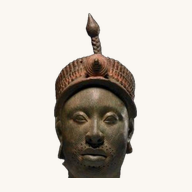
Part I — The Country and its People
Chapter 4. Government
¶1 THE entire Yoruba country has never been thoroughly organized into one complete government in a modern sense. The system that prevails is that known as the Feudal, the remoter portions have always lived more or less in a state of semi-independence, whilst loosely acknowledging an over-lord. The king of Benin was one of the first to be indeper dent of the central government, and was even better known to foreigners who frequented his ports in early times, and who knew nothing of his over-lord in the then unexplored and unknown interior.
¶2 Yoruba Proper, however, was completely organized, and the descriptions here given refer chiefly to it. With some variations most of the smaller governments were generally modelled after it, but in a much simpler form, and solely in their domestic affairs ; foreign relations so far as then obtained, before the period of the revolution were entirely in the hands of the central government at Ọ̀yọ́ (Eyeo or Katunga). It should be remembered that the coast tribes were of much less importance then than now, both in population and in intelligence ; light and civilization with the Yorubas came from the north with which they have always retained connection through the Arabs and Fulanis. The centre of life and activity, of large populations and industry was therefore in the interior, whilst the coast tribes were scanty in number, ignorant and degraded not only from their distance from the centre of light, but also through their demoralizing intercourse with Europeans, and the transactions connected with the oversea slave trade.
¶3 This state of things has been somewhat reversed since the latter half of the XI Xth century, by the suppression of the slave-trade, and the substitution therefor of legitimate trade and commerce: and more especially through the labours of the missionaries who entered the country about the same time as the springing up into being of the modern towns of Lagos, Abẹ́òkúta, and Ìbàdàn, through which western light and civilization beam into the interior.
¶4 The government of Yoruba Proper is an absolute monarchy ; the King is more dreaded than even the gods. The office is hereditary in the same family, but not necessarily from father to son: The King is usually elected by a body of noblemen known as Ọ̀yọ́ Mesi, the seven principal councillors of state.
¶5 The vassal or provincial kings and ruling princes were 1060 at the time of the greatest prosperity of the empire which then included the Popos, Dahomey, and parts of Ashanti, with portions of the Tapas and Baribas.
¶6 The word "king" as generally used in this country includes all more or less distinguished chiefs, who stand at the head of a clan, or one who is the ruler of an important district or province, especially those who can trace their descent from the founder, or from one of the great leaders or heroes who settled with him in this country. They are of different grades, corresponding somewhat to the different orders of the English peerage (dukes, marquises, earls, viscounts and barons), and their order of rank is well-known among themselves. The Oníkòyí as head of the Ekun Òsì or metropolitan province was the first of these "kings "and he it was who used to head them all to Ọ̀yọ́ once a year to pay homage to the ALÁÀFIN or King of the Yorubas.
THE ALÁÀFIN
¶8 The ALÁÀFIN is the supreme head of all the kings and princes of the Yoruba nation, as he is the direct lineal descendant and successor of the reputed founder of the nation. The succession as above said is by election from amongst the members of the royal family, of the one considered as the most worthy, age and nearness to the throne being taken into consideration. It might be mentioned also in passing that the feelings and acceptance of the denizens of the harem towards the king-elect are often privately ascertained and assured of previously.
¶9 In the earliest days, the eldest son naturally succeeded the father, and in order to be educated in all the duties of the kingship which must one day devolve upon him, he was often associated more or less with the father in performing important duties and thereby he often performedroyal functions, and thusgradually he practically reigned with his father under the title of Aremo (the heir apparent) having his own official residence near the palace; but as the age grew corrupt, the Aremo often exercised sway quite as much as or more than the King himself, especially in the course of a long reign, when age has rendered the monarch feeble. They had equal powers of life and death over the King’s subjects, and there are some cases on record of the AREMg being strongly suspected of terminating the father’s life, in order to attain full powers at once. It was therefore made a law and part of the constitution that as the AREMO reigned with his father, he must also die with him. This law had the effect at any rate of checking parricide. It continued to take effect up to the last century when (in 1858)
¶10 it was repealed by ÀTÌBÀ one of the later Kings in favour of his AREMO ADELU. The AREMO may now succeed if found worthy, but he must be elected in the usual way; but if passed over or rejected by the king-makers he must leave the city and resort to a private retirement in the provinces. This however, is not really obligatory, but as he must be superseded in his office, such a course is inevitable, unless he chooses of his own accord to die with the father.
¶11 The choice may sometimes fall upon one of the poorer princes, in the quiet pursuit of his trade, with no aspiration after the throne ; such a one is sent for, and unnecessarily ill-used for the last time to his own surprise; this was done probably for the purpose of testing his temper and spirit. He may not be aware of the intentions of the Ọ̀yọ́ MEsr until he is being admonished by them as to the duties and responsibilities of the exalted position he is soon to fill.
¶12 The nominators are three titled members of the royal family, viz., the OnA-Isokun, the ONA-AKA, and the Omo-Ola, uncles or cousins of the King, but generally entitled the "King’s fathers." These have to submit or suggest the names to the noblemen for election, but the Baṣọ̀run’s voice is paramount to accept or to reject.
¶13 Curious and elaborate ceremonies precede the actual accession to the throne. After all arrangements have been made, the ceremonies begin by a sacrifice brought from the house of the Ona-Isokun by a body of men called Omo-ninari ; these belong to a family specially concerned in carrying out all menial duties connected with the offering of sacrifices and in waiting upon the King and the priests. As soon as they enter the house where the King-elect is, he is called out, and he has to stand up with an attendant by his side. He is touched on the chest, and on the right and left shoulders with the bowl of sacrifice, the attendant in the mean time uttering some form of words. This is the signal that he has been called to the throne. On the evening of the same day, he is conducted quietly into the house of the Ona-Isokun where he spends the first night. In order to avoid the crowd, the attention of the populace is usually diverted by a procession of the Kings’ slaves and others with much noise and ado, as if escorting him, whilst the king-elect accompanied by the Aregbe’di, a titled eunuch, and a few of the Omo-ni-nari come up quietly a long way behind.
¶14 At the Ona-Isoxtn’s house, he is attended solely by the Omo-ni-nari. He is admonished and advised by those who stand to him in place of a father. Some ceremonies of purification are gone through, propitiatory sacrifices are again offered which are carried to various quarters of the city by the Omo-ni-nari.
¶15 The next night he passes at the house! of the Ọ̀tún-Iwefa (the next in rank to the chief of the eunuchs). This official being a priest of Ṣàngó, it is probable that the king-elect spends the night with him in order to be initiated into the sacerdotal part of his office, the ALÁÀFIN having as much spiritual as well as secular work to perform, being at once King and Priest to his people; and probably he learns there also the usages and doings of the huge population in the inner precincts of the palace with which the eunuchs are quite conversant. After this, he is conducted into one of the chambers in the Outer Court of the palace (Omo ile) where he resides for three months, the period of mourning, until his coronation. ;
¶16 The main gateway to the palace being closed at the demise of the King, a private opening is made for him in the outer wall through which he goes in and out of his temporary residence. During this time he remains strictly in private, learning and practising the style and deportment of a King, and the details of the important duties and functions of his office. During this period he is dressed in black, and is entitled to use a "cap of state" called "Ori-ko-gbe-ofo." (The head may not remain uncovered).
¶17 The affairs of state are at this time conducted by the Baṣọ̀run.
THE CORONATION
¶19 The coronation takes place at the end of three months, really at the third appearance of the new moon after the late King’s death. The date is generally so fixed as to have it if possible before the next great festival. It is attended with a great public demonstration. It isa gala day in which the whole city appears in holiday dress. Visitors from the provinces and representatives of neighbouring states also flock into the city in numbers.
¶20 This day is generally known as "The King’s visit to the BARA." It is the first but most important act of the ceremonies.
¶21 The Bara or royal mausoleum is a consecrated building in the outskirts of the city, under the care of a high-priestess named Iyamode; there the Kings were formally crowned, and there buried. The King enters it but once in his lifetime, and that is
¶22 at the coronation with marked pomp and ceremony. The actual crowning does not now take place in the Bara as it seems to have been, but at Koso the shrine of Ṣàngó, but the visit to the Bara is so important and indispensable a preliminary that it has become more closely identified with the coronation than that to the other shrines visited on that occasion.
¶23 Leaving the IPADI—his temporary chambers—there are two stations at which the King elect has to halt before reaching the sacred building ; the first is the Abala or area in front of the palace where a tent of beautiful cloths has been erected for him. Here he has to change his mourning dress for a princely robe. He then proceeds to the second station at the Alapini’s midway on his route where a large tent and an enclosure have been erected for his reception. Here he is awaited by a vast concourse of people and welcomed with ringing cheers. Here he receives the congratulations and homage of the princes, the nobles, the chiefs and the people and is hailed as the King. Some ceremonies are here gone through also which include distribution of kola nuts, etc., to the princes and chiefs without.
¶24 After this he proceeds to the BARA accompanied by the whole concourse of people who have to remain outside. He enters the sacred precincts attended by the Magaji Iyajin (his official elder brother) the princesses, the Ona-Onse-awo (an official), the Otunwefa (the next to the chief of the eunuchs) who is a priest and the Omo-ni-nari, a set of servants. These last are to slaughter and skin the animals to be offered in sacrifice.
¶25 At the Bara he worships at the tombs of his fathers, a horse, a cow, and a ram being offered at each tomb ; portions are sent out to each of the noblemen, princes, and chiefs waiting outside, the Baṣọ̀run receiving the first and the lion’s share or the whole. He invokes the blessings of his deceased fathers and is hereby said to receive authority to wear the crown. The visit to the BARA then is for the purpose of receiving authority or permission from his deceased ancestors to wear the crown, hence it is spoken of as the coronation. It is a fixed rule that the whole of the meat is to be totally consumed at the BARA; under no circumstance should any be taken home.
¶26 This over, the King returns hence with great pomp and show to his temporary chambers, amid the firing of feu de joie, the bleating of the Kakaki trumpet, drumming, etc.
¶27 On the fifth day after this he proceeds to Koso, the shrine of Ṣàngó, for the actual crowning. Here he is attended by the Ọ̀tún-wefa who has the charge of the shrine, the Bále (mayor) of Koso a suburban village, the Omo-ni-naris, and the Isonas.
¶28 [The Isonas are a body of men whose sole employment is to do all needle and embroidered work for royalty. They are also the umbrella-makers. The crown, staff, robes, and all ornamental beadworks, and workings in cotton, silk, or leather are executed by them].
¶29 Surrounded by the principal eunuchs and princes the great crown is placed on his head with much ceremony by the Iyakere. Who the Iyakere is, for whom is reserved this most important function will be seen below. The royal robes are put on him, the Ejigba? round his neck, the staff and the SWORD OF MERCY are placed in his hands.
¶30 On the fifth day after this, he proceeds to the shrine of Ọ̀rànyàn, here the GREAT SWORD OR SWoRD OF JUSTICE brought from ILE IFẸ̀ is placed in his hands, without which he can have no authority to order an execution.
¶31 After another interval of five days, he proceeds to the shrine of Ogun the god of war, and there offers a propitiatory sacrifice for a peaceful reign. The offerings consist of a cow, a ram, and a dog; this last being indispensable in any sacrifice to the god of war.
¶32 From the shrine of Ogun, the procession goes straight on to the palace, entering now for the first time by the main gate opened for him, the former opening through the outer wall to the temporary chambers being quickly walled up. Thus he enters the palace proper as THE KING.
¶33 But a new opening is. made for him at the Kobi Aganju through which he enters the inner precincts of the palace. This entrance is tor his exclusive use in and out of the Kobi during his reign : at his death it is closed up. At this entrance they offer in sacrifice a snail, a tortoise, an armadillo, a field mouse (emo) a large rat (okete) a toad, a tadpole, a pigeon, a fowl, a ram, a cow, a horse, a man and a woman, the last two being buried at the threshhold of the opening ; on the blood of the victims and over the grave of the two last, he has to walk to the inner court.
¶34 Human sacrifices however (now totally abolished) were not commonly practised amongst the Ọ̀yọ́s, but such immolation was always performed at the coronation and at the burial of the sovereign. By these sacrifices he is not only crowned King with
¶35 power over all, man and beast, but he is also consecrated a priest to the nation. His person, therefore, becomes sacred.
¶36 All this having been performed, it is now formally announced to the assembled public, that King "A" is dead (or rather has entered into the vault of the skies—O wo Aja) and King "B "now reigns in his stead.
¶37 During the interval of the late King’s illness, up to the time of his death, the business of state is carried on normally by the palace officers, the Òsì-’wefa personating the King, even to the extent of putting on his robes and crown, and sitting on the throne when such is required; but as soon as it is known that he is dead the Baṣọ̀run at once assumes the chief authority, and nothing can be done without him.
¶38 The King having been crowned, he is henceforth forbidden to appear in public streets by day, except on very special and extraordinary occasions; he is, however, allowed evening strolls on moonlight nights when he may walk about incognito.
¶39 This seclusion not only enhances the awe and majesty due to a sovereign, but also lends power and authority to his commands, and is the best safe-guard for public order at their present stage of civilization. Besides, it would be very inconvenient to the citizens if the King were always coming out, for according to the universal custom of the country, whenever a chief is out, all his subordinates must go out with him. It is an inviolable law and custom of the country, and is applicable to all, whatever their rank: thus, if the Baṣọ̀run is out, all the Ọ̀yọ́ Mesi must be out also. If the Bále of any town is out, all the chiefs of the town must be out also, and if the King is out, the whole city must be astir and on the move, all business suspended, until he returns into the palace.
¶40 IGBA IWA
¶41 At the commencement of every reign, the IGBA IWA or Calabashes of divination are brought from ILE IFẸ̀ to the new King to divine what sort of reign his will be.
¶42 Two covered calabashes, of similar shape and size but with quite different contents are brought, one containing money, small pieces of cloth and other articles of merchandize, denoting peace and prosperity ; the other containing miniature swords and spears, arrows, powder, bullet, razor, knives, etc., denoting wars and trouble for the country. The King is to choose one of them before seeing the contents, and according as he chooses so will be the fate of the Yoruba country during his reign.
THE AREMO
¶44 The very first official act of the new King after his coronation is to create an Aremo, and a Princess Royal or an equivalent. The Aremo is the Crown Prince. The term simply denotes an heir, but it is used as the title of the Crown Prince of Ọ̀yọ́.
¶45 The title is conferred upon the eldest son of the sovereign in a formal manner, the ceremony being termed the "christening "as of a newly born child, hence he is often termed "Omo "(child) by way of distinction The title of Princess Royal is at the same time and in the same manner conferred upon the eldest daughter of the sovereign as well ; this, however, is of much less importance than the other. When the King is too young to have a son, or his son is a minor, the title is temporarily conferred upon a younger brother, or next of kin that stands to him in place of a son, but as soon as the son is of age, he must assume his title and begin to act under the guardianship of the eunuchs who are his guardians.
¶46 The method is as follows :—Both of them must have a Sponsor, or "father "as he is called, chosen by divination from among the titled eunuchs ; this done, the Aremg repairs to the house of the Ona-Isokin to worship at the graves of the deceased Aremos, who were all buried there, and the princess to that of her deceased predecessor in her mother’s house; the King supplying them with a bullock each. The whole day is thus spent in festivities. On their return in the evening they both proceed direct to their sponsor’s house where they must reside four days, each day being marked with festivities, the king supplying two bullocks every day, and this is further supplemented by the Aremo himself. The feasts are open to the general public, whoever likes to repair to the house is a welcome guest, portions are also sent out to the princes, the noblemen, and other distinguished personages. At the end of the fourth day the Aremo, invested with the robes of his office and with a coronet, is conducted to his official residence where he takes up his permanent abode, and the princess suitably clad likewise repairs to her own home.
¶47 PUBLIC APPEARANCES OF THE KING
¶48 The King generally appears in public on the three great annual festivals of Ifá, Orun, and the Bere. In two at least of these festivals (that of the Orun and the Bere), the Baṣọ̀run is equally concerned with him.
¶49 These festivals have certain features in common, although each has its own marked characteristics. They are all preceded by the worship of Ogun (the god of war) and on the third day after, the firing of a royal salute, and the sound of the ivory trumpet announce to the public, that the King may now be seen in state, sitting on his throne, and all loyal subjects who wish to have a glimpse of his majesty now may repair to the palace.
¶50 The festival of IFÁ or MOLE takes place in the month of July, nine days after the festival of Ṣàngó. The Ifá is the god of divination. One day in the week is generally given to the consultation or the service of Ifá, but an annual festival is celebrated in its honour at Oro.
¶51 The ORUN festival takes place in September. At this festival the King and the Baṣọ̀run worship together the ORI or god of fate. The Orun from which it appears the Baṣọ̀run derives his name and title is a curious if not rather a mystical rite. The word "OOrun" signifies heaven. The title in full is Iba Osorun i.e. the lord who performs the Orun or heavenly mysteries.
¶52 The King and his Osorun are often spoken of as "Ọba aiye" and "Ọba Orun" ie., King terrestrial and King celestial. In what way His Supernal Highness performs the Orun, or what position he assumes towards the sovereign in this ceremony, is not generally known, because it is always done in private. But the rite seems to deal with affairs connected with the King’s life. It is to him a periodic reminder of his coming apotheosis, and the emblem of worship is said to be a coffin made of or paved with clay in which he is to be buried. It is kept in charge of the "Iya Ọba" (the King’s official mother) in a room in her apartments, visited by no one, and the ceremonies are performed in private once a year by the King himself, his "mother "and his Osorun, the latter taking the chief part ; consequently very little is actually known of the doings of these three august personages. But this much is allowed to be known, that the Baṣọ̀run is to divine with kola nuts, to see whether the King’s sacrifices are acceptable to the celestials or not, if the omen be favourable the ALÁÀFIN is to give the Baṣọ̀run presents of a horse and other valuables ; if unfavourable, he is to die, he has forfeited his right to further existence. But there can be no doubt that under such circumstances, it can always be managed between them that the omens be always favourable.
¶53 From this and other circumstances, it would appear that the King on this occasion occupies a humiliating position as one whose conduct is under review, hence the great privacy observed, for it is a cardinal principle with Yorubas that the ALÁÀFIN, as the representative of the founder of the race, is to humble himself before no mortal ; if such a contingency were to occur, he is to die.
¶54 Hence, no doubt, that his natural mother (if then living) is to make way for her son ascending the throne, so there will be no occasion to violate any filial duty imperative on a son who is at the same time the King. His majesty must be supreme. Even in performing reverential duties before the priests of Ṣàngó, when such are required, some privacy must be observed.
¶55 The Bere festival takes place in January, towards the end of the year, the new year commencing in March. It is the most important and the grandest of the three. It is primarily the harvest home festival, symbolized by ceremoniously setting the fields on fire to indicate that it has been cleared of the fruits of the earth.
¶56 It is an important one at Ọ̀yọ́, not only because it closes the civil year, but also because by it the King numbers the years of his reign.
¶57 The BERE itself which seems to be the symbol of so many ceremonies, is a common grass which grows only in the plain country and is used mainly for thatching houses. It is considered the most sumptuous of all other materials used for covering houses: it is the coolest, the neatest, the most durable, and lends itself best for ornamental purposes ; consequently it is highly thought of.
¶58 The festival proper is always preceded by two important ceremonies, the Pakudirin indicating the beginning, and the Jelepa the end of the ingatherings.
¶59 The Pakudirin is performed by the Ona-’wefa or chief of the eunuchs, by the Baṣọ̀run or his representative and the Ab’obaku or master of the horse.
¶60 The King in semi-state appears in the Kobi Aganju to witness the same, with several of the ladies of the palace around him, and at the entrance of the Aganju, the musicians making the occasion very lively.
¶61 The King is supposed not to have seen the new Bere grass of the year, the Ona-’wefa first steps forwards before him with a scythe made of brass or copper, performing in the air a mimic act of mowing the grass, and one of the ladies of the palace deputed for the purpose, extending her wrap as it were to receive the same, hugging it as something precious. This is done two or three times, the Baṣọ̀run then follows and goes through the same forms, and then the master of the horse. Each of these chiefs now makes a short speech congratulating the King on the advent of a new year, wishing him a long life and prosperous reign.
¶62 After this, about half-a-dozen men with small bundles of the Bere grass, neatly done up, enter the palace, with measured steps to the sound of music, and come dancing before the King in front of the Aganju. His Majesty is supposed to see the grass now for the first time that year. This ceremony is brought to a close by presents given to the men, and then all spectators disperse. From nine to seventeen days are now allowed for harvesting before the fields are set on fire.
¶63 The Jelepa is the ceremony of setting the fields on fire. This is performed by the Baṣọ̀run outside the city walls. Booths and enclosures of palm leaves having been erected for the purpose, the Baṣọ̀run with a princely train repairs thither on the day appointed. He is met there by a number of women from the palace bringing a large calabash draped with a white cloth and containing Olélé (a sort of pudding made of white beans and palm oil) and Eko (a kind of blanc-mange made of soaked corn flour), corn and beans being taken as the staples of life, the principal products of the field.
¶64 His Supernal Highness first offers a morsel of these in sacrifice as a harvest thank-offering for the Yoruba nation, after which both himself and those with him partake of the rest accompanied with palm wine or beer made from guinea corn, thanking God for the blessings of the field. This over he orders the fields to be set on fire: but if by an accident the fields have already been fired, a bundle of dry grass brought from home is used instead, for the purpose of the ceremony.
¶65 The firing of a feu de joie now serves to show that the ceremony is over and the parties are returning to the city. This is done in state. The Baṣọ̀run robes in one of the enclosures: he is attended by hundreds of horsemen and footmen, horsemen galloping backwards and forwards before him, the firing and the fifing and drumming are quite deafening. With such a right royal procession His Supernal Highness re-enters the city. On the evening of the same day, the King worships the Ogun which is a preliminary to every annual festival.
¶66 The following day is a very busy one at Ọ̀yọ́. It is a day of paying tributes of Bere grass. The whole of the Ọ̀yọ́ Mesi first send theirs to the King, the Baṣọ̀run alone would send about 200 bundles, the subordinate chiefs send to the senior chiefs, every one to his feudal lord or chief, each man according to his rank and position and so on to the lowest grades, the young men to the heads of compounds, so that it is usual to see loads of Bere passing to and fro all over the town the whole day. From the provinces also tributes of Bere come to Ọ̀yọ́ later on; e.g. from the Aseyin of Ìṣẹ́yìn, the Oluiwo of Ìwó, the Bále of Ogbomoso and other cities of the plain where the Bere grows.
¶67 This being the recognized principal festival of the ALÁÀFIN other towns in lieu of Bere send congratulatory messages with presents, or tributes ; the Ìbàdàns in their marauding days used to send slaves ; from the Ìjẹ̀ṣàs and Èkìtì countries come kola nuts, alligator pepper, firewood and other forest products. Towns nearer the coast send articles of European manufacture, and so on during this season.
¶68 The day after, being the third day of the ceremony of Jelepa and the worship of Ogun, the public festival takes place.
THE KING IN STATE
¶70 The King generally appears in state on these three festive occasions.
¶71 Facing the large quadrangle of the outer court are the six principal Kobis, that in the centre is what is known as the KoBI AGANJU or throne room where the ALÁÀFIN always appears on state occasions. It is always kept closed, and never used for any other purpose but this.
¶72 On such occasions, the floor is spread all over with mats, and the front.of the throne overspread with scarlet cloths; the posts all around are decorated with velvet cloths, and the walls with various hangings.
¶73 The throne or chair of state was made of wood at a time when the knowledge of carpentry was not common in this country ; it cannot boast of any artistic merit, but it is highly valued for its solidity, hoary age, and tradition. It is of a large size and covered over with velvet.
¶74 The crown is made of costly beads such as coral, agra, and the like, which in this poor country stand to the people instead of precious stones. It is artistically done up by experts, with fringes of small multi-coloured beads depending from the rim, which serve to veil the face.
¶75 The robes are usually silks or velvets, of European manufacture, which were of much greater value in earlier days when intercourse with the coast was not so common or easy as it now is.
¶76 The Ejigba is the "chain of office." This is made of a string of costly beads going round the neck and reaching as far down as the knees.
¶77 The Opa Ileké is the staff or sceptre artistically covered all over with small multi-coloured beads.
¶78 The Iru kere is a specially prepared cow’s tail of spotless white which the King generally holds in front of his mouth when speaking for it is considered bad form to see him open his mouth in public. He makes his speech sotto voce, and it is repeated to the assembly in a loud voice by the chief of the Eunuchs. The white tail is moreover an emblem of peace and grace.
¶79 The State Umbrellas. Umbrellas in this country are part and. parcel of state paraphernalia. In fact there was a time when private individuals dared not use an umbrella; that was in the days before cheap foreign ones were obtainable. The prohibition was first done away with at Ìbàdàn, where the war boys were allowed to enjoy themselves in any way they liked, and use any materials of clothing and ornament they could afford, as it might be for only a few days before they laid down their lives on a battlefield.
¶80 However, those of a chief are easily distinguished now by their size and quality. They are almost always of bright colouring usually of damasks. The size and number are in proportion to the rank of the chief, usually of European manufacture now, though there is a distinct family of royal umbrella makers kept at Ọ̀yọ́ who make those of the largest size. Most of the umbrellas foreign or locally made are decorated with certain emblems indicative of rank. About two dozen or more are used on these festive occasions.
¶81 Music. The Kobi, third or fourth to the Aganju is occupied by the musicians. The musical instruments consist of almost every description of fifes, trumpets and drums, of which the ivory and Kakaki trumpets and Ogidigbo drum are peculiar to the sovereign.
¶82 The King enthroned is surrounded by his favourite wives, one of whom, the Are-ori-ite, holds a small silk parasol over his head from behind as a canopy.
¶83 About 30 or 40 female Ìlàrís with costly dress and velvet caps on, are seated on the scarlet cloth on the right and on the left in front of the throne, but in the open air, under two large umbrellas, one on either side, a wide space being left between them.
¶84 Then there is a row of about ten large umbrellas each on the right and the left, both rows facing each other, leaving a wide avenue between from the throne to the main entrance gate ; under those on the right are seated the Crown Prince supported by all the princes and the principal eunuchs: under those on the left are the younger eunuchs, the Ìlàrís, the Tétus, and other palace officials. Behind these on either side are the crowds of spectators.
¶85 At a considerable distance in front of the throne, in the avenue left between the two groups, stand the Baṣọ̀run and the rest of the Ọ̀yọ́ Mesi to do homage. This is done by taking off their robes, wrapping their cloths round their waists, leaving the body bare; three times they have to run to the main entrance gate, sprinkle earth on their heads and on their naked bodies, and run back half way towards the throne, prostrating themselves on the bare ground, on the stomach and on the back!
¶86 Then follows the customary oration from the throne, the King speaking in an undertone with the iru kere in front of his mouth, and the chief of the eunuchs, who with his lieutenants the Ọ̀tún and the Òsì’wefa is standing midway between the throne and the noblemen in the avenue between the spectators, acts as his spokesman, repeating his message in a loud voice to the Baṣọ̀run and his colleagues. The Baṣọ̀run replies first, congratulating His Majesty, wishing "him long life and prosperity, the other noblemen follow in regular order, the Asipa being the last. The chief of the eunuchs in like manner repeats the congratulatory address to their lord.
¶87 That over, the sacrificial feast is now brought forward for distribution. About 40 dishes of stewed meat, 40 baskets of eko, 15 pots of beer, a bowl or two of boiled yam, a large quantity of boiled corn (maize) to these is added in later years a demijohn of rum.
¶88 The Ada-ha or king’s taster now steps forward with a rod in his right hand, anda shield on his left, accompanied by his drummer. He first dances before the King and then retreats taking with him his own portion, a basket of eko, a plate of meat, a pot of beer, one yam, a head of corn; he is to have a taste of each of these in the presence of the king, and the concourse of spectators present, after which his followers make away with the rest of his portion.
¶89 Next comes the Olosa or king’s robber, playing the clown. He is dressed in a flowing garment, creeps about on all fours, performing mimic acts of robbery for the amusement of the spectators. After a few more amusements, the curtain drops. The rest of the dishes are cleared away into the dining hall where the Asipa by virtue of his office subsequently distributes them among the noblemen and their followers according to their rank, that of the Baṣọ̀run being one half of the whole. When the curtain rises again, the King appears in a more gorgeous robe, with another crown on his head. His Majesty now steps out of the Kobi with his staff in hand, and walks towards the Ogidigbo drum, stately and majestic, and the Baṣọ̀run comes dancing to meet him ; all at once the drums, fifes, and trumpets strike up in concert, the two rows of umbrellas move forward meeting in the centre to form a shady avenue for the two august personages, the King stepping forward with measured treads to the sound of the music, and the Baṣọ̀run, dancing, and meeting him, receives from him one head of stringed cowries. This however is expected to be returned the next day, the apparent gift being merely a part of the ceremony.
¶90 This usually ends the show, but on the Bere festival the King continues his walk right on to the great entrance gate, then half round the quadrangle giving the spectators a full view of himself, then by a side door disappears into the inner precincts of the palace. The spectators thereupon disperse.
¶91 These three festivals are concluded by a few male Ìlàrís carrying sacrifices to certain quarters in the outskirts of the city in a state of perfect nudity, which is rather a trying time for them ; there is always a rush of the women clearing out of their way, on the approach of them; the performance being symbolic of some religious rite. If it is violated by any show of natural excitement, it must be atoned for, and there is but one penalty, viz., decapitation! But there is no record of any such case occurring within living memory. Their reward for this trying ordeal is, that after their return, being properly dressed, they are admitted into the King’s presence, who, sitting in state, receives them with marks of honour.
¶92 This ends the ceremonies of the festivals.
¶93 But at the Bere season, one more ceremony remains, that known as the ceremony of "Touching the grass." About 5.30 p.m. on a day appointed, the King issuing from the palace is accompanied by his slaves who have been engaged in piling into two or three heaps the bundles of bere grass scattered about in the area in front of the palace, including those brought from the provinces. The piles are done up in an artistic manner, 8 or 10ft. high in an open space away from any risk of fire. His Majesty now steps forward, and lays both hands upon each of the heaps, making a short speech, invoking blessings on the Yoruba nation, congratulating himself for being spared to see another year. This brings the Bere festival to a close.
¶94 THE FUNERAL OF THE KING
¶95 Although the funeral of the King cannot properly he said to be one of his public appearances, yet it is considered more convenient to describe it in this place along with other public ceremonies of which he is the centre.
¶96 The Kings are buried in the Bara. The funeral usually takes place at night. It is notified to the public by the sounding of the Okinkin (a musical instrument like the bugle), the ivory trumpet, and the Koso drum, a drum which is usually beaten every morning at 4.a.m. asa signal for him to rise from his bed ; to beat it at night therefore, is to indicate that he is retiring to his final resting place.
¶97 The body is removed to the Bara on the back of those whose office it is to bury the Kings the chief of whom is a titled personage known as the Ona-onse-awo, and his lieutenants. At certain stations on the route between the palace and the Bara, eleven in all, they halt and immolate a man and a ram, and also at the Bara itself, four women each at the head and at the feet, two boys on the right and on the left, were usually buried in the same grave with the dead monarch to be his attendants in the other world, and last of all the lamp-bearer in whose presence all the ceremonies are performed.
¶98 All these practices, however, have long been abolished, a horse and a bullock being used instead of human beings.
¶99 The King is buried in black and white dress; but the crown on his head, the gorgeous robe with which he was laid out in state, and with which his corpse was decked to the Bara, and the bracelets on his wrists and ankles are never buried with him, these become the perquisites of the Ona-onse-awo and his lieutenants.
¶100 The Bara in which the Kings are buried is. distinguished by its aloof situation from public thoroughfares in the outskirts of the city, and having to it as many kobis as there are Kings lying there, one being erected over each. The present Bard enshrines the bones of King OLUEWU the last of ancient Ọ̀yọ́ with those of the late Kings of the present city. It is not open to the public ; several of the late King’s wives are secluded here (as in a convent) and charged with the sole duty of taking care of the graves of their departed husbands.
¶101 Their mother superintendent is the Iyamode generally styled "Baba" (father). She is thus styled because being entirely devoted to the worship of Ṣàngó, one of the earliest deified Kings, she is often "inspired" or "possessed "by the god, and thus came to be regarded as the embodiment of that famous King.
¶102 Additions are made to their number at every fresh burial, usually from among the favourites of the deceased husband. These women must all be celibates for life, unfortunately among the number are usually found some who are virgins and must remain so for life: any misbehaviour is punished with the death of both culprits, the man on the day the crime is detected, and the woman after her confinement.
¶103 Besides those who are immolated at the death of the sovereign there used to be some "honourable suicides "consisting of certain members of the royal family, and some of the King’s wives, and others whose title implies that they are to die with the King whenever that event occurs. With the title they received as a badge a cloth known as the "death cloth," a beautiful silk damask wrapper, which they usually arrayed themselves with on special occasions during the King’s lifetime. Although the significance of this was well-understood both by themselves and by their relatives, yet it is Surprising to see how eager some of them used to be to obtain the office with the title and the cloth. They enjoyed grcat privileges during the King’s lifetime. They can commit any crime with impunity. Criminals condemned to death and escaping to their houses become free. These are never immolated, they are to die honourably and voluntarily.
¶104 Of the members of the royal family and others to die were :—
¶105 1. The Aremo or Crown Prince who practically reigned with his father, enjoyed royal honours, and had equal power of life and death.
¶106 2. Three princes with hereditary titles viz., the Magaji Iyajin, the Agunpopo, and the Olusami.
¶107 3. Two titled personages not of royal blood viz., the Òsì’ wefa and the Olokun-esin (master of the horse) who is generally styled "Ab’obaku," i.e. one who is to die with the King.
¶108 4. The female victims were :—
¶109 Iya Ọba, the king’s official mother ; Iya Naso, Iyalagbon (the Crown Prince’s mother) ; Iyale Molé (the Ifá priestess), the Olorun-ku-mefun, the Iyamonari, the Iya’-le-ori (these are all priestesses) and the Are-ori-ite the chief favourite.
¶110 It will be observed that all the above-mentioned are those who by virtue of their office are nearest to the King at all times, and have the easiest access to his person ; to make their life dependent on his, therefore, is to ensure safety for him against the risk of poisoning, or the dagger of the assassin.
¶111 The custom is that each should go and die in his (or her) own home, and among his family. The spectacle is very affecting. Dressed in their "death cloth," they issue from the palace to their homes surrounded by their triends, and their drummers beating funeral dirges, eager crowds of friends and acquaintances flocking around them, pressing near to have a last look at them or to say the final farewell as they march homewards. The house is full of visitors, mourners and others, some in profuse tears ; mournful wailings and funeral odes are heard on all sides enough to break the stoutest heart. While the grave is digging, the coffin making, a parting feast is made for all the friends and acquaintances ; and as they must die before sunset, they enjoy themselves as best they can for that day by partaking of the choicest and favourite dishes, appearing several times in changes of apparel, distributing presents with a lavish hand around, and making their last will disposing of their effects. When everything is ready, the grave and the coffin approved of, they then take poison, and pass off quietly. But if it fails or is too slow to take effect, and the sun is about to set, the last office is performed by the nearest relatives (by strangling or otherwise) to save themselves and the memory of their kin from indelible disgrace. The body is then decently buried by the relatives and the funeral obsequies performed.
¶112 In many cases voluntary suicides take place. Some of the King’s favourite slaves who are not required to die often commit suicide in order to attend their master in the other world expecting to enjoy equally the emoluments of royalty in the other world as in this.
¶113 But these customs are now dying out with the age especially since King ÀTÌBÀ in 1858 abolished that of the Crown Prince dying ; the loss of-experienced princes like the Iyajin around the throne is also felt irreparable. With the exception of the women, all the men now refuse to die and they are never forced to do so, but are superseded in their office if the next King wills it; they must then retire quietly from the city to reside in any town in the country in order to prevent the confusion of two individuals bearing the same title. As for the Crown Prince, he expects to succeed his father on the throne but if he is rejected by the king-makers, he also has to retire from the city.
¶114 COURTIERS AND HOUSEHOLD OFFICERS OF THE CROWN
¶115 The palace officials consist of :—
¶116 I. Titled officers. II. The Eunuchs. III. The Ìlàrís.
¶117 Some reside in the palace, others attend at regular hours every day for duty.
¶118 I. The principal officers having duties in the palace are :—
¶119 I. The Ona-Olokun-esin or Ab’Ọba-ku i.e. the master of the horse, i.e. one who is to die with the King. This officer resides in his own house but repairs to the palace daily on duty. He has free access equally with the Eunuchs to all the apartments. The title is hereditary. As his name implies he is to die with the King to be his attendant in the other world, and consequently he is granted unrestricted liberty to live as he likes, and to do whatever he likes, and, like all other officials who must die with the King, his house is a sanctuary of safety and reprieve for all criminals condemned to death, if they can escape thither.
¶120 2. The Ona-ile-mole is the Ifá priest or chief diviner, a kind of domestic chaplain. He has for his assistants the Are-awo and others. They are to consult the Ifá oracle for the King every fifth day called Ojo-Awo i.e. the day of the mysteries.
¶121 3. The Ona-Otise Awo. The daily duties of this officer are not so well-defined, but he has to attend daily at the palace. He has his‘lieutenants to the sixth grade. But their chief duty is to carry the remains of the deceased monarch from the palace to the Bara for interment.
¶122 4. The Ona-modeké. This is the civil counterpart of the military title of Sẹ́rìkí. This officer is the head, or leader of all the youths in the city and country, capable of bearing arms, whoever may be their father or master. He forms a band of them all, and is supposed to train them in manly sports and civic duties. It is his prerogative to shield members of his band from the penalties of the law whenever they have become liable to such, by any rash act.
¶123 5. The Isugbins. These are members of the palace orchestra. They number about 210 persons, playing on. fifes, the Okinkin and the Ivory trumpets, and the special drums Koso and Gbedu, etc.
¶124 (a) The Alukoso or Koso drummer’s chief duty is to wake up the King every morning at 4 a.m. with his drum.
¶125 (b) The Aludundun or the Dundun drummer. He has to attend at the palace every day within certain hours, including the visiting or business hours. He has one of the front Kobis assigned to him, where he sits discoursing events with his drum, all during his office hours. With it, he pre-announces the presence of any visitor in the palace, so that in whatever part of the palace the King may be, he can tell by the sound of the drum who has entered the court yard before the personage is actually announced. This is one of the peculiarities of the Yoruba language, and the art of the drummers. The names, praises and attributes of every family of note are known to all drummers, and musicians, and they are experts in eulogizing and enlarging on the praises of any one they wish to honour, speaking it with their drums. If for instance a white man enters the palace, the drummer would strike up: "Oyinbo, Oyinbo, afi okun se ona" (the white man, the white man who makes of the ocean a high way). In strains like this he would continue for a while enlarging upon his praises.
¶126 6. The Arokins. These are the rhapsodists or national historians, an hereditary title ; they have an apartment to themselves where they repeat daily in songs the genealogy of the Kings, the principal events of their lives and other notable events in the history of the Yoruba country.
¶127 7. The Ile male is the palace surveyor. He has charge of all the buildings within that vast compound, especially of the Kobis. He is to see that every part is kept in good repair. He is also to attend to the drains and the grounds, especially after a heavy fall of rain. He is said to be the principal officer who is to wash the corpse of the King and dress it before it is placedin the coffin.
¶128 8. The Téius. These are the sheriffs or King’s executioners. They are about rg in number, each one of them with his subordinates has specified duties to perform e.g., it is the duty of the 15th with his subordinates to clear the grounds and dishes after the King has entertained the Ọ̀yọ́ Mest. They number about 150 in all...
¶129 II. The Eunuchs. The Eunuchs are called Iwefa or Iba-afin (contracted to Baafin) i.e. lordlings of the palace. The principal are :—The Ona’efa or chief of the Eunuchs, the Ọ̀tún’efa and the Òsì’efa his principal lieutenants, and others to the sixth grade. Besides these are the untitled ones, and boys.
¶130 The Ona’efa is a high legal personage; he hears and decides suits and appeals brought to the King whenever His Majesty cannot sit in person, and his decision is as good as the King’s whose legal adviser he is. We have seen above the principal part he plays in public festivals and state ceremonies.
¶131 The OOtun’efa has the charge of the suburban town of Koso, built in honour of the national god Ṣàngó. It is his duty to worship at the shrine at stated periods on behalf of the Yoruba people. He sometimes helps to decide cases. He is also one of the chief guardians of the King’s children.
¶132 The Òsì’ éfa or Olosi although the least of the three yet is the most honoured. He represents the King on all occasions and in all matters civil as well as military. He sometimes acts as commander-in-chief in military expeditions, he is allowed to use the crown, the state umbrellas, and the Kakaki trumpet, and to have royal honours paid to him. On such occasions he is privileged also to dispense the King’s prerogatives. His ordinary duties are: to be near the King’s person at all times, having free access to every part of the palace including the harem; to see that the King’s bed is properly made, before he retires every night; to visit him at midnight and at cock-crow to see if he has had a restful night, and to call him up at 4 a.m. before the Koso drum begins to sound. He is to head those of the King’s wives who are to dance at the Akesan market once a year, after the deity presiding over markets has been propitiated. With Eni-oja one of the titled ladies of the palace, he has charge of the King’s market and enjoys in part the emoluments accruing therefrom.
¶133 Why these exceptional honours are bestowed upon the third in rank among the Eunuchs, will be told hereafter in the history of one of the early kings.
¶134 The Eunuchs are a grade higher than the Ìlàrís and must be respected by them ; however young a Eunuch may be, he must be addressed as "Baba" (father) by any Ìlàrí even the oldest.
¶135 The custom of castrating a man is said to have originated from the punishment inflicted for the crime of incest or ot beastiality.
¶136 The Eunuchs are distinguished by the manner they wear their gowns gathered on the shoulders, leaving their arms bare. They are now generally chosen from boys bought with money, and employed first as pages to the King, or attendants on one of his wives. The custom of choosing boys was introduced by one of the later Kings; his reason for it was, that before the age of puberty, boys will hardly be cognizant of their loss, and he would thus spare himself the remorse of conscience which would follow the mutilation of an adult, and also save his victim from a life-long mortification.
¶137 Emasculation of an adult is now only resorted to instead of capital punishment in cases of adultery with the wife of a king ; but in order that the system may not be abused, provincial kings are not allowed to resort to this mode of punishment, nor even to keep Eunuchs ; any one really guilty must be sent to the capital where a special surgeon is kept for the purpose who is skilful in the art.
¶138 The Eunuchs are the guardians of the King’s children, the princes and princesses as a rule are born in the house of one of the principal Eunuchs for as soon as any of the King’s wives becomes a mother, she is separated from the other women, and placed under the guardianship of one of them, and she is not to return to the palace until the child is weaned.
¶139 The titled ones among them are masters of large compounds, and they also keep their own harems as well ; their wives are called "Awewo," i.e. one with hands tied ; because they are doomed to be for ever childless. In cases of adultery disclosed by pregnancy both the defaulters in early days were to suffer capital punishment ; the man on the day the crime was proved against him, and the woman with the issue on the day she is delivered. These extreme measures, however, have been allowed to die out, in favour of fines or other less severe punishments.
¶140 The Eunuchs have the exclusive right of seizing anything in the market with impunity. They have also the unenviable privilege of mingling with the King’s wives either in the harem or whenever they appear in public on any festive occasion.
¶141 Ill The Ìlàrís. The term Ìlàrí denotes parting of the head, from the peculiar way the hair of the head is done. They are of both sexes, they number some hundreds, even as many as the King desires to create.
¶142 The individual to be created an Ìlàrí is first shaved completely, then small incisions, are made on the occiput (if a male) and on the left arm, into both of which a specially prepared ingredient is rubbed, supposed to be a charm capable of giving effect te whatever the name given to the individual at the same time signifies. Their names generally signify some attributes of the King, or are significant of his purpose, intention or will, or else the preservation of his life, e.g. Ọba l’olu, the King is supreme; Ọba-ko-se-tan, the King is not ready ; S’aiye ro, the upholder of the world (i.e. the kingdom) ; Ọba gb’ori, the King the overcomer ; Madarikan, do not oppose him. The following are the names of some of the principal Ìlàrís, all of which will be seen to be significant.
¶143 1 Kafiaiye f’ Ọba 30 Ote d’afo
¶144 2 Madarikan 31 Aiye-gbemi 3 Ikudefun 32 Magb’orimipete 4 Ilugbenka 33 Kutiya
¶145 5 Obajuwonlo 34 Kape laiye 6 Opayakata 35 Agbasa
¶146 7 S’aiyero 36 Ilugbohun 8 Mob’oludigbaro 37 Ọba gb’aiye 9 Obagbenle 38 Agbelegbiji 10 Obagbori 39 Ọba diji
¶147 11 Ayunbo 40 Kosiku
¶148 12 Ote o lowo 41 Olu orin-kan 13 Kotito 42 Kosija
¶149 14 Obakosetan 43 Enu f’oba 15 Orisa fetu 44 Ọba l’agba 16 Ọba d’origi 45 Mako’hun 17 Sunmo-Ọba 46 Osan
¶150 18 Olukobinu 47 Ọba gbede 19 Kafilegboin 48 Ọba femi 20 Obadirere 49 Ọba gba-iyo 21 Makobalape 50 Ikufo.
¶151 22 Mab'obadu u 51 Orikunkun 23 Temileké 52 Mako’hun 24 Ọba-ni yio jilo 53 Olufowoti 25 Ori-ehin 54 Img kojo 26 Ọba-tun-wa-se 55 llusinmi
¶152 27 Agbala 56 Ododun
¶153 28 Agbard 57 Eni-iran
¶154 29 Kutenlo 58 Agbe defun
¶155 59 Ọba-li-a-isin 64 Madawo t’oba-lori 60 Emi-mo l'Ọba-mi 65 Ma-ni-Ọba lara 61 Igba-abere 66 Maro-Ọba-lohun 62 Ọba l’olu 67 Oridagogo
¶156 63 Akegbe 68 Apeka
¶157 Every male Ìlàrí has a female counterpart who is called his companion. The Ìlàrís themselves by courtesy call them their "mother." They are both created at one and the same time and they are supposed to seek each other’s interest, although there must be no intimacy between them; the female Ìlàrís being denizens of the King’s harem ; the only attention they are allowed to pay each other is to make exchange of presents at the yearly festivals. ;
¶158 Each Ìlàrí has a representative image made of clay called "Sugudu," having incisions on its head and arm similar to his own, with the same ingredient rubbed into them.
¶159 The I[laris are to keep the head shaved, one half being done from the middle line downwards alternately every fifth day except the circular patch on the occiput where the incisions were made ; there the hair is left to grow as long as possible being always plaited and sometimes dyed black with indigo.
¶160 The male Ìlàrís are the King’s body guard or "The keepers of his head." They are of different grades including high-placed servants, messengers, and menials. Some of the favoured ones are made masters of large compounds, the King supplying them with horses and grooms, and assigning to them certain gates where they collect tolls, the proceeds being divided between their master and themselves for their maintenance ; they are also feudal lords of some masters of large compounds in different parts of the city who serve them in various capacities in war or in time of peace. ;
¶161 All the inmates of their houses are for the most part the King’s slaves, and every newly made Ìlàrí is handed over to the charge of one or other of these highly-placed ones.
¶162 These favoured ones ride upon the tallest horses whenever the King goes out in public, forming his body guards; others are servants to these ; but their chief work one and all is that of house repair year by year.
¶163 On any festive occasion when the King appears in state, as many of the male Ìlàrís as are required to be present must each one take his "sugudu" with him to his seat. They are on such occasions to be without a headgear or breeches with only a cloth over the body, passed under the right arm, and knotted on the left shoulder, the arms being left bare.
¶164 It is the especial privilege of the Ìlàrís, male or female, to carry nothing on the head save their hats or caps.
LADIES OF THE PALACE
¶166 The ladies of the palace consist of eight titled ladies of the highest rank, eight priestesses, other ladies of rank, besides Ìlàrís and the Ayabas or King’s wives.
¶167 The whole of them are often spoken of loosely as "the King’s wives," because they reside in the palace, but strictly speaking the titled ladies and the priestesses at least should not be included in the category. Again, all the ladies of rank are often spoken of as Ìlàrís, but there is a marked difference between them.
¶168 The following are the ladies of the highest rank in their due order :—
¶169 1 Iya Ọba 5 Iya-fin-Iku
¶170 2 Iya kere 6 Iyalagbon
¶171 3 Iya-Naso 7 Orun-kumefun 4 Iya-monari 8 Are-orite
¶172 1. The Iya Ọba is the King's (official) mother. For reasons stated above (vide p. 48) the King is not to have a natural mother. If his mother happens to be living when he is called to the throne, she is asked to "go to sleep," and is decently buried in the house of a relative in the city. All the inmates of that house are accorded special privileges and enjoy marked deference as "members of the household of the King’s mother."
¶173 The King sends to worship at her grave once a year. One of the ladies of the palace is then created Iya-Ọba, and she is supposed to act the part of a mother to him. It is her privilege to be the third person in the room where the King and the Baṣọ̀run worship the Orun in the month of September every year.
¶174 She is the feudal head of the Baṣọ̀run.
¶175 2 The lya kere. Next to the King’s mother, the Iya kere holds the highest rank. Greater deference is paid to the Iya Ọba indeed, but the Iya kere wields the greatest power in the palace. She has the charge of the King’s treasures. The royal insignia are in her keeping, and all the paraphernalia used on state occasions, she has the power of withholding them, and thus preventing the holding of any state reception to mark her displeasure with the King when she is offended. We have seen above that she is the person entitled to place the crown on the King’s head at the coronation.
¶176 She is the "mother "of all the Ìlàrís male and female, for it is in her apartment they are usually created ; she keeps in her custody all the "sugudus" bearing the marks of each Ìlàrí in order to ensure the safety of the King’s life.
¶177 Great and honourable as is the Olosi, she exercises full power over even him, and can have him arrested and put in irons if he offends. She is the feudal head of the Aseyin, Oluiwo, and the Bále of Ogbomosg. With the assumption of this office, she is, of course, to be a celibate for life.
¶178 3. The Iya-Naso has to do with the worship of Ṣàngó generally and is responsible for everything connected with it.
¶179 The King’s private chapel for Ṣàngó worship is in her apartment, and all the emoluments and perquisites arising therefrom are hers. She has also to do with the same at Koso.
¶180 4. The Iya-monari is the first lieutenant and assistant to the Iya-Naso. It is her office to execute by strangling any Ṣàngó worshipper condemned to capital punishment, as they are not to die by the sword, and hence cannot be executed by the Tétus.
¶181 5. The Iya-fin-Iku is the second lieutenant and assistant to the Iya-Naso. She is the King’s "Adosu Ṣàngó," i.e. the King’s devotee to the Ṣàngó mysteries. As all Ṣàngó worshippers are to devote one of their children to the worship of the god, she stands in place of that to the King. She has the charge of the sacred ram which is allowed to go everywhere and about the market unmolested, and may eat with impunity anything from the sellers.
¶182 6. The Iyalagbon.—The mother of the Crown Prince is always promoted to the rank of Iyalagbon. In case she is not living whoever is promoted to that office acts like a mother to him. She enjoys great influence, and controls a portion of the city.
¶183 7. The Orun-kumefun is also connected with the Aremo.
¶184 8. The Are-orité. This official is the King’s personal attendant. She is to see that his meals are properly prepared, and his bed properly made, and also to see him comfortably in bed before retiring to her own apartment. She is to hold the silken parasol over his head as a canopy when enthroned, and is constantly by his side to perform small services for him on state and other occasions.
¶185 These eight ladies holding responsible positions are each of them the head of a small compound within the palace walls.
THE PRIESTESSES
- Iya’le Ori
- Iyale Molé
- Iya Orisanla
- Iya Yemaja
- Iya Olosun
- Iyafin Osun
- Iyafin Eri
- Iyafin-Orunfumi
¶188 (1) Iya’le Ori is the priestess of the god Ori or god of fate. In her apartment is the King’s Ori and she is the one to propitiate it for him.
¶189 (2) Iya’le-mole has in her keeping the King’s Jfa god, and when the Ifá priests come every fifth day to worship and to consult it, she takes an active part in the ceremonies. She is the head of all the Babalawos (Ifá priests) in the city.
¶190 (3)—(8) as their names denote, are priestesses of the gods indicated by the title.
OTHER LADIES OF HIGH RANK
- The Iyamode
- The Iya’le Odùduwà
- The Ode
- The Obagunte
- The Eni-Oja
- The Iya’le-Agbo
- The Iya-Ọ̀tún
¶193 (1) The Iyamode.—This high official resides in one of the outhouses of the palace, but her duties are not specially in the palace. She is the superior of those celibates living in the Bard and is styled by them "Baba" i.e. father.
¶194 Her office is to worship the spirits of the departed Kings, calling out their Egiguns in a room in her apartments set aside for that purpose, being screened off from view with a white cloth.
¶195 The King looks upon her as his father, and addresses her as such, being the worshipper of the spirits of his ancestors. He kneels in saluting her, and she also returns the salutation kneeling, never reclining on her elbow as is the custom of the women in saluting their superiors. The King kneels for no one else but her, and prostrates before the god Ṣàngó, and before those possessed with the deity, calling them "father." These are among those set apart for life-long service at the Bard. When any one of them is thus "possessed "by the spirit of deceased monarchs (it is said of them "Ọba wa si ara won") and comes raving from the Bara to the palace, she is immediately placed under the charge of the Iyamode; the possessed on such occasions prognosticates, and tells the people what sacrifice they are to offer to avert impending evils. The ceremony on such occasions is to pour some water into a mortar, covering it with a wide calabash, and this the other women in the palace beat vigorously as a drum; the possessed and others infected with the excitement dancing to the sound of this drumming.
¶196 The Akunyungbas (the King’s bards) are instructed in her apartments, their teacher comes there three times daily for three months or more until the learners are perfect in their studies. Small corporal punishments, twitchings, of the ears, and cracks on the head are not spared on these occasions, if they are not quick at catching the words or if their memory fails them.
¶197 With the assumption of this office, the Iyamode is, of course, to be a celibate for life.
¶198 (2) The Iya’le-Odùduwà is the priestess of Odùduwà the supposed founder of the Yoruba nation. A special temple is built in the palace for him where his image is enshrined and worshipped. She is the head of all Odùduwà worshippers in the city. She resides in one of the out houses, and does not rank with the eight priestesses mentioned above. ;
¶199 (3) The Ode is the head of all the worshippers of the god Osési. On state occasions she appears dressed as a hunter (hence her name) wearing on her shoulder a bow ornamented with strings of cowries neatly strung.
¶200 (4) The Obagunté is not regarded as having a very high position, although she represents the King in the Ogboni house on ordinary occasions, her work being strictly connected with that fraternity. She enters the Ogboni chamber on all occasions and acts in the King’s name, reporting to his majesty the events of each day’s sitting. Whenever the King wishes to entertain the Ogbonis, she has to undertake that duty.
¶201 (5) The Eni-oja is at the head of all the devil-worshippers in the town. She also has charge of the King’s market, and enjoys all the perquisites accruing therefrom. She wears a gown like a man, on her arms the King leans on the day he goes to worship at the market, i.e. to propitiate the deity that presides over markets. She has under her (1) the Olosi who has joint responsibility with her for the market, and (z) the Aroja or market keeper, an officer whose duty it is to keep order, and arrange the management of the market, and who actually resides there.
¶202 (6) Phe Iya’le-agbo is a private attendant on the King, having charge of his private pharmacy. His agunmu (powders) and agbo (infusions) are all in her care : she is to see that they are in a condition fit for use when required.
¶203 All these ladies, except the Obagunie and Iya’le mole although generally styled "Ìlàrís "are not really so, and that is known from the manner their hair is done up. They are really above the Tlaris.
¶204 The Iya-Ọba, and Iya mode are always shaven, the others plait their hair in small strips from the forehead to the top of the head and gather the rest from the back to the top, tying all into one knot with a string. This style is termed the Ikokoro.
¶205 The Ode, Eni-oja, Iyafin-Iku, Iya-Olosun and the Iya’le Odùduwà adorn theirs with the red feathers of the parrot’s tail.
¶206 The Ìlàrís.—The female Ìlàrís are somewhat differently shaved from the male, their incisions being made from the front to the back of the head along the middle line; the hair is allowed to grow along the same line, and it is plaited into two horns front and back, being twined with a string or thread, and the sides of the head shaved alternately every fifth day.
¶207 The following are the names of the principal female Ìlàrís, every one of which is significant :-—
- Obaloyin
- Maje-Ọba-koye
- Didun-l’Obafe
- Ire-l’Ọba-ise
- Igba-ewe
- Ire k’aiye
- Ori-ogbo
- Arosin
- Ajinde
- Oju’re
- Alosin
- Akosin
- Omi-su-yarin
- Bamwowod
- Afeka
- Awoda
- Irebe
- Agbejo
- Awùjalẹ̀
- Ori’re
- Oju’re
- Awigba
- Alogbo
- Oridijo
- Tijotayo
- Aiye f’obase
- Aji gbohun
- Iwadero
- Omuyé
- Ajigbore
- Obadaré
- Alanu
- Aronu
- Apa-o-ka
- Ina-Ọba-koku
- Agbala
- Ota-ko-ri-aye
- Ma-dun-mi-de-inu
- Oledetu
- Madajo-l’Ọba
- Ajijofe
- Olu-f’oba
- Iwapéle
- Ohungbogbo
- Aiyedeéro
- Ehin-wa
- Maha-ro-t’oba
- Onjuwon
¶209 These female Ìlàrís have the exclusive privilege of using the female head ties, or men’s caps, the ordinary Ayabas or King’s wives are distinguished by carrying their heads bare, always shaved, and their head ties used as a belt round the breasts.
¶210 At the demise of the King the whole of the Ìlàrís male and female go into mourning by dropping their official (Ìlàrí) names, and letting their hair grow. At a new accession, the whole of them shave their heads. One of the earliest acts of the new sovereign after the coronation and the investiture of the Aremo (Crown Prince) and just before the next great festival is to create all the Ìlàrís afresh by batches every 5 days, giving a new name to each and adding a new set of his own; only the lances of the head are re-done, not those of the arm. Each batch is to remain seven days at the Ile Molé. This "distribution of honours" is eagerly sought after.
MEMBERS OF THE ROYAL FAMILY OCCUPYING RESPONSIBLE POSITIONS
¶212 As a rule, distinguished members of the Royal Family except those holding responsible positions do not reside in the metropolis, a great number of them may be found scattered all over the provinces especially in the Ekun Òsì or Metropolitan province, where each one resides as a lord of the town or village. They may take no part in the administration of affairs in the town, lest they overshadow the chief of the town who is generally the founder or his descendant, but due deference is loyally accorded.them, and certain privileges are granted them as befitting their rank. One such was Àtìbà the son of King ABIODUN who resided in the town of Ago with Oja the founder, after whose death Àtìbà became practically the master of the town before he was subsequently elected King.
¶213 Some of the princes with a large family and a large following build their own town and become lord of the town. Such was Ayeijin who built the town ot Suru near the ancient Ọ̀yọ́ popularly known as Ile Gbageré from the attributive of the founder.
¶214 There are those however, who hold high positions in the government such as the following :—
¶215 1. THE ONA Isokun. 2. THE ONA AKA. 3. THE OMO-OLA.
¶216 These are known as the tathers of the King, hence the saying :—
¶217 "Ona-Isokun baba Ọba, Ona-Aka, baba Isokun." i.e.
¶218 The Ona-Isokun the King’s father, the Ona-Aka, father to the Isokun. That is to say that they stand in the relation of a father to the King, who naturally cannot have a father living. _To them it appertains to advise, admonish, or instruct the King, especially when he comes to the throne at a very early age, and as such lacks the experience indispensable for the due performance of his all important duty. The titles are hereditary.
¶219 We have seen above that the nomination to the throne is in their hands. The Ona Isokun seems to be the most responsible of the three. We have seen that the King-elect is to sleep in his house the first night after his election, as the formal call to the throne comes from him. Lustrations, divinations, and propitiations for the new King are done in his house. Part also of the ceremony of creating the Aremg is pertormed in his house; there all the princes are entertained in festivities, and there also all crown princes are buried if they die in that position.
¶220 Next to the above are those who are termed "brothers "to the King, they are :—
- The Magaji Iyajin
- The Olusami
- The Arole Ọba
- The Atingisi
- The Agunpopo
- The Arole Iya Ọba
¶222 Officially, the Aremog takes his rank among these princes, especially in public assemblies and is generally reckoned as the last of them in official order.
¶223 As the king must have official "father’ and "mother "so also "must he have official "brothers." Of these the Magaji Iyajin is the most distinguished. He is known as the King’s elder brother, whose duty is to perform the part of an elder to a younger brother by defending his interests.
¶224 The term "Magaji" is the natural title of every heir to a great estate and is usually borne by the eldest son (or anyone in that relation) in the family. In this official royal circle the Iyajin is the eldestson. The term "Iyajin" implies the repelling of insults and indignities. The title therefore means the elder brother, who wards off insults and indignities.
¶225 This will often be found necessary when the King is young and inexperienced, and too conscious of his power, or sometimes rash. It is the Magaji’s place to let the consequences of his action fall on himself rather than on the King who is the embodiment of the nation.
¶226 THE AROLE Ọba is the official in whose house all the princes are to be buried, and in the month of July every year the whole of the princes and princesses, from the Ona-Isokun downwards including the Aremo repair to his house to worship the spirits of their deceased ancestors. A horse is usually offered in sacrifice, and all have to feed on the flesh of the same. The Iyajiu’s portion is the head.
¶227 The Aremo as we have seen above is the Crown Prince. The term signifies an heir apparent, lit. Chief of the sons. How the title is formally conferred has been seen above.
¶228 The Aremg practically reigns with his father, having nearly equal power, especially when the monarch is old and feeble.
¶229 From the period of the greatest prosperity of the nation to the time of the intertribal wars, the Aremos were almost invariably tyrannical, and given to excess: they contributed largely to the disloyal explosion that caused the civil wars and the breaking up of the unity of the Yoruba kingdom ; they were,therefore, required to die with the father at his demise. Otherwise they expect to succeed to the throne as in earliest times, but they had to be elected thereto by the constitutional king-makers who would never elect one who has been infamous.
¶230 Since King Àtìbà in 1858 disallowed the practice in favour of his Aremg Adelu, thé custom has died out both for the Aremo and the other princes.
THE NOBILITY
¶232 There are two classes of noblemen at Ọ̀yọ́; in the first, the title is hereditary; the second which is strictly military is the reward of merit alone, and not necessarily hereditary. In both, each member is styled "Iba" which means a lord being a dimunitive of "Ọba" a king.
¶233 A. THE Ọ̀yọ́ Mesi
¶234 The first class of noblemen consists of the most noble and most honourable councillors of state, termed the Ọ̀yọ́ Mesi. They are also the king-makers. They are seven in number and of the following order :—
¶235 (1) The Osorun, (2) Agbakin, (3) Samu, (4) Alapini, (5) Laguna, (6) Akiniku, (7) Asipa.
¶236 The title of each (as above said) is hereditary in the same family but not necessarily from father to son; it is within the King’s prerogative to select which member of the family is to succeed to the title or he may alter the succession altogether.
¶237 They represent the voice of the nation ; on them devolves the chief duty of protecting the interests of the kingdom. The King must take counsel with them whenever any important matter affecting the state occurs. Each of them has his state duty to perform, and a special deputy at court every morning and afternoon and whom they send to the ALÁÀFIN at other times when their absence is unavoidable; they are, however, required to attend court in person the first day of the (Yoruba) week, for the Jakuta (Ṣàngó) worship and to partake of the sacrificial feast.
¶238 (1) The Osorun or Iba Osorun (contr. to Baṣọ̀run i.e., the lord that performs the "Orun") may be regarded as the Prime Minister and Chancellor of the kingdom and something more. He is not only the president of the council but his power and influence are immeasurably greater than those of the others put together. His is the chief voice in the election of a King, and although the King as supreme is vested with absolute power, yet that power must be exercised within the limit of the unwritten constitution, but if he is ultra-tyrannical and withal unconstitutional and unacceptable to the nation it is the Baṣọ̀run’s prerogative as the mouth-piece of the people to move his rejection as a King in which case His Majesty has no alternative but to take poison and die.
¶239 His Highness being a prince is practically as absolute as a King in his own quarter of the town.
¶240 Next to the ALÁÀFIN in authority and power, he often performs the duties of a King. He takes precedence of all provincial kings and princes. There were times in the history of the nation when the Baṣọ̀runs were more powerful than the ALÁÀFIN himself.
¶241 During the long course of history there have been several alliances between the two tamilies so that, in the older line of Baṣọ̀runs at any rate, the blood of the royal family runs also in their veins.
¶242 Several points of similarity may be noted between the ALÁÀFIN and his Baṣọ̀run The ALÁÀFIN is Ọba (a king) he is Iba (a lord). The ALÁÀFIN’S wives are called Ayaba, the Baṣọ̀run’s Ayinba. They are similarly clothed, carrying their heads bare and shaven, and their head-bands used as belts; but the Ayinbas are not equally avoided by men as the Ayabas are.
¶243 The Iba Osorun has kobis to his palace as well, but a limited number; those of the ALÁÀFIN being unlimited. He too has a number of Ìlàrís as a king, but they must be created for him by the ALÁÀFIN.
¶244 The ALÁÀFIN has his crown, his throne, his Ejigba round his neck. The Osorun has a specially made coronet of his own, a specially ornamented skin called the WaBi on which he sits, and a string of beads round his neck also like the Ejigba.
¶245 We have seen that at the principal festivals of the ALÁÀFIN, the Baṣọ̀run also has minor festivals to observe in conjunction and has his part to play at the main observance also.
¶246 When the ALÁÀFIN reigns long and peacefully enough to celebrate the Bebé, a festival akin to the royal jubilee, the Baṣọ̀run must follow with the Owara.
¶247 But it is a peculiarity of the Baṣọ̀run’s children that the boys are never circumcised.
¶248 Although the title is hereditary in the same family yet it is within the King’s power to change the line of succession when necessity demands that course.
¶249 Thus the whole unwritten constitution of the Yorubas seems to be a system of checks and counter-checks, and it has on the whole worked well for the country.
¶250 There have been five different families of the Baṣọ̀run line, each one with its distinctive cognomen. The first and oldest belonged to the family totem of Ogun (the god of war) and have for appellatives Moro, Maso, Mawo, Maja, Ogun. This was the original line contemporary with the earliest Kings. It covers the reign of 18 Kings and ended with Baṣọ̀run Yamba, in the reign of King OJIGI.
¶251 With the long lease of power and influence enjoyed by this tamily, it became as wealthy and great as, or even greater than the sovereign himself, especially as some of the Baṣọ̀runs out-lived two or threesuccessive Kings. Therefore King GBERU the successor of Ojigi transferred the succession to his friend Jambu of another line, whose appellatives were Maja Maro. This line embraced the reign of seven Kings and ended with Asamu in ABIODUN’S reign.
¶252 The third began with Alobitoki in Aole’s reign, having the appellatives of Maja Majo of the totem of Agan.
¶253 This line was not allowed to continue, it flourished during the reign of one King only, for Ojo Abutumaku the son of Onisigun and grandson of Baṣọ̀run Ga was of the older line. The fourth line began with Akioso in King Majotu’s reign, and also ended with himself in the reign of OLUEWU, the last of ancient Ọ̀yọ́. This family was rather insignificant.
¶254 Olúyọ̀lé the first Baṣọ̀run of the new city was the grandson of Baṣọ̀run Yamba, and therefore of the older Ogun line.
¶255 The fifth and last line commenced with Gbenla in the reign of King ÀTÌBÀ, the totem is Ayé and is the family now in office and has already lasted through the reign of three kings.
¶256 The Baṣọ̀runs of Ìbàdàn after Olúyọ̀lé are only honorary with no national duties attached to the office.
¶257 A SYNOPSIS OF THE BAṢỌ̀RUN FAMILY
¶258 Baṣọ̀runs. Appellatives. Family Totems. 1. Efufukoferi to Yamba Moro, Maso, Maja Ogun 2. Jambu to Asamu Maja Maro (?) 3. Alobitoki Maja Majo Agan 4. Akioso (?) Ese 5. Gbenla to Layode (?) Aye
¶259 (2) The Agbakin.—The duties of this official are not so welldefined, but the present Agbakin has the charge of the worship of Ọ̀rànyàn.
¶260 (3) Samu. The duties of the Samu are not clearly known.
¶261 (4) The Alapini.—He is the head of the Egugun mysteries, and as such he is at the head of religious affairs in general. He has the charge of the famous JENJU, who is the head Egugun of the country, and who executes witches! He is at once a religious and a secular personage ; he shares with the priests all religious offerings, and in secular matters with the noblemen of his class. By virtue of his peculiar office he must be a monorchis.
¶262 (5) The Laguna is the state ambassador in critical times.
¶263 6) The Akiniku.—The real duties of this officer are not known.
¶264 (7) The Agipa as the last of them performs the duties of the junior. He is called the "Ojuwa," i.e. the one who distributes whatever presents are given to the Ọ̀yọ́ Mesi. The Baṣọ̀run in these cases has always the lion’s share viz., one half of the whole, the other half being equally divided between the rest of them.
¶265 The Asipa of the present Ọ̀yọ́ being the son of Oja the founder of the town, has the chief voice in all municipal affairs. He is thereby acknowledged to be the master of the town.
¶266 The provincial kings and ruling princes rank also as the noblemen of the first-class.
¶267 B. The Ẹ̀ṣọ́s
¶268 Next in importance to the Ọ̀yọ́ Mesi and of a rank below them are the Ẹ̀ṣọ́s or guardians of the kingdom. These constitute the noblemen of the second class. They also are addressed as "Iba." It isa military title, not necessarily hereditary. It is the reward of merit alone, and none but tried and proved soldiers are selected for that rank.
¶269 First and foremost among them and apart by himself stands the Kakanfò, an Ẹ̀ṣọ́ of the Ẹ̀ṣọ́s. Then the 70 captains of the guard ten of whom are under each of the seven councillors. Each wears an Akoro (or coronet) and carries in his hand no weapon, but a baton or staff of war known as THE INVINCIBLE.
¶270 There is a common saying which runs thus :—
¶271 "Ohun meji l’o ye Ẹ̀ṣọ́ Ẹ̀ṣọ́ ja O le ogun Ẹ̀ṣọ́ ja O ku si ogun." One of two things befits an Ẹ̀ṣọ́ The Ẹ̀ṣọ́ must fight and conquer (or) The Ẹ̀ṣọ́ must fight and perish (in war). He is never to turn his back, he must be victorious or die in war. There is another saying :— "Ẹ̀ṣọ́ ki igba Ọ̀fà lIehin Afi bi o ba gbogbe niwaju gangan." An Ẹ̀ṣọ́ must never be shot in the back His wounds must always be right in front. Also another saying :— "Alakoro ki isa ogun." One who wears a coronet must never flee in battle.
¶272 They are of two ranks 16 superior and 54 inferior, 70 in all and they all must reside in the capital.
¶273 The following are the titles of the former, all of which are significant :—
¶274 Gbonka Ẹ̀ṣọ́ Ọ̀rànyàn Sagbedo Obago Esiele Kogbona Ole Orunto Owota Sakin Odigbon Sagbua Sadoe Eruku Gboingboin Adaha
¶275 So much is this title thought of by military men and others and so great is the enthusiasm it inspires, that even the children. and grandchildren of an Ẹ̀ṣọ́ hold themselves bound to maintain the spirit and honour of their sires. The Ẹ̀ṣọ́ is above everything else noble in act and deed.
¶276 "Emi omg Esg" (me born of an Ẹ̀ṣọ́) is a proud phrase generally used even to this day by any ot their descendants to show their scorn for anything mean or low, or their contempt for any difficulty, danger, or even death itself.
¶277 Most of the Ẹ̀gbá chiefs sprang from the Ẹ̀ṣọ́s of Ove, Okukemu the first "king’ of Abẹ́òkúta was a Sagbua.
¶278 A special notice must now be taken of the Kakanfò who stands at the head of the Ẹ̀ṣọ́s.
¶279 The Kakanfò. The title given in full is Are-Ona-Kakanfò, It is a title akin to a field-marshal, and is conferred upon the greatest soldier and tactician of the day.
¶280 This title was introduced into the Yoruba country by King Ajagbo, one of the earliest and most renowned of Yoruba Kings.
¶281 Like the Ìlàrís, at the time of his taking office, he is first to shave his head completely, and 201 incisions are made on his occiput, with 201 different lancets and specially prepared ingredients from 201 viols are rubbed into the cuts, one for each. This is supposed to render him fearless and courageous. They are always shaved, but the hair on the inoculated part is allowed to grow long, and when plaited, forms a tuft or a sort of pigtail.
¶282 Kakanfòs are generally very stubborn and obstinate. They have all been more or less troublesome, due it is supposed to the effect of the ingredients they were inoculated with. In war, they carry no weapon but a baton known as the "King’s invincible staff." It is generally understood that they are to give way to no one not even to the King, their master. Hence Kakanfòs are never created in the capital but in any other town in the kingdom.
¶283 There can be but one Kakanfò at a time. By virtue of his office he is to go to war once in 3 years to whatever place the King named, and, dead or alive, to return home a victor, or be brought home a corpse within three months.
¶284 The ensigns of office are :—
¶285 1. The Ojijiko. This is a cap made of the red feathers of the parrot’s tail, with a projection behind reaching as far down as the waist.
¶286 z. An apron of leopard’s skin, and a leopard’s skin to sit on always.
¶287 3. The Asiso or pigtail as above described.
¶288 4. The Staff Invincible.
¶289 The following are the Kakanfòs who have ever borne office in the Yoruba country :—
¶290 1. Kokoro gangan of Iwoye
¶291 2. Oyatope a
¶292 3. Oyabi », Ajase
¶293 4. Adeta » Jabata
¶294 5. Oku » Jjabata
¶295 6. Àfọ̀njá laiyal’okd ,, Ìlọrin
¶296 7. Toyeje » Ogbomoso
¶297 8. Edun » Gbogun
¶298 9. Amepo ,, Abemo
¶299 10. Kurumi ,, Ìjàyè
¶300 11. Ojo Aburumaku ,, Ogbomoso (son of Toyeje) 12. Latosisa » Ìbàdàn the last to hold office.
¶301 Nearly the whole of them were connected with stirring times and upheavals in the country. Àfọ̀njá of Ìlọrin, Toyeje of Ogbomoso Kurumi of Ìjàyè, and Latosisa of Ìbàdàn being specially famous. Ojo Aburumaku of Ogbomoso fought no battles, there being no wars during the period; the change that has taken place in the country left the Ìbàdàns at this time masters of all warlike operations. But in order to keep his hand in, he fomented a civil war at Ogbomoso which he also repressed with vigour.
PROVINCIAL GOVERNMENTS AND TITLES
¶303 Every town, village or hamlet is under a responsible head, either a provincial "king" or a Bále (mayor). In every case the title is hereditary (excepting at Ìbàdàn) as such heads are invariably the founder or descendants of the founder of their town.
¶304 The provincial kings are styled the lords of their town or district, and from it they take their title, e.g. :—
¶305 The Oníkòyí, lord of Ikoyi; Aseyin, lord of Ìṣẹ́yìn; Alake, lord or Ake ; Olowu, lord of Òwu ; Oluiwo, lord of Ìwó; Alakija, lord of Ikija,etc. There area few exceptions to this rule, where the first ruler had a distinctive name or title before he became the head of the town or district, e.g. :—
¶306 Timi of Èdè, Atawoja of Òṣogbo, Awùjalẹ̀ of Ìjẹ̀bú, Okere of Saki, Onibode of Igboho, etc., in which case the distinctive name becomes the hereditary title of the chief ruler.
¶307 A provincial king is, of course, higher than a Bále as a duke or an earl is higher than a mayor. They are privileged to build kobis to their palaces, and to create Ìlàrís which Báles are not entitled to do. They are also allowed an Akoro (coronet) which Báles are not allowed to have; but few of them indulge in large state umbrellas. They are invested originally with power from Ọ̀yọ́ whither they usually repair to obtain their titles, the sword of justice being given them by the ALÁÀFIN at their installation. Every one of them as well as every important Bále has an official at Ọ̀yọ́ through whom they can communicate with the crown.
¶308 They are also invested with an Opaga by which they are empowered to make and keep an Ìlàrí. The Opaga is an iron instrument of the shape of an Osain, but taller and is surmounted with the figure of a bird. This is the Osain worshipped by Ìlàrís. To be deprived of it is equivalent to being deprived of one’s rank.
¶309 To dethrone a kingling, he is publicly divested of his robe and sandals and the announcement is made that XYZ having forfeited his title, he is deprived of it by AB his suzerain or feudal lord.
¶310 The following are the kinglings in the Ọ̀yọ́ provinces.
¶311 1. In the Ekun Òsì or Metropolitan province :—
¶312 The Oníkòyí of Ikoyi; Olugbon of Igbon; Aresa of Iresa ; the Ompetu of Ijeru; Olofa of Ọ̀fà.
¶313 2. In the Ekun OOtun province :-—
¶314 Sabigana of Igana; Oniwere of Iwere; +Alasia of Asia ; Onjo of Oke’ho ; Bagijan of Igijan ; Okere of Saki; Alapata of Ibode ; Ona Onibode of Igboho; Elerinpo of Ipapo; Ikihisi of Kihisi ; Aseyin of Ìṣẹ́yìn ; Alado of Ado; Eleruwa of Eruwa; Oloje of Oje.
¶315 3. In the Ibolq province :—
¶316 The Akirun of Ìkirun; Olobu of Ilobu; Timi of Èdè, the Atawoja of Òṣogbo ; Adimula of Ifẹ̀ Odan.
¶317 4. In the Epo province:
¶318 The Oluiwo of Ìwó; Ondese of Idese.
¶319 Of these vassal kings the Oníkòyí, Olugbon, the Aresa and the Timi are the most ancient.
¶320 Since the wave of Fulani invasion swept away the first three, those titles exist only in name. The Oníkòyí has a quarter at Ìbàdàn, the bulk of the Ikoyi people being at Ogbomoso, the family is still extant and the title kept up.2_ The same may be said of the Aresa at Ìlọrin. But wherever the representative head of the family may be, he is completely subject to the ruler of the town, be he a Bále or a king. Thus the Olugbon at Ogbomosg is subject to the Bále of Ogbomgso, the Aresa to the king or Emir
¶321 In the Ekun Òsì and Ekun Ọ̀tún provinces, no special remarks are called for in the arrangement of the titles in the government ; they are for the most part a modified form of the Ọ̀yọ́ titles.
¶322 Ibolq titles.—Amongst the Ibolos the royal family is called Omolaisin. The title next to that of the king which answers to the Baṣọ̀run is the Osa, next to the Osa comes the Aro, then the OOdofin and then the Ejemu. - These are the principal councillors. The other subordinate titles are chiefly military viz., the Jagun and his lieutenants the Olukotun and Olukosi. Then the Agbakin, Gbonka, Asipa which are Ọ̀yọ́ titles that have been borrowed. Then the Saguna, Sakotun, Sakosi, Asapé, Oladifi Esinkin, and the Ar’ogunyod.
¶323 The Elesije is the chief physician.
¶324 Smaller towns are governed by the Bále, and the Jagun (or Balógun) is the next to him. In time of war, the Bále appoints the Jagun to go with the Kakanfò to any expedition to which the ALÁÀFIN may send the latter ; but if it isa great expedition to which he appoints the Oníkòyí, all the other vassal kings, and the Báles of every town were bound to go with him. The affairs of the town are then left to be administered by the Bále Agbe,i.e. the chief of the farmers. The duties of the Bále Agbe on ordinary occasions are to Superintend the tax collectors, and to assist the Jagun who superintends the cleaning of the roads.
¶325 THE IYALODE, i.e. the queen of the ladies is a title bestowed upon the most distinguished lady in the town. She has also her lieutenants OOtun, Ost, Ekerin, etc., as any of the other principal chiefs of the town. Some of these Iyalodes command a force of powerful warriors, and have a voice in the council of the chiefs. Through the Iyalode, the women of the town can make their voices heard in municipal and other affairs.
¶326 The King’s civil officers judge all minor cases, but all important matters are transferred to the ALÁÀFIN of Ọ̀yọ́ whose decision and laws were as unalterable as those of the ancient Medes and Persians.
THE Ẹ̀GBÁ PROVINCE
¶328 "Ẹ̀gbá ko l’Olu, gbogbo ni nse bi Ọba (i.e. Ẹ̀gbás have no king all of them act like a king), is a common saying. That is to say, they have no king that rules. The king is acknowledged as the head of the government, but only as a figure head. More marked was this when they lived in separate townships before their concentration at Abẹ́òkúta. The Ogbonis constitute the town council, and they are also the executive, and even the "king’? was subject to them. The same rule holds good even at Abẹ́òkúta for each township.
¶329 Amongst the highest Ogboni titles are :—
¶330 The Aro, Oluwo, Apena, Ntowa, Bala, Basala Baki, Asipa, Asalu, Lajila, Apesi, Esinkin Ola, Bayimbo, Odofin. .
¶331 The warriors rank next after the Ogbonis, the Balógun and the Sẹ́rìkí being the most important.
THE ÌJẸ̀BÚ PROVINCE
¶333 Among the Ìjẹ̀bús the civil authorities are of three divisions, viz., the Osugbos or Ogboni, 2, the Ipampa, and 3 the Lamurin. Without these acting in concert, no law can be enacted or repealed. Of these bodies, the Osugbos are the highest for even the king himself must be of that fraternity. The Lamurins are the lowest.
¶334 Amongst the Ẹ̀gbás and Ìjẹ̀bús, the Ogbonis are the chief executive, they have the power of life and death, and power to enact and to repeal laws: but in the Ọ̀yọ́ provinces the Ogbonis have no such power; they are rather a consultative and advisory body, the king or Bále being supreme, and only matters involving bloodshed are handed over to the Ogbonis for judgment or for execution as the king sees fit.
¶335 The actual executioners at Ọ̀yọ́ are the Tetus, amongst the Ibolos, the Jagun, and in the Epo districts the Akodas or sword bearers of the principal chiefs, acting together.
¶336 THE ÌJẸ̀ṢÀ AND ÈKÌTÌ PROVINCES
¶337 In the Ìjẹ̀ṣà and Èkìtì provinces the form of government is more or less alike, with slight modifications. The tendency is to adopt the Ọ̀yọ́ forms; but they have some admirable systems of their own. The municipal arrangements of the Ìjẹ̀ṣàs are quite excellent.
¶338 It has been mentioned above that there are 16 provincial kings recognised in the Èkìtì province under four principal ones. The title of Ọwá is a generic term for them all, including that of Ilẹ̀ṣà. The Ọwá of Ilẹ̀ṣà stands by himself, for the Èkìtìs hold the Ìjẹ̀ṣàs separate from themselves.
¶339 The Orangun of Ìlá is sometimes reckoned amongst the Èkìtìs ; but he is not an Èkìtì although his sympathies are with them. He aims at being the head of the Igbomina tribes, but Ìlá seems to stand by itself.
¶340 Titles in ancient times may be obtained by competition, and it was not always the most worthy but the highest bidder that often obtained them.