Part II — Yoruba Kings and Contemporary Events
Fourth Period — Arrest of Disintegration, Inter-tribal Wars, the British Protectorate (Atiba to Adeyemi)
Chapter 24. Conflicts In The North
§ 1. THE CELEBRATED BATTLE OF ÌKIRUN OTHERWISE CALLED— "THE JALUMI War"
¶2 THE Are of Ìbàdàn at this crisis hastily filled up one or two gaps in the ranks of the chiefs. Ọ̀rànyàn was worshipped on the 20th October and the standard of war immediately marched northwards to the seat of carnage. It was a most unfavourable time for the army to march out, as it was the time of the latter rains. The rivers were unusually full, and unhappily many of the soldiers found a watery grave in the overswollen Ọba and Osun rivers before ever they came in sight of the enemy.
¶3 The expedition was altogether a trying one for the Balógun, for the Are even in this hour of danger recklessly continued to practise those short-sighted, suicidal policies of his which tended to weaken the power of Ìbàdàn, thus showing a great lack of statesmanship. He slyly tried to handicap the Balógun by making the Òsì his rival. To this young man already of considerable importance he assigned most of his own war-chiefs and his fighting slaves, and also all the fighting men of the late Sẹ́rìkí Iyapo his old rival. Intoxicated with such honours conferred upon him, the Òsì looked down upon the Balógun; he not only refused to obey orders, but often dictated his wish to the Balógun. Happily the latter was a man of great experience, of consummate tact, and marvellous resources ; he. would readily yield in minor points as of no great importance in order to maintain peace and harmony at this crisis. Twice before they reached Ìkirun he claimed in advance from the Balógun a reward for the victory that he would achieve, for he was confident that the honour of the victory would be his. At each time the Balógun sent him 10 heads of cowries. It must be added, however, that he was scarcely ever sober during the expedition. The free use of spirituous liquors was considered at this time the acme of pleasure and mark of greatness ; spirits being at this period beyond the reach of poor men.
¶4 At Òṣogbo the Òsì deeply offended the principal slaves that formed his body guard, and on whom he depended at the supreme hour of danger, by disfiguring two of them with facial marks for an offence of seizing things from people in the market by way of privilege. The big slaves interceded in vain. They pleaded for any other punishment but that, but he gave them no heed, the culprits were marked with two gashes on either cheek from the top of the head to the chin. This action they were determined to revenge whenever opportunity offered.
¶5 At Òṣogbo, he also related to those about him a dream he had in which he saw his late father Ògúnmọ́lá and his brother Osun. He felt rather uncomfortable thereat, and was.advised to offer sacrifices to them. This he did with a horse and a cow.
¶6 Meanwhile at Ìkirun matters were growing from bad to worse. The last battle fought before the arrival of the Ìbàdàns was on the 30th October, 1878, in which the Ìkiruns were hemmed in on all sides, and they had to fight within the town walls. Balógun Ogboriefon with the Ìbàdàn forces at last entered Ìkirun on Thursday the 31st October. It was said that the Akirun, Oyebode the chief ruler of Ìkirun, when he saw the Ìbàdàn forces marching into the town for his succour was so overcome with joy that he could only say to the Balógun "Àjàyí, are you come? I am almost done for." The Balógun replied, "Take courage, take courage, we are come, your deliverance is at hand."
¶7 The Balógun of Ìbàdàn now learnt from the Ìkiruns the situation of affairs. The allies were in three different camps. The Ìlọrins under the command of Ajia were encamped by themselves Northeastwards, near the Ìkirun farms; the Ìlás and Èkìtìs together not very far off from the Ìlọrins under Prince Adeyala of Ìlá, and Fabunmi of Oke Mesin respectively, and the Ìjẹ̀ṣàs under their generals Ayimoro and Ogunmodede eastwards. These last had in the meantime captured the small town of Iba near Ìkirun and were encamped within its walls. Iba we may mention was the paternal town of Osuntoki the Máyè of Ìbàdàn (afterwards. Bále) who headed the contingent for the relief of Igbájọ.
¶8 From these three points the foes marched in the day of battle, and attacked Ìkirun on all sides.
¶9 At a council of war held the very day of their arrival the Balógun of Ìbàdàn proposed to give the men one or two days’ rest, the journey from Ìbàdàn being tedious on account of the incessant rains and the privations they endured, and then to march against the confederates. The Òsì again opposed the Balógun. He was to march at once the next day "before the allies are aware of our arrival ;" and if the Balógun will not go, he will. "To-morrow," said the Balógun "will be Friday, and Fridays being unlucky days it is not likely the allies will attack us, and the men may as well have some rest."
¶10 The Òsì again objected, and the Balógun yielded the point. Then again the Balógun in ordering the battle proposed to divide the Ìbàdàn army into two parts, one led by himself against the armies of the Ìlọrins and the Èkìtìs encamping not very far off from each other, especially as he had been told that was the strongest part ; and the other under the Òsì to go against the Ìjẹ̀ṣàs encamping eastwards at Iba. Again the Òsì objected. "The Ìlọrins and the Èkìtìs lie to the left of us,":said he, "and I am the commander of the left, to the left therefore I go." "Very good," replied the Balógun "You can have your own way."
¶11 As the Òsì commanded nearly the half of the whole Ìbàdàn forces, there was no reason why he should not accomplish successfully what he proposed to do, provided he acted with reason and judgment.
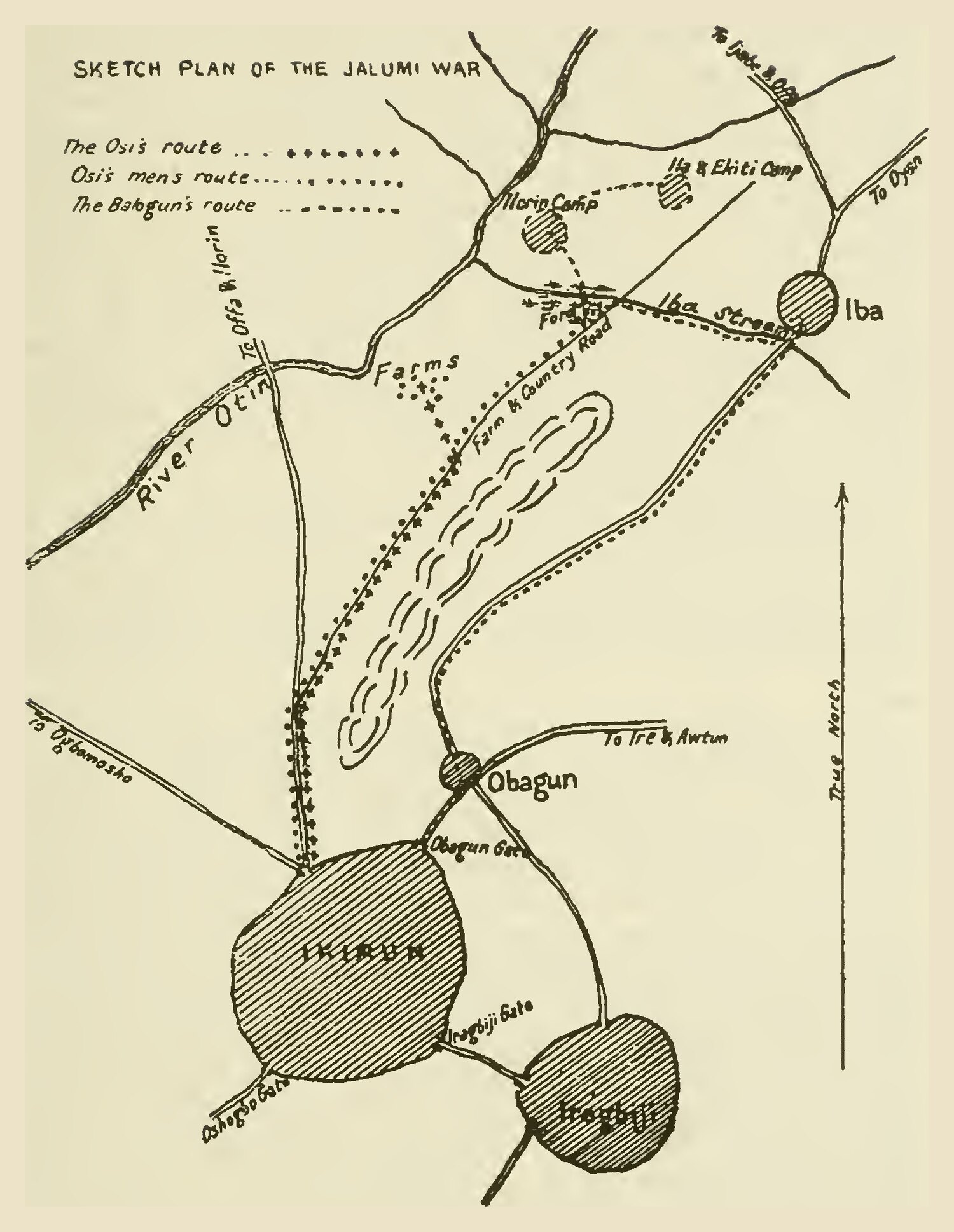
¶12 Those about him reported that he was restless and sleepless all night, he ate little but drank much, and it had been so since their arrival at Òṣogbo. He emptied a bottle of gin before ordering his horse to be saddled long before daybreak. He marched out of the town by the Northern (Ọ̀fà) gate, long before his war-chiefs including Akíntọ́lá were ready. He dismounted and halted a while before dawn behind the town wall until some of his men came and then he proceeded ; the others had to hurry after him one after another as each was ready.
¶13 The Balógun at dawn with the Ọ̀tún marched out by the eastern or Ọba’gun gate leading past the ancient village of that name, along the fine road that leads to the town of Iba where the Ìjẹ̀ṣàs were then encamped.
¶14 The Òsì’s route lay for about three miles along the highway to the north, then it verged towards the right nearly at right angles along a farm road,a high range of mountains parallel to this separating the forces of the Òsì from those of the Balógun. About three miles along this farm road the Ìlọrin camp could be descried on the left hand side, situated on a hill on the other side of a morass, but approachable by a ford which lay about a mile further on, which point was more directly near the Èkìtì camp. Those of Òsì’s men who had gone before went straight along to this ford, but the Òsì wishing to take a short cut to the Ìlọrin camp left the road and went by a bush path and through farms with the intention of attacking the Ìlọrins on both sides at once. This after-thought he never communicated to those before. Many of his warchiefs coming on after him went straight on along the road not knowing that he had left it for a bush path straight for the Ìlọrin camp.
¶15 The Èkìtìs were surprised to see the Ìkiruns out against them but the reason soon became evident, they had been reinforced. Those who went early to the stream were driven back at the sight of the Ìkiruns, and they reported to the camp the advance of the enemy.
¶16 Fabiimi and his colleagues attacked them vigorously and overpowered them ; they were surprised at not seeing their chief and no reinforcement coming up to their aid, so they were driven back and dispersed. Fabiimi pursued them till he came to the spot where Ilori the Òsì took to the bush path, and this was pointed out to him. By that time Ilori had attacked the Ìlọrins and had repelled those out against him, and was pressing hard to capture the camp when he heard the sound of Akíntọ́lá’s drum coming up behind him "Kiriniun Onibudo," "Kiriniun Onibudo." He sent a mounted messenger to greet Akíntọ́lá and to say "You are rather late in coming, I had almost entered the Ìlọrin camp, however, you are welcome."
¶17 But the messenger never returned, and Ilori’s men noticed that the rolling of the drum was not perfect in style, they therefore suspected treachery and communicated their fears to their master. But he replied "Who else can it be? Is not that Akíntọ́lá’s warcry Ki-ri-ni-un Oni-budo?" When too late, he discovered the treachery. Fabumi of Oke Mesin it was who was counterfeiting the war-cry of Akíntọ́lá, who had been left behind.
¶18 It was at such a crisis like this that his guards would have stood by him to a man and kept the enemy at bay until relief should come from those he left behind ; but he had insulted those trusty servants and this was their time of revenge. He was helped to his horse, but at best he was not a good rider, and his head had become muddled by drink. The horse soon got entangled in a yam field and fell down, and the illustrious Ilori was taken alive and conducted to the Ìlọrin camp! At the camp he was stripped of everything he had on, a rag being given him to wrap across himself and was kept in a room under close supervision. One Koiditan a renegade from Ìbàdàn betrayed his personality to the Ìlọrins, and they in ecstasies of joy at the capture of so illustrious a prisoner gave themselves up to feasting and enjoyment for the day, apprehending no further trouble. The Ìkiruns sadly disappointed at this turn of events were ready to stone the Ìbàdàns, they insulted them to their face saying to them "We could not drive them away indeed, but we never suffered so ignominious a defeat as_ this, and what is the good of you?"
¶19 So the Òsì’s men were scattered, many of them fleeing back to the town met those just coming out, and together they fled back to Ìkirun.
¶20 But some of them instead of retracing their steps to Ìkirun went across the mountain range to the other side and told the Balógun what had happened. They met him in the thick of the fight with the Ìjẹ̀ṣàs, company after company on both sides marching to the fighting line, attacking each other furiously. As soon as the escaped arrived and reported "The Òsì has been captured alive and his army dispersed!" The Balógun was startled; but he was a man full of resources, and endued with remarkable presence of mind "Sh ’ said he to the men, "say nothing of this to any one as you value your lives." He quickly called about half-a-dozen of his slaves, and bade them roll themselves in the dust —they did so. He then bade one of his servants "bind them hand to neck as men captured in battle and take them to the Ọ̀tún with my compliments, and say Ilori has entered the Ìlọrin camp, here are captives that he sent us. What are we doing? "He then sent a message to Babalola his eldest son saying "I can see what your younger brother is doing but goodness alone knows what you are doing ; be careful, lest I disinherit you in favour of him." Just then a company of Ìjẹ̀ṣàs were coming to the attack, but instead of another company of Ìbàdàns meeting them in the fighting line, he threw his whole force suddenly upon them and overwhelmed them. He ordered that everyone be put to the sword, and they were all massacred. They had scarcely done this when another company was coming gaily on to relieve these. The Balógun ordered a feint retreat so as to allow the company to advance further before firing, so his men hastily retreated, and this retreat encouraged the Ìjẹ̀ṣàs to advance forward. The Balógun meanwhile had his eyes on them to see the effect of the massacre. As soon as the Ìjẹ̀ṣà company came up suddenly on their massacred comrades, finding them wallowing in their blood, they stood stock still, panic stricken. The Balógun noting this at once ordered a general charge "Omo Ìbàdàn, e gba efi ti won." (Ìbàdàn boys, up and at them). "E ma je won o lo—"(let not one escape) at once rang throughout the whole army, and the panic stricken Ìjẹ̀ṣàs gave way, the panic spread throughout their army, and the Balógun followed them up foot to foot into the town of Iba where they were encamped, and Iba was retaken. The bulk of the Ìjẹ̀ṣàs fell into his hands. He then issued that heartrending, never to be forgotten order "Let no one stay for booty or captive, all prisoners must be slain at once, both will hamper us, the latter may prove treacherous." And so all the Ìjẹ̀ṣàs captured were put to the sword. It was a heartrending sight, for many of them were formerly slaves at Ìbàdàn who ran away to enlist under the flag of rebellion or of liberty (from whatever point we view it). Old comrades, calling each other by name craved for mercy. But the Balógun’s orders rang out "Whosoever will not kill his captive, let him be killed with his captive." So all were massacred! And then the Balógun immediately turned his face northwards towards the Ìlọrin camp without delay. As they marched along a body of Èkìtìs about 1,000 strong appeared on their right flank to attack them, but the Balógun neither noticed nor regarded them, notwithstanding all their efforts at firing ; they had to cease firing of their own accord, amazed at such a spectacle. There was but one thought uppermost in the Balógun’s mind, and in that of every Ìbàdàn soldier, viz., how to rescue Ilori the Òsì.
¶21 It was about 2 p.m., when the Ìlọrins heard the drum of the Balógun coming. "And who is that again?" they asked, and were told "The Balógun." "Any other Balógun besides the one we captured this morning? "they asked. They went out to meet the Ìbàdàns, and within a short time, they were repulsed. The fine river that flowed by the town of Iba, flowed also along the foot of the hill where the Èkìtì camp was situated, and from which they obtained water. That river loses itself in a morass here below the Ìlọrin camp, and the only spot where a ford was possible was along a winding stream breast deep at this season. The Ìlọrins having retreated to the other side held the Ìbàdàns in check for a while on the other side of the morass. There they stood face to face, the attackers and the defenders.
¶22 Chief Akíntọ́lá, who we may remember was attached to the Òsì’s army, was left behind as we saw when that unfortunate chief rushed on before daybreak to his own fate. By the time he came up to his chief, the tragedy had taken place, and he was met by the fugitives defeated by Fabumi. He therefore retraced his steps back to Ìkirun, and took the other route to join the Balógun. By the time he reached Iba, the Balógun had finished with the Ìjẹ̀ṣàs and had cleared out of the place, and he had to follow in his track to where the battle was now raging. The Ìbàdàn boys all but exhausted after the morning’s fight and the day’s march, encouraged at the sight of fresh troops were exhilarated by the inspiriting air of Akíntọ́lá’s war cry, which the whole army took up with a swing "Kiriniun Onibudo Kiriniun Onibudo." Thus came up Akíntọ́lá; and stretching forth his hand across to the enemy, half turned on his saddle to his men he said "Awon ta nu? Awon ta l’emba se ta nta?" (and who are those? Who are they with whom you are exchanging shots?) Immediately the Ìbàdàn boys dashed into the morass, treading on one another they struggled across the quagmire and hurled themselves upon their foes. The Ìlọrins taken aback by this unexpected, this mad rush became completely demoralized and gave way. The Ìbàdàns
¶23 SKETCH PLAN OF THE JALUMI WAR
¶24 The Òsì's route .. . Òsìs mens rowte.--.. The Balógun's route
¶25 True North entered the Ìlọrin camp, captured a large number, put some to the sword and demolished the camp. All those who were captured in the morning with the Òsì, speedily rejoined their comrades and made captives among their captors. The Òsì’s men were among the foremost to seek out their master, but alas, the worst had befallen him. When he heard the noise and tramp of the Ìbàdàns within the Ìlọrin camp, he tried to make his escape; he rushed out of his confinement and hid himself in a clump of fignut trees not far from the tent. The Ìlọrins in their hasty flight did not forget the illustrious captive, but he could not be found until betrayed by a woman who saw him in his hiding place; then a man with drawn sword rushed upon him and put him to death before he made good his own escape. The same fate befel several of the minor chiefs, Ilori’s fighting men who were caught with him that morning. Ìjẹ̀ṣàs and Èkìtìs who had lived at Ìbàdàn and knew all these chiefs at sight easily pointed them out to the Ìlọrins. Koiditan the renegade and betrayer of the Òsì was caught, and taken to Ìkirun where he was subsequently tried and publicly executed.
¶26 The Balógun then turned towards the Èkìtì and Ìlá camp. It was evident that they had no longer any spirit of resistance left in them. By one assault that was taken also, and so the three camps were smashed on one and the same day by Balógun Àjàyí Ogboriefon. The victory was decisive and complete, and Ìkirun was saved.
¶27 The Ọ̀fà people who had long been groaning under the yoke of Ìlọrin took this opportunity to throw off their yoke. They cut the bridge over the Otin river at the rear of the Ìlọrins, and when these in their flight came to the river now swollen, with the Ìbàdàns at their heels, they rushed into it. Here thousands upon thousands of men, women and horses perished. The river at one point was said to be so choked with human bodies and carcases of horses that some fugitives who came later were able to escape upon corpses. Ajia the Ìlọrin commander-in-chief escaped with great difficulty with one of his favourite wives, but several Ìlọrin chiefs and well-to-do people were caught. Prince Adeyala of Ìlá fell among the slain but Fabumi of Oke Mesin managed to escape. The roads were said to be strewn all along with loads which the Ìlọrins could not carry in their hasty flight. The Ìbàdàns pursued their victory right up to Erin about 8 miles from Ọ̀fà; the head chiefs however remained at Ìkirun.
¶28 This event gave the name to this expedition "Ogun Jalumi," i.e. the rush-into-the-river war.
NOTABLE EVENTS OF THE DAY
¶30 1. Roti, Ilori’s head slave and a very great favourite, with whom he was as a most intimate friend, eating out of the same dish and drinking out of the same cup, and from whom he was never parted, was in another part of the field that fatal morning when the disaster overtook his master. When he observed that something was wrong, he rode up hastily asking "Ilori da? Ilori da?" (And where is Ilori?) The reply was "Ogun mu u lo" (taken by the enemy). He uttered one deep groan "O—h" He then bade his comrades farewell "Good-bye to you all, no home for me again." He drew his sword, put spurs to his horse and dashed into the midst of the Ìlọrins, slashing on the right and on the left, killing many before he fell among the slain.
¶31 2. Akíntọ́lá’s drum played a most notable part in the day’s business ; it won and lost for the Ìlọrins, it lost and won for the Ìbàdàns. And here let us note a most remarkable instance of retributive justice. The trick now played upon Ilori by Fabumi by which Ilori was captured was the same played by Ilori’s father the famous Ògúnmọ́lá upon the Ìjàyès after the Iwawun war. It will be remembered how on his return march he counterfeited the war cry of Kurumi of Ìjàyè, and in that way all Ìjàyès who had escaped into the mountains thinking their master was come to their rescue came down from their hiding places and fell a prey into his hands (vide Chap. xviii, page 349). The same trick was now played by Fabumi on his son with fatal results.
¶32 3. The Ifẹ̀ and Mọ́dàkẹ́kẹ́ people who always joined the Ìbàdàns in every expedition of theirs came up late this time after everything was over. The Ìbàdàn boys taunted them to their face and accused them of intentional delay because of the formidable appearance of the war; but said they "we have already shown that we can do without you."
¶33 The Ifẹ̀s never uttered a word of excuse, nor resented the remarks but followed up the chase and took Ilofa. (The fact was that the Ifẹ̀s had secretly wished the issue to be otherwise in order to cast off their own yoke also ; and the Mọ́dàkẹ́kẹ́s having their eyes on them would not leave them behind). They also joined in taking Omu, Erinmope, Gogo, etc., and the conquest was pursued up to Ekan. This was a small town but the men of that place were mostly hunters and sharp-shooters. They manned their walls so that the Ìbàdàn boys failed to take it by assault. The Balógun hearing this sent Ali Laluwoye the Ọ̀tún to their help. He was nearly a month in this small place and was content to reduce it by famine. They negotiated peace, sending valuable presents by Aturu who was sent to conclude a treaty with them. The Bále and Balógun of the place were sent by Ali to Ìkirun to the Balógun of Ìbàdàn to ratify the treaty. The Ọ̀tún was thereupon recalled from the siege, to the great disgust of the Ìbàdàn warboys who grumbled much against their unlucky and inefficient chief.
¶34 The victory and its cost were reported at Ìbàdàn simultaneously on the 5th of November, so that the joy was greatly tempered with the painful loss they had sustained by the death of Ilori and his brave comrades.
¶35 The Balógun received orders not to waste time to retaliateon the Ìjẹ̀ṣàs or Èkìtìs as they would soon tender their submission. He was not to go beyond Ìlá, but rather to turn his face against Ìlọrin towns.
¶36 On the 18th November the Ìlọrins sent ambassadors to Ìbàdàn to sue for peace. The Are took occasion to remind them of the parable of the whorish wife returning to her husband and what he predicted would likely be the result. Knowing that their overtures were only for the purpose of redeeming their chiefs who were captured in the war, and kept as state prisoners, and still smarting under the loss of [lori the Òsì and his brave comrades, the Are and chiefs sent them back home without an answer.
¶37 Whilst the Ìbàdàns were rejoicing and mourning at the same time over the affairs in the north, the Ẹ̀gbás came to kidnap in their farms on the 22nd of December, and some farmers were carried off to Abẹ́òkúta.
¶38 The Balógun was at length recalled and the Ìbàdàns returned home on the 23rd December, 1878, with the Balógun in an indifferent state of health.
§ 2. THE RESULTS OF THE JALUMI WAR.
¶40 The results that followed this crushing defeat of the allies were totally different from what the Are of Ìbàdàn had expected. In his opinion the disastrous results to the Ìlọrins were quite sufficient to make them hold aloof from the rebel states, and these he expected would tender unreserved submission, and that things would henceforth move as smoothly as before ; but, as we shall see matters took a totally different turn everywhere. The Are now saw the necessity of being on friendly terms with at least one of the neighbouring states. The Ìjẹ̀ṣàs and Èkìtìs were subject states, he could never treat with them on terms ofequality. The Ìlọrins lately defeated were characteristically untrustworthy, Ìbàdàn could have nothing to gain from that quarter. The Ẹ̀gbás the Are was determined to subjugate so as to open a free route to the coast to all Ọ̀yọ́s through the river Ogun. There remained only the Ìjẹ̀bús with whom Ìbàdàns could possibly treat, and therefore the Aresent large presents with some slaves to the Awujaleof Ìjẹ̀bú and craved for friendly relations, as there had never been any cause of quarrel between them. But the Ìjẹ̀bús refused a rapprochement and declined the presents. They openly declared themselves allies of the Ẹ̀gbás and Èkìtìs, surmising that all this pretence of friendship was mainly for the purpose of procuring war materials from the coast through the Ìjẹ̀bús themselves.
¶41 The Are resented this rebuff by sending another raiding expedition to the Ẹ̀gbá farms. The Balógun who returned home from Ìkirun ill, was getting worse and worse every day, so he sent the Ọ̀tún and the Sẹ́rìkí, but they returned on the 4th of January, without a single captive.
¶42 Meanwhile the storm was gathering thick in the north and north-east. The effect of the late defeat was to exasperate rather than dishearten the allies, and they were determined more than ever not only to wipe off the disgrace but also to crush the Ìbàdàn power if not destroy that town altogether.
¶43 Although the Ìlọrin refugees were well treated at Ọ̀fà yet they were determined to take vengeance by destroying that town for their conduct in destroying the bridge over the river Otin which occasioned such tremendous losses to them.
¶44 Karara the Hausa Balógun of Ìlọrin, who, on account of his marked disloyalty to his King was denied the honour of conducting the battle which ended so disastrously, came out to succour the escaped. He came as far as Elehinjare, but when he heard of the Ìbàdàns pursuing as far as Erin, he retreated to Ganmo as he was not then prepared to fight. Here he remained until he received orders to destroy the town of Ọ̀fà. This he meant to do by stratagem, and to make quick work of it. He asked leave of the Olofa to allow him to pass through his town to Erin in order to punish that small town for intrigue. But the Olofa was wide awake ; he knew who the prime intriguer was, therefore, the reply he gave was "Not until I am removed out of the way." Karara now threw off the mask and openly declared war against Ọ̀fà; leaving Ganmo he went forward and pitched his first camp.
¶45 This expedition was not popular at Ìlọrin, because King Alihu wished to be on good terms with the Ìbàdàns, at least for the present, in order to ransom all the Ìlọrin chiefs caught in the last war. But Karara it was said threatened to convert his camp into a town, and set up Momo the heir apparent to be king over it, in opposition to Ìlọrin, and so Alihu was obliged to let him have his own way.
¶46 The Ọ̀fàs sent to Ìbàdàn for help on the 20th of February, 1879 ; the Are sent Ali the Ọ̀tún with all his forces, also Kanike one of his own head slaves with some of his men, and the Ọ̀tún, Òsì, and Ekerin of the Sẹ́rìkí; later on he sent Akíntọ́lá.
¶47 This on the whole was a very weak force, for, although there were some very strong men in it, yet the leader of the expedition was held to be both unlucky and incompetent.
¶48 But King Alihu did not despair; in order to conciliate the Ìbàdàns he declared all the roads in his territory open for trade so that all Ọ̀yọ́s immured in Bida and in Hausa towns were able to come down in safety. He then sent an embassy again to Ìbàdàn to negotiate for peace between them, and to arrange for the ransom of the Ìlọrins captured in war, but the Are declared he could not entertain the idea unless the siege of Ọ̀fà was raised.
¶49 The Are now endeavoured to fill up the gaps made in the late war by making some indispensable appointments. Akintaro the heir of the late Balógun Akere he made the Òsì Balógun in place of the late Ilori. For the great house of Ògúnmọ́lá there was none but the youthful Kongi son of the late Osun, Ilori’s elder brother. He was now advanced to be the head of the house with the title of Areagoro. These two were the most important.
¶50 Death of the Balógun of Ìbàdàn.—In the midst of this crisis the Ìbàdàns suffered an irreparable loss by the death of their Balógun. On the 7th of April, 1879, the firing of musketry, volleys upon volleys announced to the public that Àjàyí nick-named Ogboriefon had passed away! The town went into deep mourning, as he was the last of those veteran generals of Ìbàdàn, who had seen great fights and made a name, with the sole exception of the Are. Those who were now to the fore were not the old and experienced but the young and untried heirs of great houses according to the policy favoured by the Are. "He was buried at about 10 p.m., with full pagan and military rites. An eye-witness thus described the interment. The grave was dug in his bedroom, the large coffin was first lowered, and the body wound up as usual was placed in it, and then nailed up. Four flint-lock guns, a naked sword, and strings of cowries were placed upon the coffin, and a kid was immolated, the blood being poured on the lid of the coffin, and prayers offered to the gods for his soul.
¶51 Àjàyí was a native of Ejigbo, he came to Ìbàdàn for the love of a military career. He was nick-named Ogboriefon from the following circumstance :—At a battle in the Efon country, he noticed a man who posted himself behind a large tree doing havoc to the Ìbàdàns. The man was using two guns giving an assistant the one he had discharged to be reloaded for him while he took his deadly aim with the loaded gun. Àjàyí then a common soldier quietly crept into the bush behind him, going on all fours till he came near enough to this marksman, and then suddenly shot him down dead. The assistant bolted clean away. Àjàyí then cut off the Efon’s head held it by the ear between his teeth being besmeared all over with blood, and with the man’s guns on his shoulders came again to his comrades who raised for him a shout of triumph and acclaimed him "Ogboriefon "i.e. a carrier of the Efon’s head.
¶52 He was always a poor man, for he spent too lavishly, but he was a brave and hardy soldier. This characteristic cleaved to him all through life from a private to the post of commander-in-chief and was the cause of many errors in his procedure which all but marred his career. For a long time his favourite companions were his only slave Jato, a man with a fair complexion, and his horse ; then some friends associated together and made him their leader, and thus by degrees he rose to a responsible position. His first military appointment was when he was created an Abese and sent to Ilora during the Ìjàyè war to reinforce the Ọ̀yọ́ army against Iran. He was marched off with Ògúnmọ́lá to Iwawun where he received a wound which nearly proved fatal to him.
¶53 The next period where he made a name was the Ilẹ̀ṣà war, when he and Latosisa were stationed at the Odo road where he had to oppose Ògèdèngbé and the army from the city, and Latosisa that from the country ; and Ògèdèngbé capitulated to him.
¶54 The blot on his character was serious. He intrigued to get rid of Ajobo who had helped him to bear the expenses incidental to his taking office on filling the post of Òsì Balógun which was bestowed upon him after the Ilẹ̀ṣà war. Also his withdrawal from the coalition in the insurrection against the Are and the betrayal of Iyapo. Added to these was the wholesale massacre of the Ìjẹ̀ṣà.captives in the taking of the camp at Iba, for which however, he pleaded military necessity.
¶55 But there were pleasing traits in his character. His liberality and humility gained him the respect of the soldiers and made his memory lasting. He will always be remembered as the hero of the Jalumi war. His eldest son Babalola was his heir, and became the head of his house.
§ 3. THE EKITIPARAPOS
¶57 Instead of tendering their submission as the Are thought they would do, the Ìjẹ̀ṣàs, Èkìtìs, Efons and other tribes hitherto subjected to the Ìbàdàns formed an alliance which they termed Èkìtì parapo i.e. the Èkìtì confederation. They raised a formidable army and were determined not only to liberate themselves but also to overrun the Ọ̀yọ́ tribes right on to the Ìbàdàn farms at the river Ọba.
¶58 They invited Ògèdèngbé to come over to lead them ; but this hardy warrior, having crossed swords more than once with the Ìbàdàns was loth to do so again, but rather tried to see what might be done by entreaties and remonstrance in order to ameliorate the condition of his people. The arrogance of the Are made him deaf to reason; he simply snubbed Ògèdèngbé for his pains ; but this simple hearted soldier regarding his oaths to the Ìbàdàns kept to his promise and for a long time never moved from his retreat. Meanwhile Fabumi of Oke Mesin headed the confederates and was on the march again for Ìkirun ; the news of the death of the Balógun of Ìbàdàn seemed to put more spirit and courage into them.
¶59 When the news of this reached Ìbàdàn the Are ordered the Sẹ́rìkí to arrest their progress. The Sẹ́rìkí was very reluctant to go for two reasons. Firstly, he wished to be present at the funeral obsequies of the late Balógun his chief, but the urgency of the affairs in the north-eastern frontier brooked no delay. Secondly, he had been clipt of his wings as it were, for his Ọ̀tún, Òsì, and Ekerin had been ordered to Ọ̀fà and he was left single-handed.
¶60 But he must obey orders, and thus he started for Ìkirun. On reaching Ìwó, he was detained by the venerable King of Ìwó.
¶61 "What do you intend to do," asked he, "with such a small handful of men? The Are could never have had the slightest idea of the nature and strength of the confederacy." His Highness thereupon sent to Ìbàdàn and acquainted the Are with the formidable nature of the task before him.
¶62 The Are with enemies all around him was trying to behave cautiously and with prudence: he did not know what the Ẹ̀gbás and Ìjẹ̀bús might do if the town were denuded of men; however, he sent a small force to reinforce the Sẹ́rìkí at Ìwó. The allies at this time were using all their endeavours to isolate Ìbàdàn by cutting off all communications from it. At this crisis the Lisa of Ode Ondo sent messengers to Ìbàdàn to inform the Are how the allies had offered him large presents to induce him to join the alliance, and close against the Ìbàdàns the only route by which they could now communicate with the coast, viz, that by Oke Igbo, but he wished to be neutral. He might send if he liked to verify his statements, and let his messengers see the presents for themselves. The Are replied by sending the Lisa large presents and begged him to keep strictly neutral, and to keep that road open.
¶63 The Ìjẹ̀bú Remos in the South who are simple traders were much annoyed by this closure of the roads, which put a dead stop to their occupation. Ìbàdàn is their only customer, but their Suzerain the Awùjalẹ̀ of Ode having joined the alliance, they were helpless. They however conceived an idea of sending to their countryman resident at Ìbàdàn, Chief Soderinde the Balógun of the cavalry, to induce the Are to send another embassy to the Awùjalẹ̀ and that they would act as a go-between. The Are was glad to comply with this request, but the Awùjalẹ̀ took the presents and the slaves sent, but rejected the Remos as intermediaries.
¶64 The fact of his accepting the presents sent a ray of hope into the Are to make one more effort. He therefore summoned to him all the natives of Ìjẹ̀bú Ode resident at Ìbàdàn with Abinusawa, an Ìjẹ̀bú Prince, at their head, one who had some influence at home and begged them to act as plenipotentiaries for him in arranging terms of friendship with the Ìjẹ̀bús. These were glad to be of some service to their hosts, and were confident of success. But they were not even allowed to reach the town of Ode, they were stopped at Aha by an Agurin and sent back with the following message :—
¶65 "Why should the Ìbàdàns now desire our friendship? Let them remember the scant courtesy with which they have treated us in the past. When they were going to the Ìjàyè war we remonstrated with them but to no purpose. When we entreated them to receive back Ajobo expelled, they utterly refused even to take home his dead body. When they had differences with Efusetan, Aijenku, Iyapo we interfered and offered our good offices but were not listened to. If they are tired of the war and want peace, let them first arrange with the Ẹ̀gbás, recall their troops from Ọ̀fà and from Ìkirun, and let the Are go to sleep."
¶66 This was the end of all negotiations with the Ìjẹ̀bús, but the Ìjẹ̀bú residents still continued to make efforts to negotiate, but the Are would not expose himself to another rebuff.
¶67 Once more the Lisa of Ondo sent messengers to Ìbàdàn on hearing of the Balógun’s death; they brought the Are some presents and performed funeral obsequies for the late Balógun, killing a ram and pouring its blood on his grave.
§ 4. THE BEGINNING OF THE ACTUAL CONFLICT
¶69 The Sẹ́rìkí’s forces met the confederates near Ìkirun, and once more the clash of arms resounded between Ọ̀yọ́s and Èkìtìs. After several battles, the Èkìtìs began to retreat before the Ìbàdàns towards Mesin Ipole via Igbájọ ;* this town was deserted at the approach of the allies. The Sẹ́rìkí drove them beyond Igbájọ and pitched his camp about a mile beyond, and from thence cleared the undergrowth in the forest for miles in the direction of Mesin Ipole. Another reinforcement from Ìbàdàn met him here in the person of Akintaro the newly-made Òsì, and chief Aderibigbe. Here was enough force now to crush those opposed to them. The Are’s young Chiefs could fight, but they lacked the wisdom gotten by experience.
¶70 The Ìbàdàns were surprised to see the allies advancing to attack them in their camp through the openings they had made in the forest, and concluded that they must have received reinforcement from Ògèdèngbé, the rumour of whose approach then filled the country. They therefore took the precaution of guarding the camp and the rear by the Òsì whilst the Sẹ́rìkí advanced to the attack. The Sẹ́rìkí had his father’s veterans about him who instructed him in all his movements, where he was to sit, and when he was to charge. There was a dreadful carnage that day on both sides. When at the right moment the Sẹ́rìkí (through his advisers) ordered a general charge, they found the Èkìtìs immovably firm as a rock! From repeated conflicts, and from their former slaves, the Èkìtìs had grown accustomed to the methods of the Ìbàdàns, and were prepared against them. There was then no help for it but to maintain their ground vis a vis whilst a desperate struggle ensued. At length, the Ìbàdàns a little while after made a sudden dash and secured a prisoner. From the obstinate resistance offered, the Ìbàdàns thought they were opposing Ògèdèngbé, but the prisoner told them it was Fabumi of Oke Mesin. "Where is Ògèdèngbé then?" they asked, and were told, "Not yet come." And further : "Who lay in ambush at our rear?" "No one." "Where is the remnant of your army?" "This is all." With this assurance the Sẹ́rìkí now sent to the camp for reinforcements. It was about 4 p.m. that the drum of Akintaro the Òsì was heard coming, and when the Èkìtìs saw fresh troops coming they gave way and fled. But it was too late to pursue them far. The Òsì’s men claimed the honour of the victory as theirs, as the enemy did not dare to await their approach. Those who bore the brunt of the fight since morning were naturally hurt at this, and trifling as this circumstance might appear, it altered the character of the whole campaign, and the larger issues that depended upon it. Jealousy and rivalry now take the place of judgment and discretion.
¶71 Disaster upon disaster followed on both sides in subsequent battles ; the allies again and again sent repeated messages to call Ògèdèngbé to their help. "We will fight now," said they, "to the best advantage, the Ìbàdàn army is divided into three parts, one part at home to guard the town against the Ẹ̀gbás and Ìjẹ̀bús, one part at Ọ̀fà against the Ìlọrins, and it is but a third part we have to oppose."
¶72 Ògèdèngbé was a very straight-forward man, he was always true to his word. Although a sworn enemy to the Ìbàdàns, yet he wished to be faithful to his covenant with them, for he had sworn never to oppose them. On making Ita Ogbolu his headquarters for excursion into the Igbo Ani country, he sent to Ìbàdàn, and the Are gave him a war standard, and also sent him a contingent consisting of his slaves and volunteers among the restless and warlike youths of Ìbàdàn. Hence Ògèdèngbé was reluctant to enter upon this war rashly. But he received invitations from all the allies, as well as from the Ẹ̀gbás and Ìjẹ̀bús, Ìbàdàn being considered a formidable neighbour whose power they all dreaded and were resolved to see it crushed this time.
¶73 Ògèdèngbé at last issued from Ita Ogbolu his retreat, and took the field at the head of the Èkìtì parapos against the Ìbàdàns.
¶74 On hearing this, the Ìbàdàn war chiefs sent home again for more reinforcements, and on the 3rd November, 1879, the Are sent the following chiefs, viz., Babalola the son and heir of the late Balógun Ogboriefon, Ojo late Bále Opeagbe’s son, and Ogundepo the uncle of the Sẹ́rìkí.
¶75 It was the belief of the war chiefs that the Are deliberately planned to weaken them all one by one, so as to make room for his own son to be supreme over them, for instead of sending an adequate force which could deal with the whole affair in one blow he kept sending them by dribblets, promising each batch that whichever came out victorious would take the lead of the others, thus creating a spirit of jealousy among them. Hence every newcomer had to fight singlehanded, and never received support from those already in the field.
¶76 Babalola had to oppose Ògèdèngbé at Kíríjí as his father opposed him many years ago at Ilẹ̀ṣà. The combatants met about three miles from Mesin Ipole, and Babalola fresh from home and probably in order to make a name, fought three successive battles which established his fame as a worthy heir of the hero of the Jalumi war. He bore the brunt of the battle with the Èkìtìs alone, the Sẹ́rìkí and all he met before him just sat in the battlefield surrounded by their men, all looking on, ready to retrieve a disaster should any occur.
¶77 A custom initiated by the late Balógun Ibikunle and Ògúnmọ́lá at the time of the Ìjàyè war was still kept up for the war chiefs to have about them pages in training called "Baba ni nma sa" (the Master says I must not run away). They were all dressed in red uniforms and were to sit around their master whatever may be the condition of the fight : they may be beyond gunshot, or equally exposed with their master in a close fight. Babalola had about 400 of these ; at the first fight he lost 140 in killed and wounded. At the second fight he lost more, at the third fight they were wiped out!
¶78 Thus the Are began by wasting their strength, and those in the field, out of jealousy of each other, played his game until experience brought about a better judgment when too late.
§5. THEARE TO THE FRONT
¶80 Such was the state of affairs at the seat of war whilst the Are’s son and his slaves and household war-boys were enjoying themselves at home, till they became surfeit with pleasure and all excesses, the report of which reached the war chiefs from time to time at the seat of war. Whenever the Ìjẹ̀bús or Ẹ̀gbás were descried kidnapping in Ìbàdàn farms, the war chiefs at home would be sent after these, but the Are’s sons and slaves.would march out leisurely after these in blazing costumes, and instead of pursuing after the enemy would contentedly encamp in the Ìbàdàn farms, feeding on the crops and cutting down standing corn as fodder for their horses!
¶81 The war chiefs in the field having wasted their strength in the manner indicated above, and finding themselves as it were being over-ridden by the Are’s sons and slaves, were resolved to invite himself to the war, to take command of the army in person, and when there they were determined to take revenge on him and his menials for all their insolent acts at home. By virtue of his title as Kakanfò he was bound to respond to his people’s call, and consequently he sent to the King at Ọ̀yọ́ to ask leave to "take the field, and to return home within 17 days. The King granted his consent reluctantly, knowing that he was determined to go.
¶82 The Are at this time exhibited some of the worst phases of human nature. At such a pitch of glory his word being law to all Ìbàdàn and its dependencies, he became the dupe of his flatterers; he considered himself a god and that nothing was impossible for him to effect. He certainly thought he would make a short and easy work of the task before him, but the chiefs who invited him to the war had a different plan in their head. Their resolve was to humble his pride, and to avenge the death of Aijenku and that of Iyapo, the late Sẹ́rìkí in particular, both of whom he ordered to "go to sleep."
¶83 Sanusi, the Are’s eldest son, further exasperated the war-chiefs by the impudent songs he permitted his bards to indulge in at their expense; thus:
¶84 The expedition that occupied Akere’s son! three years,
¶85 The war over which Awarun’s son? has spent six months in vain,
¶86 But one day will it take Alabi*, son of Iyanda Aro‘,
¶87 With silver-studded hands he’ll extricate and bring them home.
¶88 Again they sang: A club is thrown at a lime, Both lime and club got entangled, And the stick and the lime, Iyanda’s son will disentangle and bring home.
¶89 But there were those even among his followers at home who disliked these proceedings. Many were the followers of Sumonu, the Are’s nephew, who was a more affable and good-natured fellow and much preferred to Sanusi. The followers of the latter, noticing this, permitted his drummer to beat:
¶90 "Sanusi joba na a gbo ni Kanu,
¶91 Iro, iro, Aremo ko pe meji." (That Sanusi is supreme is known up to Kanu, Nay, nay, two heirs there cannot be.)
¶92 The retort to this came from the populace in their dances :
¶93 "To prostrate to father, and then to the son, I cannot stoop to two at once. And where is such a thing ever done? On the hilltop is such a thing done."
¶94 The Are’s house at Ìbàdàn is on the top of a hill. All these sayings and doings were duly reported in the camp, and the war chiefs there were resolved to have these high-flown talkers in the camp, where only valour counts.
¶95 The Are, in order to strike a blow with effect, recalled Ali the Ọ̀tún Balógun and Akíntọ́lá the late Iyapo’s brother from Ọ̀fà to join him at the camp. Akíntọ́lá preceded Ali to the camp and, as a young Mogaji he also was allowed to fight a battle singlehanded as each of his predecessors had done. He distinguished himself above them all ; bya flank movement he bore down on Ògèdèngbé suddenly with a vigorous onslaught, surprised and captured him, but he was let off. It was not the intention of these
¶96 war-chiefs to defeat their enemy to the Are’s advantage, but each of them wished to show what he can do.
¶97 Ògèdèngbé fell into the hands of one of Akíntọ́lá’s slaves who said to him, "Ologun, yara, Ọ̀yọ́ nbo" (Captain be quick, Ọ̀yọ́s are coming.) The hide on which he was sitting, the kegs of gunpowder all about him, his charms and amulets were all taken, the Ìjẹ̀ṣàs were utterly discomfited, but Akíntọ́lá withdrew and there was no further fighting that day.
¶98 But the result of this fight was to drive the allies to a vigorous preparation for a more desperate resistance, especially as they heard that the Are was coming. It was reported that Ògèdèngbé, on hearing the rumour of the Are’s coming, sent a messenger to ask him whether the report was true, and if so, in regard to the oath he had taken, and for past favours he had received from him, he was loth to meet in the field a chief who had given him the war standard he was using. He would therefore retire with half the Èkìtì forces, leaving the rest for an easy conquest; only he prayed for his clemency towards his countrymen. So faithful and honest was Ògèdèngbé. But the Are, instead of returning courtesy for courtesy, proudly dared him to remain if he would share the fate of those he would soon crush under his heels!
¶99 But Ògèdèngbé, out of deference to the Are, sent another private messenger to meet him at Òṣogbo on the same errand. The Are’s answer was, "Is he still there and not gone away yet? Well, he will have himself to thank for the consequences." Ògèdèngbé and his countrymen were fighting for freedom; courtesy and generosity he was prepared to yield to, but threats and defiance he was determined to meet with obstinate resistance.
¶100 The Are, on reaching Iréhé went by Otan and intended to take the Ekitiparapos in the rear, thus placing them between two fires. But the Ìbàdàn chiefs lest their plans should be defeated grew excited, sent urgent messages after messages entreating him to come to them to the camp and take no other course. Said they: "The veterans and the flower of your army are here in the camp, who are those about you with whom you would risk your safety by taking another course? They are but slaves who will desert you at the sound of the first gun. Not so did Lakanle of old when our fathers called him to their help at Iperu in olden days. As he went straight to them so do you come to us now and lead us to victory."
¶101 In the meantime the Tjesas, hearing the Are was contemplating another route, were determined to checkmate him. Ògèdèngbé left the command with one Olubayode, a great war-chief, and took with him his well-trained veterans to waylay the Are. and if possible to take him alive. He was rather disappointed at the Are’s being dissuaded from carrying out his plan. He missed his game.
¶102 The war-chiefs’ estimate of the value and fighting qualities of the Are’s slaves and household officers was not from spite but from actual fact ; they had learnt to appraise them at their true valuation in the Ado and Aiyede wars and in the raids on Ẹ̀gbá farms especially before Osiele. They were no longer the hardy and trusty veterans of the Ilẹ̀ṣà and other wars when there was keen rivalry between them and the late Àjàyí Ogboriefon. A life of ease and debauchery had since brought about degeneracy ; they were more distinguished for displaying red and showy uniforms, sitting round their master and boasting of past deeds.
¶103 The Ìbàdàn war-chiefs entered into a secret compact before the Are’s arrival never to achieve a conquest or capture a town while he was living. for, said they, "What is the use? The lion’s share of our achievements will go to him, and we shall only help to increase the number of his slaves who are now lording it over us."
¶104 The Are again on arriving at the camp did not call them all together and harangue them or praise them for what they had done. On the contrary his son Sanusi marched straight on through the camp and pitched his tent in a field of standing corn which the Ìbàdàns had planted outside the camp. "Cut all down," said he "we do not need it, how long are we going to stay here?" He had cause to regret this afterwards.
¶105 The Are led the host to the field the next day, the 4th of May, 1880. The war-chiefs fought with their accustomed bravery to show him what they could do, but no more. At the first onslaught the Ìjẹ̀ṣà chief Olubayode was caught and slain, the Ìjẹ̀ṣà army became demoralized, and gave way ; the Ìbàdàn warboys pursued them right into the gates of Mesin Ipole. The Ìbàdàn war-chiefs seeing this passed the word round from mouth to mouth, "Afaro, afaro," i.e., "Refrain, refrain "(or "halt, halt.")
¶106 The Ajero saved the situation for the Èkìtìs that day, for seeing all in full retreat he stood by the gate of the town, and the first Ìbàdàn boy that entered he shot down dead ; the others, seeing no war-chief or leader of any kind behind them, retreated hastily. The Ìbàdàn war-chiefs sat in groups, each under a tree here and there in the battlefield surrounded by their men as if resting for a while, but the Are could not get them to do anything more than skirmishing that day. He took in the situation at a glance, and was determined to sleep on the battlefield that day, and offer battle the next day, although it was pouring with rain, and there was no shelter. Cold and wet he was advised to return to the camp, but he at first refused to do so; then the chiefs and elders of his house approached him and remonstrated with him, saying, "It is folly to remain on the battlefield; we are all wet, and it is still raining. Suppose the Èkìtìs were to fall upon us in the night, it will be all to their advantage, because they will come from home quite fresh, with ammunition dry." The Are was sore at heart, recalling the achievements of his old rival and comrade the hero. of the Jalumi war. That he, the Kakanfò, should not be able to achieve as much and a great deal more was a mixture of shame, pain and grief to him. With great difficulty he was prevailed upon to return to the camp for the night, and the fight was resumed the next day.
¶107 The secret combination against the Are was divulged to him by Chief Aderibigbe, probably with the hope of his making amends to the war-chiefs, but the Are, instead of calling these young men together and pacifying them, answered with some asperity, "I have fought in front of their fathers and it is now their turn to fight for me and they will not ; as we are all equally concerned, let us agree to remain indifferent."
¶108 The Ekitiparapos, on the other hand, fighting as they were for their independence, went on strengthening their forces by drawing recruits from the utmost bounds of the country behind them, throughout the Ìjẹ̀ṣà, Èkìtì, Efon, Yagba and Akoko countries tight on to Egbe. They further strengthened their alliance with the Ìlọrins by an exchange Of troops. One Ogunmodede with a strong force of Ìjẹ̀ṣàs, was sent to the Ìlọrin camp, and the Ìlọrins sent one Lasebikan with his men to the Èkìtì camp. This arrangement, we should rather say, was an astute measure of the Ìlọrins by which they retained a firm hold on the Èkìtìs, so that they could not withdraw from the alliance even if they wished to do so, and this proved to be the case many years afterwards as we shall see in due course.
¶109 The allies had also the great advantage over the Ìbàdàns, in that they had free access to Benin for ammunition whilst nearly all the roads were closed to the Ìbàdàns. Long flintlock guns with large muzzles were imported from Benin ; these, when fully loaded and fired, gave a report which reverberating from hill to hill all around sounded like Ki-ri-ji-i, from which this war was named the Kíríjí Campaign.
¶110 Famine soon broke out among the Ìbàdàns, the provisions they brought from home were exhausted, and the standing corn around the camp had been cut down by Sanusi to make room for his tents. The common soldiers had now to live on palm nuts, certain edible roots, and whatever they could procure from the forests to sustain life, whilst there was plenty in the town for the allies.
¶111 The Are, to emphasize his determination to see that this business should at once come to a finish, removed the camp to the spot where he sat at his first battle, called Elebolo, from the abundance of the herb Ebolo in the place. The Èkìtìs, to show their determination to resist him, left the town of Mesin Ipole and encamped on the spot where Babalola fought his three celebrated battles ; and so both camps stood face to face to each other surrounded on all sides by high mountains, deep ravines and craggy rocks. It seemed Providence had brought both armies into this defile, to teach them a lesson. In the day of battle there was no room for them to deploy, the situation being worse for the Ìbàdàns than for the Èkìtì mountaineers in their native mountains. The battles now became more frequent and bloody, and at every fight the Ìbàdàns lost one or more distinguished war-chiefs.
¶112 At a battle on the 18th May Kupolu, the Commander of the infantry of the Are’s bodyguard, was killed, and Akintaro the Òsì Balógun was mortally wounded.
¶113 On the 1st of June died Opehinde, one of the chiefs left in charge of the town.
¶114 On the 11th of June Ajenigbe the Ekerin was mortally wounded. He died the next day.
¶115 Chief Oluferegbe, Kongi’s stepfather, also fell in battle.
¶116 On the 31st August a sanguinary battle was fought at Kíríjí with heavy losses on both sides.
¶117 Thus for a long period of time a serious battle or a skirmish took place nearly every other day with heavy losses on both sides.