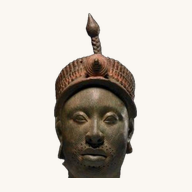
Part II — Yoruba Kings and Contemporary Events
Fourth Period — Arrest of Disintegration, Inter-tribal Wars, the British Protectorate (Atiba to Adeyemi)
Chapter 22. A New Reign And Evil Prognostications
§ 1. THE END OF ADELU THE ALÁÀFIN OF Ọ̀YỌ́ AND ACCESSION OF ADEYEMI
¶2 KING ADELU did not attain to the age of his father. His accession was marked by confusion, wars, and rumours of war all over the country for about four years, due chiefly to the Ìjàyè war and its sequels ; but after this peace and tranquility prevailed, except for the Ìbàdàn raids and the subjugation of the Ìjẹ̀ṣà and Èkìtì provinces.
¶3 Towards the end of his reign he met with an accident by being thrown off his horse, and as a consequence a prolonged illness ensued. After his convalescence he had an attack of paralysis which was probably due to internal injury sustained by the fall, but it was generally attributed to poison administered by the Crown Prince, who was impatient to come to the throne ; it was also said that his accomplice and agent was the King’s favourite wife Alayoayo. Among all the denizens of the royal harem she was the only one who could be termed Queen, for she had the whole village of Awe and half the city of Ọ̀yọ́ serving her, and the whole of the King’s treasures were at her disposal, so that one could scarcely imagine what could have so alienated her affections as to make her an accessory to such a crime. It was subsequently discovered, however, that the Crown Prince had an illicit intercourse with her, and that she was enceinte by him! It was in order to cover her shame and disgrace, therefore, that she lent herself to the accomplishment of this double crime, and the more readily as the Crown Prince promised her the same position and influence when he came to the throne, as he fully expected he would.
¶4 As the King grew worse day by day and had to keep his bed for about a month, the rumour of his death began to gain ground. Thereupon the Ọ̀yọ́ Mesi repaired to the palace and requested to see his majesty even in his sick bed, in order to be assured of his condition. Accordingly, he was bolstered up in one of his apartments, and the curtain was drawn in order that the noblemen might see him and thus he held his reception for the last time. A few days after, the beating of the Koso drum and the blowing of the ivory trumpet at midnight announced to the public the death of their King.
¶5 Such an occasion was a time of dire distress in the palace, for apart from those who were bound by their special office to die with the King immolation was more or less indiscriminate in order to furnish the monarch with a large retinue in the other world. Hence every one tried to hide himself or herself in every nook and corner imaginable and in the ceilings of their apartments.
¶6 As an instance of the indiscriminate slaughter which occurred on this occasion we may mention the following :—
¶7 Kudefu the King’s favourite Ìlàrí and head of all his slaves on the morning of the death before it was officially announced went to know of his master’s condition, and learning he was dead he was going home sad at heart to die of his own accord.
¶8 Alega the keeper of the gate seeing him coming from the inner apartments, being inquisitive, approached him to learn of their august master’s condition. Kudefu at once unsheathed his sword saying "You go before, I am coming at your heels to be attendants on our master in the other world" and in one stroke he cut off his head and then coolly went home to die. Several who were too inquisitive lost their lives in this way. In that vast compound those in one corner of it may not know what was taking place in another.
¶9 It was also a time of mourning for the relatives of those who have received the "death cloth "knowing that they must have to bury in the evening a relative strong and healthy in the morning and up to the time the fatal cup is taken.
¶10 Alayoayo was very reluctant to die, and begged hard that her life should be spared, relying probably on the Crown Prince’s promise to her. But in this she was sadly disappointed ; for this reason she stayed much longer in the palace than she was expected to do, for according to custom she must die at home among her own people. When at last she knew that death was inevitable, she issued from the palace well-dressed in her "death cloth "with her drummer before and her maidens carrying large calabashes full of kola nuts, she trod her way homewards to the measures of the drum scattering kola nuts with a lavish hand right and left to the crowd of spectators thronging her way from the palace gates to her home, to have a last glance at her.
¶11 In the meantime a great feast had been made at her home for all friends and relatives to partake with her for the last, during which time the grave was in digging and the coffin made. She distributed her property among her relatives and her only son. When the hour was come she bade all farewell and repaired to her chamber and the fatal cup was placed in her hands. But owing to the preventives she had fortified her system with, the effects were neutralized ; this was repeated again and again, with the same result. So towards sunset the disappointed relatives in order to prevent an indelible disgrace to the family had to strangle her, and then gave her a decent funeral. The same may be said more or less of all those who had received the "death cloth."
¶12 The Aremo (Crown Prince) also was told to die, but not only did he refuse point blank to do so but was also determined to ascend the throne. His grandfather had abolished the custom of the Aremo dying with the father, his own father the monarch now deceased was his father’s Aremo and he succeeded him on the throne, and why then should he die? But the Ọ̀yọ́ MESI were not in favour of his ascending the throne because of his surpassing cruelties. One instance among many to illustrate this :—
¶13 A young man Folarin by name had a mistress of whom he was deprived by the Aremo. One day, seeing Folarin pass along the street he sent for him and with a heavy blacksmith’s hammer smashed his knees and ankles rendering him a cripple for life, and then nicknamed himself "Alagbede Akesan ti itun Folarin l'ese re (the Akesan blacksmith who can recast Folarin’s limbs). By such deeds he forfeited his rights to the throne, which would have been indisputably his had he been as kind and humble as his father.
¶14 In the meantime he was bidding high for it, he secured the support of the King’s slaves by feasting them on a bullock and a donkey slaughtered every day. But the Ọ̀yọ́ MESI who rejected him put forward the Asipa (son of the founder of the town) to oppose him, and both parties were in arms. Not aware of the actual facts of the situation he distributed arms and ammunition to all the men of the Apara, Ajagba, and Seke wards and was determined to expel the Asipa from the city that day and demolish his house. The war drum was beating, and the Famifami trumpet calling to arms and he was just ready to mount his horse when the Baṣọ̀run appeared on the scene with about 400 men behind him all unarmed like himself. Said he to him "Your royal highness, will you pull down the fabric your fathers have set up? Will you destroy the city your father and grandfather helped to raise? Be quiet, all will be right."
¶15 With such soothing words he dissuaded him from going forward. By this time the King’s slaves had been won over. The Baṣọ̀run had scarcely finished when the Apeka (the head slave) came on horseback with his men all unarmed. He began with "My lord, what is it? Why is this?" The Aremo in a rage retorted with
¶16 "Away with you. Are you not my club who ought to have been striking hard for me by this time? Is it now to ask such a question when you ought to be acting?
¶17 The slaves took exception to this language of their master to their chief. We have noticed in Part I what influence these so-called "slaves," especially the titled ones, wield, as their goodwill and assent with those of the members of the harem must be obtained before any election can be considered valid. They now professed to be offended because their chief was metaphorically styled "kumo" i.e. a club, and they declared openly that they would have nothing more to do with the Aremo. They refused to enter his house from that day ; the cow and the ass were slaughtered as usual and the feast prepared but no one came to partake of it.
¶18 The Prince again sent for the men in the Apara, Ajagba, Seke and Akeitan wards, who were loyal to him ; their chiefs came as in duty bound but their men had been disbanded, and not a single armed man came with them!
¶19 The Prince was now at his wits’ end, and greatly mortified by seeing himself deserted by all those who had promised him their support. At last Prince Iyajin his father's uncle sent for him, and undeceived him of his hopes. The Ọ̀yọ́ MESI have not elected you and there is the end of it. I would advise you to leave the city quietly or build a house at the outskirts, and live there in dignified retirement."
¶20 The Prince returned home much depressed and made preparation to leave the city. He entered the palace and denuded it of all its treasures. He sent several loads to the Bara to be kept there until sent for ; and whatsoever he did not or could not take away he smashed and made a bonfire of them in the palace courtyard, and the wells he filled with kegs of gunpowder and broken pieces of crockery. Some wives of his who had offended him he confined in a closed room with ceilings, and had the entrance walled up. He then proceeded to his farm at Agodomgbo and unfettered a few hundreds of the slaves put in stocks there, and ordered them to carry all those loads with him to Ìbàdàn. The Are of Ìbàdàn received him with open arms and assigned him a portion of land to build on in the Yemetu quarter.
¶21 The late King ADELU was the first born son of his father ÀTÌBÀ. He was born when his father was but a youth. He became a companion to his father in all his turmoils, especially when as a private man ÀTÌBÀ chose the career of a soldier of tortune.
¶22 ADELU was much older than his brothers, as they were born a very long time afterwards when their father was in better circumstances. Asa son, he was very obedient and dutiful, always ready to answer his father’s calls whatever he may be doing, and many a time whilst at his meals. He was an absolutely just man, strict to a fault. He so abhorred stealing that with him robbers had no alternative but instantaneous execution. The following stories told of him will illustrate his strictness.
¶23 1. A certain young woman sold beads on credit to a buyer, but when the money was not forthcoming in time the creditor went to demand it. Not finding the debtor at home but seeing her beads hanging on a peg in her apartment being determined to have either the money or the beads, she went in and took her beads away until they should be paid for.
¶24 An imperfect report of this came to the hearing of the King representing her as having entered the rooms of another woman when she was out, and taken her beads away! The King without further enquiries and proper investigation of the case ordered her execution at once! He keenly regretted this afterwards, when the whole facts were brought to his knowledge.
¶25 2. He sent a few of his slaves for tall poles to build his Kobi. On their return he saw a yam tied to the load of one of them. He questioned the headman how he came by it, but not being satisfied with the plea that it was a gift of a farmer, and surmising that they had been taking undue advantage of poor farmers out of privilege , he was determined to put a stop to that custom.
¶26 The executioner was immediately at his service and he was instantly decapitated. This incident had the desired effect. All through his reign stealing or taking by violence out of sheer privilege, so common with the King’s slaves, was utterly unknown, everybody’s property was safe.
¶27 His public executioner was called Kolohé. A call at his name Kolohé was usually sufficient. He was at his duty at a moment's notice.
¶28 He loved his people and would never allow any of the princes to distress the poor with impunity. An instance was given of a prince who fought with a commoner and cut off one of his fingers. This being reported to his father he severely reprimanded the prince, and was determined to exact a full retaliation of the deed. But the constitution of the country forbade him to disfigure a prince so he ordered someone to be brought from the family of his mother as a substitute. A young virgin was met in the house beating corn and she was summoned to the palace. The King ordered Kolohé to lop off the same finger of the young woman as that which the prince cut off from the man’s hand. This was done instantly. Then said the King to her "It is not my fault it is your cousin who deprived you of your finger."
¶29 That was his rude idea of justice. As that young woman and all the relations of the prince’s mother enjoy great advantages under his auspices, so they should be ready to suffer for his crimes. And again, the training of children devolves greatly on the mothers, therefore both herself and her relatives would learn to train their children to good behaviour. A misguided notion of doing what was right.
¶30 With his children he was very strict and scarcely any one of them escaped punishment from him, and whoever among them he had occasion to lay his hands on, carried sore sides for weeks or months and would have to lie on cotton wool or banana leaves.
¶31 He was particular to see them all engaged in some industry, either weaving or farming. Even the Crown Prince, who has official duties to perform, must employ his spare moments in weaving or tailoring. The King was particularly strict with him for his many cruel acts; and although above law many a time would the father surprise him in his house, and ere he could escape would lay heavily on him with a stick or the flat of a cutlass.
¶32 His Majesty encouraged agriculture in every possible way. As he could not visit his farm by daylight he often did so on moonlight nights to examine the crops and advise the head farmer, who was often taken by surprise at his visits. His crops were usually stocked in huge barns until food was becoming dear, which was usually just before the next harvest ; then he would open his barns and flood the markets with food at a little below the market price, "My children must not starve," he used to say. Notice was usually given and farmers warned before the King’s stores came into the market, so that they might not run the risk of a loss by being undersold.
¶33 He was exceptionally kind to the thrifty and to those farmers and their wives who showed themselves industrious.
¶34 It is customary in this country to give goats to the womenfolk to rear for their own keep, the kids being shared with the owner. But in his case, he would demand none from those who kept theirs well except a young billy occasionally. He would rather add to their store. But careless owners would get no encouragement from him.
¶35 He was a perfect organizer, a man of taste, he appreciated and rewarded excellencies wherever found.
¶36 If any man was accused before him and he understood the individual was then in his farm, he would never allow him to be sent for, and whenever the case was heard the defendant would have every consideration from the King: but if actually guilty he was let off with a light fine. "If a man is not idle" he used to say, "he must be a good man." He loved and respected the C.M.S. and American Baptist Missionaries at Ọ̀yọ́ in his days. He was kind and liberal to them during the Ìjàyè war when they were in straitened circumstances. He was universally mourned by his people.
THE ACCESSION OF ADEYEMI.
¶38 Prince ADEYEMI the fourth son of ÀTÌBÀ was elected to the throne in succession to his eldest brother the late King ADELU. He at first declined it in favour of an elder brother Adesiyen who had a prior right, the eldest surviving Adelabu being at that time an exile at Ìbàdàn, and from his character was on no account eligible. Adesiyen, however, urged his younger brother to accept it as he was in bad health, and for him to have to go through all the ceremonies and wear the crown perhaps for only a few days would be inconvenient for all concerned, and for himself also. He was on a decline from phthisis. He promised however to aid ADEYEMI as much as he could with his advice and counsel, wishing him a long and prosperous reign. Then ADEYEMI accepted the offer.
¶39 ADEYEMI’S accession was acclaimed by the populace without a dissentient voice, he being very popular with all the people especially with foreigners and provincials. All the traders from Ìbàdàn, Abẹ́òkúta, Ìjẹ̀bú and elsewhere used to lodge in his house, and all used to partake of his hospitality. As a prince, his weakness was drink ; not that he did it to excess, but he was in the habit of visiting the brewers of native malt liquor every day with numerous followers and would satisfy them all at his own expense. Hence his popularity and universal acceptance. High hopes were, therefore, entertained of a happy and prosperous reign for one who was a friend to all.
¶40 But no sooner had he ascended the throne than an evil reign was prognosticated for him. As usual the divination was sent from the sacred city Ile Ifẹ̀. The "IGBA IWA consisting of two covered calabashes identical in shape and size, similarly draped but the contents of which were different were brought before him. The one contained money (cowries), cloth, beads, etc., indicating a happy and prosperous reign, the other gunpowder, bullets, razor, knife, miniature spears and arrows, indicating wars and turmoils. He was to choose one and by his choice determine the fate of the Yoruba kingdom. Unfortunately he chose the latter and from that time evil days were held to be in store for the country. This was fulfilled by the troubles initiated by the Are of Ìbàdàn, which culminated in the protracted 16 years’ war which involved the whole of the
¶41 Yoruba country and ended by the British protectorate and the loss of the Yoruba People of their absolute independence.
¶42 The "sword of state" or rather of justice was also sent from Ile Ifẹ̀ which every sovereign must have before he can order an execution.
¶43 The following were the sons born to ADEYEMI before he ascended the throne :—Adelakun (the Arémo) Ajuan, Akére I, Akére II, Tela Kunduke, Tela Kankansi, and Origade. Adelakun, however, was his natural son and consequently it was Ajuan’s mother that was created an Ìlàrí and raised to the title of Iyalagbon.
§ 2. ÌBÀDÀN RAIDS ON THE CONFINES OF THE KINGDOM THE WOKUTI EXPEDITION
¶45 At this time there was peace all over the Yoruba country, trade between the coast and interior was brisk, caravans went to Abẹ́òkúta from the interior every day, and to Ìjẹ̀bú via Ìbàdàn once a month. These littoral tribes however, would not allow those from the interior to pass on to the coast, but traders from the coast can travel in safety right on to the Niger and Bida. The Ìbàdàns were now at the zenith of their glory. All the Ìjẹ̀ṣà and Èkìtì tribes and some Oké Ogun towns paid their tributes regularly, and from the easy victory of the Are’s first expedition all the tribes dreaded the power of the Ìbàdàns, and gave no cause of offence, and the Are himself was very much elated, being almost idolized by the war boys.
¶46 In the midst of this profound peace the Are and his chiefs on the 26th of November, 1875, started on his second expedition for slave-hunting. They proceeded to the Èkìtì country direct via Ìlá and encamped at Yahapa. Seeing such a large hostile force menacing, a large number of the Èkìtìs concentrated their forces at Ìjẹ̀ṣà Ahayé for self protection. The place was taken without much opposition. But the expedition was intended against Aiyede the capital city of Esu the Ata, lord of the Yagba and Akoko tribes in the confines of the Yoruba country North-eastwards. But ere this large army reached Aiyede that city and its environs had been deserted. It is said that the Ata was rather their friend and not a foe, and nothing but plunder hunger took them there. Some of the Ìbàdàn chiefs, therefore, had privately sent and apprized the Ata of the coming danger which he would never be able to oppose, and therefore he should at once seek safety in flight. Some escaped to a distance of five days’ journey knowing the ferocious way the Ìbàdàns have of pursuing their prey. The Ata himself escaped to Omt Ijélu, a town supposed then to be impregnable. Built on a high hill, strongly walled, and surrounded by a thorny thicket, the pathway for entering the town being narrow and well guarded. It had successfully repulsed three attacks before and therefore was considered safe. Finding Aiyede deserted, the Ìbàdàn Sẹ́rìkí who led the way tracked the fugitives to this place. He hada preliminary skirmish that evening and he encamped at the foot of the hill awaiting his chiefs. In course of the night, the Balógun, and afterwards the Are arrived, and next morning the Sẹ́rìkí went to pay his respects to them awaiting orders. But as he was returning to his tent and his drum was rolling "Kiriniun Onibudo "before him, the warboys thought he was going to the battlefield. "The Sẹ́rìkí is going, the Sẹ́rìkí is going "flew from mouth to mouth and immediately the great host not waiting any longer for orders from the leaders rushed after this young and intrepid general, himself being bornealong with them, unable to reach his tent to put on his war-dress; these were brought to him in the field. In one assault the thorny thickets were crumbled like matchwood under the feet of myriads, Omu was taken and Esu the Ata brought a prisoner before the Are.
¶47 The illustrious captive was kindly treated by the Ìbàdàn chiefs, but the Ìlọrin army (which accompanied them) requested the Are to hand him over to them as their mortal foe. This the Ìbàdàns positively refused to do. "It is not our custom," said they "to put to death a fallen leader or hero." This refusal created a disaffection between the Ìbàdàns and Ìlọrins which the latter were determined to avenge whenever an opportunity offered.
¶48 Omu was after all a very small town and the Ìbàdàn host a large and insatiable one, the Are and the Balógun therefore returned to their base at Yahapa and allowed the Sẹ́rìkí to lead the young men further on in search of prey.
¶49 The next place attacked was Ikole. They had a preliminary skirmish in the evening of their arrival before retiring to prepare for a regular pitched battle the next day ; but at moonlight the Ikole people deserted the town and sought refuge by flight to various places. The Ìlọrins who were well acquainted with their haunts did very well for themselves in the pursuit, but the others who did not fare so well scattered themselves throughout the length and breadth of the Akoko country like hungry wolves seeking for prey. The people hid themselves in caves, ravines, and in dens, some escaped as far as to Egbe. The Ìbàdàns pursued on and on until they reached the border of the Emir of Bida’s territory. There they came up with some of the Bida cavalry who questioned the leading chiefs as to their authority for trespassing in King Imoru’s territory. They apologized, and after an exchange of presents and kola nuts, they parted as friends. These cavaliers were described as seated erect on powerful horses, their spears were of burnished brass which glittered in the noon-day sun.
¶50 Having reached the utmost limits possible the Sẹ́rìkí now retraced his steps to meet the Are at their base. But a great disaster befel a part of the Ìbàdàn host on their way back. Some who lingered behind were hastening on to join the Sẹ́rìkí and took a shorter route to the left with a steep descent. The mass behind pressing on those before, hundreds were hurled down and trampled underfoot ; the clouds of dust raised by myriads suffocated many and left them no power of resistance, and so within the space cf -half-an-hour hundreds had lost their lives!
¶51 There the survivors, in order to find the bodies of relatives and friends to perform the last offices for them, piled corpses in heaps, presenting a gruesome sight! A man on horseback rode up, and seeing he had lost there all his brothers and friends who came with him to the expedition groaned out "and what shall Isay at home?" He drew out his pistol and discharged it in the ear of his horse. Reloading, he blew out his own brains! So that not one out of that family returned home to tell the tale. This tragedy gave the name to that expedition, "Wokuti," piling of corpses.
¶52 At Yahapa before the camp was broken up for the homeward march, the Ìlọrins once more made a strenuous effort to get the Ata, but Chiefs Aijenku and Iyapo the Sẹ́rìkí confronted them saying "If you were the leaders of this expedition and we followed you, you would have had aclaim; but as we are the leaders and you follow us, we have told you it is not our custom to kill a fallen king or general and that is the end of the matter." The Ìlọrin troops parted here in no pleasant mood.
¶53 The Ìbàdàns returned home on the 19th of February, 1876. This was the last of the Ìbàdàn raiding expeditions in the Èkìtì, and was, perhaps, the most powerful force that ever marched out of their gates. They were now confronted with the task of statesmanship, of consolidation and organization which turned out to be a more difficult affair.
§ 3. THE NEW POLICY
¶55 The power of the Ìbàdàns being dreaded by all the interior tribes, their messengers to the provinces under them took undue advantage of the subject states and that to such an extent as to drive them to rebellion. The very name Ìbàdàn stank in the nostrils of all the Ìjẹ̀ṣà and Èkìtì tribes, so that they were only seeking for an opportunity for throwing off their yoke. And strange to say these messengers who were doing all the mischief were not the Ìbàdàn born, but the Ìjẹ̀ṣà and Èkìtì slaves who were sent with messages to their own native towns!
¶56 AS soon as each one gets outside the Ìbàdàn town walls he secures to himself the services of a drummer and fifer and a bard to sing the praises of his master as if the latter were coming : he collects behind him idle fellows who follow no regular employment and he moves as a little chief aping the master who sent him. When he enters a town he asks for the Ìbàdàn Ajele there and introduces himself as the messenger of such and such a chief, the Ajele is to introduce him to the authorities of the town who will assign him quarters for lodging. The landlord has to defray all expenses of the keep of this messenger and his followers who will remain there as long as they like, time being no object to them. The best local dishes with chicken or mutton must be provided every day with pots of local beer or palm wine. The master of the house has to levy on all the inmates for the contribution of their share, even to the old women who lived on spinning cotton for their keep, none is exempted, all are to contribute their quota. Nor is this all: cruelty, vanity, debauchery were more common with them than otherwise. A landlord would be compelled to wait on them at meals, at times holding the lamp in his hand for them and sometimes the lamp is placed on his head making him as it were a lamp post whilst they are partaking of his hospitality! Forcing their women, raping their girls, rifling their valuables, are common causes of complaints, and return to Ìbàdàn with booty as from a raid. Who dares touch the messenger of a great Ìbàdàn chief? Thus all the Ibolos under their protection, the Ìjẹ̀ṣàs, Èkìtìs, Yagbas, and Akokos were groaning under the yoke of Ìbàdàn, not from paying tribute which was only nominal, but the excesses of these messengers who were their own sons.
¶57 Thoughtful men at Ìbàdàn hearing this, the late Bále Orowusi and his policy now reversed by the Are.
¶58 It was found that the messengers of the Are and of the Balógun were the greatest offenders in this business leading the country into the vortex of a revolution. The other chiefs foreseeing the evil, remonstrated with their leading chiefs, but these, from what they profited by these messengers would not check them. Matters came to a crisis in October and November 1876 when the minor chiefs made matters too hot for the leading chiefs and compelled them to put a stop to these enormities. Three of these messengers were caught decoying people from the provinces to Ìbàdàn to be sold. Being brought before the council and convicted, two were executed at the Baṣọ̀run market (the usual place of execution) and the third outside the north eastern (or Ìwó) gate, the highway to their hunting grounds as a warning to other messengers. The effect however was only slight and transient, the feelings in the provinces were by no means allayed.
§ 4. THE CIVIL MURDER OF CHIEF AIJENKU THE FOHOKO.
¶60 The Are now began to evince more and more the characteristics of a Kakanfò. Experience has shown us that a Kakanfò always caused trouble at home and abroad. Their paths were always marked with blood. We have only to the history of Àfọ̀njá of Ìlọrin, Edun of Gbogun and Ojo Amepo who were rivals, of Kurumi of Ìjàyè among others; and now Latosisa of Ìbàdàn was on the same track. His primary object was to suppress all the leading chiefs who were his equals or superiors, and the first man to feel his power was Chief Aijenku that old and experienced war-chief, who had made a name in the field when the Are was nowhere. He was the only check on him at the commencement of his administration. Aijenku was amongst the first settlers of Ìbàdàn. He entered the town on horseback being then a little chief. He was a powerful man as we saw that he alone opposed the whole forces of the Ẹ̀gbás before Ìjàyè, when Ògúnmọ́lá and the other chiefs were absent at Iwawun (vide Chap. xviii) and, although fortune did not set him at the head of affairs yet he was, as he had always been, one who could not be overlooked. He was never a private man at Ìbàdàn. He was the Asaju for Olúyọ̀lé the first Baṣọ̀run when the Are was only a palm tree dresser! And, although fortune had now raised Latosisa the Are above him, yet Aijenku was like a king in his own quarter of the town, where he was acknowledged, loved, and venerated by all the Oké Asa people, a tribe in the Ekun Òsì province now resident at Ìbàdàn. Aijenku at the public meetings in course of debate often told the chiefs of the administrations of former distinguished rulers that made Ìbàdàn what it was to-day. This the Are and others of grasping propensities like him never liked to hear, and the Are in particular was ever on the look out for an opportunity of putting an end to this "historian."
¶61 Aijenku on the other hand whenever he spoke did so boldly as one who by.age, experience, and past services in many a bloody field was competent to give them advice. He had little sympathy even amongst the junior chiefs, who were all affected with the prevailing avarice; for he was said to be of an irritable temper, too bold and pointed in his remarks, and when he reproved, did so without respect of person or rank; and being so capable a warrior there was a latent fear that if this man was backed up and eventually placed at the head of the government he would rule with rigour and become oppressive.
¶62 At length an opportunity afforded itself for taking revenge on this chief, and the Are and the other chiefs were not slow to make use of it. Igbájọ was one of the tributary towns under him. The people of that town being dissatisfied with their ruling chief deposed him and appointed another Aregbajo. The deposed came to Ìbàdàn to ask the aid of the Ìbàdàn government to reinstate him. The Are and the other chiefs were for reinstating him, but Aijenku was opposed to that measure and gave his reasons. He spoke in his usual authoritative way which offended his brother chiefs and hence on the 13th of January, 1877, he was rejected by all the chiefs in the public meeting, and that declaration was confirmed by his being deprived of all the towns hitherto tributary to him, including this very Igbájọ. He bore his humiliation patiently and the next day (14th) went to the adjourned meeting with a few slaves to offer to the assembly in payment of fines, and to ask to be pardoned. The chiefs refused to pardon him, they further disgraced him; he had to return home disappointed and with a heavy heart. But what roused the old Lion to desperation was the attempt to deprive him of the tolls of the Abẹ́òkúta gate. This was on the 20th of January there, and drove his men away. He was exasperated beyond measure, and was resolved upon civil war, come what may. Said he:—"The Abẹ́òkúta road was opened at the peril of my life. The scars in my body and my disfigured hands were the result of that special conflict when none of the present chiefs was in existence, and while I am living no one will deprive me of this." He drove away those who had displaced his men and resorted to arms, defying anyone who would oppose him. He roused the town to action by permitting the women in his district to sing :—"O di ori odi, asa ko le wole ko gbe eiyele’ (next to an impossibility, the hawk cannot enter into the house to take away a pigeon). Meaning that no one would dare face their chief in his own house.
¶63 The town was in commotion, the excitement in that part of the town was very great, but no one came forward to oppose him. The C.M.S. agents waited on the Are to express their regrets for the events of the day. The Are made only a cursory remark on the subject. He said "It is the public that is against him, not I, and we were surprised to hear that he was in arms, against whom, we know not."
¶64 Knowing his might, the chiefs moved cautiously to undermine his great power, Nothing was done till the following Monday the
¶65 22nd at the general meeting of the town council. There they won over all the chiefs who were his personal friends, and to his subordinate chiefs they offered titles and ranks and tributary towns, and then decided to attack him in a body.
¶66 Having thus deprived him of all his mainstays, word was sent to him to quit the town, or die, or to prepare for the worst. His slaves seeing their master in such a plight, and the impossibility of their being able to resist the whole town opposed to him sought each one his own safety by flight, some to one chief, some to another.
¶67 A private message was sent to him to seek refuge in old Tajo’s house, who had received permission to shelter him, for if he resisted it would mean not only his own life, but also the lives of his wives and children.
¶68 As soon as it was known that he had left his house, the whole town in arms swooped down upon his quarter of the town, and sacked every house, removing everything, even to grinding stones, earthenware pots and dishes, doors, firewood, etc., leaving the whole place in desolation and ruin as a conquered town. The writer could not suppress his emotion when he saw the sight the next morning. It was heartrending, especially when on reaching Chief Tajo’s house he met the chief quite besieged by scores of mothers wailing the loss of their children. Several interested friends called on him in Chief Tajo’s house and even the Are himself called in the evening, disclaiming all responsibility. It was the doing of the town, said he, and not the work of an individual. He was said to have offered him the following cold comfort : "Take comfort and be thankful your life is spared you. Remember how many towns subverted by your arms have been made desolate, and how many kings have suffered as you now do. Be of good courage, be not cast down, all will be right."
¶69 At the public meeting of the town council of the 25th January, 1877, at the Are’s, it was decided that he should return to his house, and hence, each of the principal chiefs sent his sword bearer to accompany him home from Tajo’s. Two days later the chiefs having heard that Tajo’s people were taking advantage of the fallen chief's condition to pillage his farm, sent to warn the old chief to check his people ; the main object of the chiefs was to humiliate Aijenku and not to ruin him altogether.
¶70 On the 30th of January, 1877, the C.M.S. agents, by the permission of the Are, paid the fallen chief a visit in grateful recognition of his kindness and the protection he extended to the agent and the body of Christians in his quarter. After some expressions of sympathy and a few words of comfort addressed to him, he said
¶71 "I did not at first expect that matters would come to this crisis, but having come up to such a pass, I restrained my people from fighting as I was unwilling to shed a drop of blood in a town of which I was among the foremost of the settlers, and where I built houses, and where I was blessed with wives and children. This is the third compound I have built at Ìbàdàn. If I had chosen to go, I have friends at Abẹ́òkúta who might receive me with open arms ; and who will dare pursue me if I leave the town? But I prefer to die here, and to have an honourable burial."
¶72 But alas, the chief’s troubles were not over. The matter was revived again by some of the ill-disposed. At one of the public meetings of the council it was insinuated by some that, "if he is not finished up with, such a man like that, a turn of the wheel of fortune may one day place him at the top, and woe betide any one of us or our offspring then living."
¶73 His slaves who had sought the protection of other masters, seeing their master now at home, began to return one by one to him. So it was resolved by the chiefs in council that he should not receive them again but that each should return permanently to their temporary masters. The fallen chief submitted to this also. Yet still at a meeting of the 12th February, 1877, word was sent to him that it was resolved that he should die! "What else have I done? "asked he of the messengers. They replied, "We do not know, we are only sent to tell you to die." Aijenku went again to Tajo’s house where he had taken refuge before, to ask for his interference again; but this chief had been forewarned not to meddle in this matter again, and therefore he did not show his face to his doomed friend. "The Master is not at home "is a well understood phrase, and the veteran soldier, overpowered with grief went home, gave his last orders to his children and retired finally to rest, by blowing out his own brains. This was the second cold-blooded murder perpetrated by the Are.
§ 5. PLOT AGAINST THE SẸ́RÌKÍ IYAPO
¶75 Strange as it may seem, yet so it was that the young and intrepid Sẹ́rìkí Iyapo was one of the principal agents in hounding the late chief to death. One would have supposed that the chief being the Areagoro or Alter Ego of his own father in his days, he would have looked up to him as a second father. But it seems Iyapo felt that his own glory would not be complete while this old chief was alive, and that the house of Aijenku should look up to him as supreme in that quarter of the town as it did in the days of his father which could hardly be the case while the old chief was alive. But retributive justice soon overtook him also. The main object of the Are being to suppress all who could successfully oppose his designs, the Sẹ́rìkí Iyapo was not exempt from his ban and he readily raked up charges and accusations against him.
¶76 Iyapo was one of those engaged in the plunder of the house of the late Aijenku. He was now accused of having in his possession a basket of beads which had belonged to the late chief; and, although it was given up on demand, yet the chiefs were resolved upon his overthrow, for his independent and defiant attitude.
¶77 It would seem as if the virtue of gratitude was at a discount at Ìbàdàn in those days, for the Are himself was much beholden to this young and valorous chief, when there was an insurrection against him for his overthrow, on account of his atrocities ; but for Iyapo he certainly would have put an end to his own life. Instead of succouring him now, he joined the others and turned against him.
¶78 Just a fortnight after the death of Aijenku, Iyapo was impeached at the meeting of the chiefs, and was told either to quit the town or die. The young and brave general was determined not to pay any fines, but if needs be to fight it out. Fines only whet their appetites for greater demands, and they are never satisfied until they have seen the last of their victims. He had the cases of Ajobo, the Lady Efusetan, and the late Aijenku before him, he therefore "stood by his guns" and defied them all. Unfortunately for him, his own brothers joined in the plot against him, and on threatening them they fled to the Are for protection!
¶79 But the elders of the Are’s house waited on him and reminded him of the good and loyal services Iyapo had rendered him in the past, and they prevailed upon him to relent, and not to proceed to the extremity with him, for really he had done nothing unpardonable. He listened favourably to them, and the Iyapo affair was lulled for a while.
¶80 But the intention was not given up, for within two months it was revived again, and again suppressed, each of the chiefs disclaiming any responsibility for the rumour. But still, they were only feeling their way, for Iyapo was too influential a man to be overpowered suddenly. The Are’s chief grievance against him was that Iyapo had usurped his rights, because he would allow no confiscation of houses in his quarter. Whoever offended he punished himself, for which purpose he always kept a bundle of atori whips in his house. Those great chiefs who enriched themselves by plundering and confiscating people’s houses as a punishment for slight offences found they could not do so in Iyapo’s quarter. "The whole of my quarter consists of but one compound and I
¶81 am the head of it," he used to say. No outside interference was allowed, and any head of a compound convicted of any offence he punished himself. The Are had cause to hate him for this.
¶82 The Balógun also eyed him suspiciously as potentially a usurper of his title, for the Are more than once threatened to depose him and transfer the title to Iyapo. The Ọ̀tún was not even taken to account, he was regarded as "white-feathered." The Òsì and the Sẹ́rìkí were rivals, both equal in age, each the head of their father’s house, and commanded their means and men; the Òsì’s title was higher, but Iyapo’s influence was greater, and so it was that he was positively hated by the principal leading chiefs, but none had the courage to face him.